
Assessable Profits in Hong Kong: A Freelancer's Guide to Calculating Taxable Income (2026)
Learn exactly how Hong Kong's Inland Revenue Department calculates assessable profits for freelancers and small businesses. Walk through deductions, capital allowances, the two-tiered rate, and a fully worked example for the 2025/26 year of assessment.
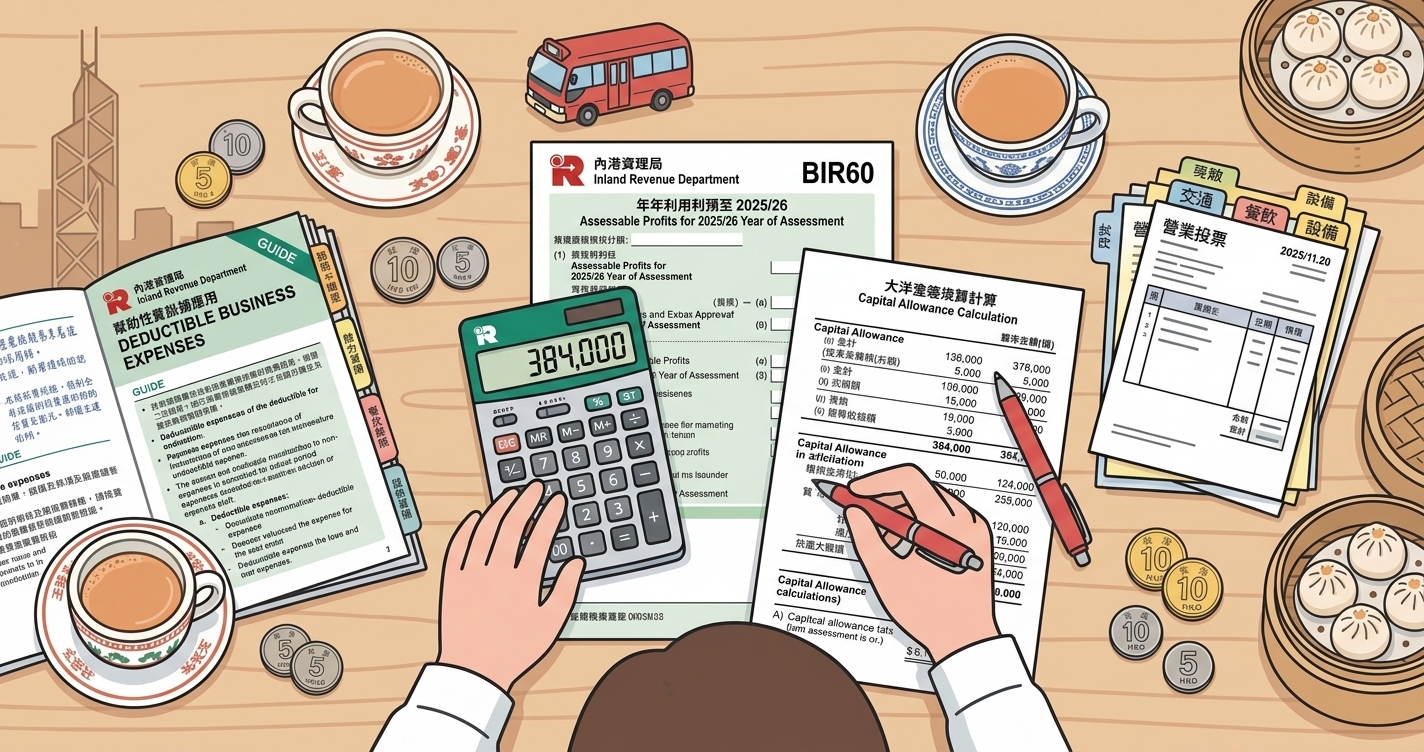
Disclaimer: This article provides general information for Hong Kong freelancers and small business owners about how assessable profits are calculated under the Inland Revenue Ordinance. It is not tax or legal advice. Rules are current as of April 2026 but may change — always confirm specifics with the Inland Revenue Department (IRD) or a qualified Hong Kong tax professional before filing your BIR60.
Why “assessable profits” is the single most important number on your BIR60
If you are a self-employed freelancer or sole proprietor in Hong Kong, the Inland Revenue Department does not tax the total amount that lands in your bank account. It taxes your assessable profits — a specific legal figure that starts with your gross income, strips out what the Ordinance allows you to deduct, and produces the number that the two-tiered profits tax rate is applied to.
Misunderstand this single calculation and you either pay too much (by missing legitimate deductions) or too little (by deducting things the IRD will later disallow, with interest and penalties). For a Hong Kong freelancer pulling in HK$600,000 a year, the gap between an optimised and an unoptimised return is easily HK$15,000–HK$40,000 in tax. This guide walks you through the mechanics for the 2025/26 year of assessment.
The core formula
For a sole proprietor or unincorporated business, the basic formula the IRD applies is:
Assessable Profits = Gross Receipts from Business − Allowable Deductions ± Adjustments − Concessionary Deductions − Loss Brought Forward
The profits tax rate is then applied to that figure. For unincorporated businesses (which is what most freelancers are), the two-tiered rate for 2025/26 is:
- 7.5% on the first HK$2,000,000 of assessable profits
- 15% on assessable profits above HK$2,000,000
Only one business entity per group of related parties can claim the lower 7.5% slice, and the rate is set out in the IRD's two-tiered profits tax regime explainer.
Step 1 — Identify gross receipts from business
Gross receipts are all income arising in or derived from Hong Kong from your trade, profession or business. For freelancers, this typically includes:
- Invoices paid by Hong Kong and overseas clients for work performed in Hong Kong
- Platform payouts (Upwork, Fiverr, Toptal, Contra) net of platform fees (you can also gross-up and deduct the fee separately)
- Retainer income, rush fees, and reimbursed expenses billed to clients
- Bad debts recovered that were previously written off
- Trading stock sold, including digital goods (courses, templates, NFTs used in trade)
Income that is not included in assessable profits includes dividends from Hong Kong companies (exempt), capital gains on long-term investments (no CGT in HK), and salaries taxed separately under Salaries Tax. The territorial source principle still applies — profits genuinely sourced offshore may be non-taxable, but the bar to prove this is high and contested.
Step 2 — Apply the “wholly, exclusively, necessarily” test to deductions
Under Section 16(1) of the Inland Revenue Ordinance, an expense is only deductible if it was incurred in the production of chargeable profits. In practice this becomes the wholly, exclusively and necessarily incurred test. Courts and the IRD apply three questions:
- Wholly — Was 100% of the spend for business purposes?
- Exclusively — Was the purpose solely business, with no material private benefit?
- Necessarily — Was it reasonably required to earn the income?
If any of the three is a “no”, either the expense is disallowed outright or it must be apportioned (see home office below).
Common deductible expenses for HK freelancers
- Co-working space membership and office rent
- Client-related travel within Hong Kong and reasonable overseas travel for client meetings
- Professional subscriptions (Adobe, Figma, Notion, GitHub, Xero, etc.)
- Marketing costs — website hosting, Google/Meta ads, printed business cards
- Stationery, printing, postage and small office supplies
- Mobile phone and internet bills (apportioned for private use)
- Professional indemnity and business insurance
- Bank charges and merchant fees on business accounts
- Bad debts written off after reasonable collection efforts
- Interest on loans used for the business
- Legal and accounting fees (except on capital items or penalties)
- Sub-contractor and outsourcing fees (with proper documentation)
Step 3 — Handle the home office apportionment
A home office is deductible only on the part exclusively used for business. If your flat is 500 sq ft and your dedicated workspace is 80 sq ft (16%), you can generally claim 16% of rent, electricity, gas, broadband and a proportional share of management fees. The IRD does not publish a fixed safe-harbour, so keep:
- A floor plan or photograph showing the dedicated space
- Monthly utility bills in your name
- A short written note explaining the apportionment method
For more detail see our Hong Kong home office deductions guide.
Step 4 — What you cannot deduct
Even if the money left your account, these items are blocked under Sections 16 and 17 of the Ordinance:
- Domestic or private expenses, including your own salary as a sole proprietor
- Capital expenditure — e.g. the purchase price of a laptop, camera, or car (you claim depreciation/capital allowances instead)
- Improvements to capital assets (versus repairs, which are deductible)
- Payments to your spouse or family members that exceed an arm's-length rate
- Fines, penalties and the provisional profits tax itself
- Voluntary MPF contributions above the statutory cap
- Life insurance premiums (those go under Salaries Tax reliefs if applicable)
- Expenses that are recoverable under insurance
Step 5 — Add back capital allowances (depreciation)
Because you cannot deduct the full cost of a capital asset in year one, the Ordinance gives you depreciation allowances on plant and machinery. The main rates for 2025/26 remain:
- Initial allowance: 60% of qualifying capital expenditure in the year of purchase
- Annual allowance: 10%, 20% or 30% on the reducing value, depending on the asset class
Typical annual rates: computers and office equipment 30%, furniture 20%, motor vehicles 30%. Full class tables are on the IRD's Departmental Interpretation and Practice Notes No. 7. Keep every invoice for seven years — the IRD's minimum record-keeping period under Section 51C.
Step 6 — Claim concessionary deductions
After ordinary deductions you can claim a small but valuable set of concessions:
- Approved charitable donations — up to 35% of assessable profits, to Section 88 charities
- MPF mandatory contributions — up to HK$18,000 for self-employed persons per year
- Voluntary health insurance (VHIS) — up to HK$8,000 per insured person per year if applicable
- Qualifying annuity premiums and TVC — combined cap of HK$60,000 per year
Step 7 — Worked example: Chloe the freelance brand designer
Chloe runs an unincorporated design studio from her Kennedy Town flat. Her 2025/26 year looks like this:
- Gross invoices issued and paid: HK$780,000
- Upwork and Stripe fees: HK$28,000
- Co-working desk at Garage Society: HK$42,000
- Software subscriptions: HK$14,400
- Marketing & ads: HK$9,200
- Home office (16% of HK$72,000 rent + utilities): HK$11,520
- New iMac (HK$25,000) — Initial allowance 60% = HK$15,000; annual 30% on balance = HK$3,000. Total Year 1 capital allowance: HK$18,000
- MPF mandatory contributions: HK$18,000
- Approved charitable donation to Section 88 charity: HK$5,000
Calculation:
- Gross receipts: HK$780,000
- Less allowable deductions (fees, co-working, software, marketing, home office): HK$105,120
- Less capital allowance: HK$18,000
- Less concessionary (MPF + donation): HK$23,000
- Assessable profits: HK$633,880
- Profits tax at 7.5% (under HK$2M): HK$47,541
If Chloe had filed on gross receipts alone, she would have overpaid by more than HK$10,900. Run your own numbers with our free income tax calculator.
Step 8 — Losses, provisional tax and loss brought forward
If your deductions exceed your income, you have a tax loss. Unincorporated business losses can be:
- Set off against other chargeable income under Personal Assessment, or
- Carried forward indefinitely against future profits of the same trade
The IRD also issues provisional profits tax based on last year's assessable profits. Paying this on time matters — late payment triggers a 5% surcharge after the due date and another 10% after six months under Section 71.
Common mistakes that inflate assessable profits
- Deducting the purchase price of equipment instead of using capital allowances
- Forgetting to apportion home office utilities for private use
- Claiming 100% of a mobile phone bill without evidence of business-only use
- Missing concessionary deductions (MPF, charity) that sit outside P&L
- Treating reimbursable client expenses as gross receipts and also deducting them twice
- Not keeping receipts for seven years — losing deductions under IRD audit
How Denpyo helps freelancers get this right
The hardest part of assessable profits is not the formula — it's keeping the 400+ receipts, invoices and statements that back every deduction. Tools like Denpyo can photograph each receipt, auto-extract the vendor, date, amount and tax treatment, and store the digital copies for the full seven-year retention window that Section 51C requires. When BIR60 time comes, you export a clean ledger that maps directly to your Part 5 Profits Tax schedules. You can also use our free expense deductibility checker to sanity-check whether a specific expense meets the “wholly, exclusively and necessarily” test before you claim it.
Key takeaways
- The IRD taxes your assessable profits, not your gross receipts.
- The formula is: gross income − allowable deductions − capital allowances − concessionary deductions ± loss adjustments.
- Deductions must be wholly, exclusively and necessarily incurred for the business.
- Capital assets get depreciation allowances over several years, not a one-off deduction.
- Keep records for seven years and reconcile them monthly.
- The 7.5% two-tiered rate on the first HK$2M is the biggest gift to Hong Kong freelancers — don't forfeit it by filing a sloppy return.

Track expenses, maximize deductions
Denpyo scans your receipts and finds tax savings automatically.