
Digital Nomads in Hong Kong: Tax Obligations and Visa Options (2026)
A 2026 guide to Hong Kong's territorial tax system, Top Talent Pass (TTPS), QMAS, and the 7-year record-keeping rule for digital nomads and freelancers.
Disclaimer: This article is for general informational purposes only and does not constitute tax, legal, or immigration advice. Tax residency, visa eligibility, and filing requirements depend on your specific circumstances and may change. For personalised guidance, consult a qualified Hong Kong tax adviser or immigration lawyer. Always verify current rules with the Inland Revenue Department (IRD) and the Immigration Department.
Why Hong Kong works for digital nomads in 2026
Hong Kong has quietly become one of Asia’s most attractive bases for digital nomads and remote workers. A territorial tax system, a low headline profits tax rate of 7.5–15%, and no GST/VAT make it financially appealing, while world-class infrastructure, English-friendly services, and fast international flights keep it practical. Hong Kong does not yet have a dedicated “digital nomad visa” like Malaysia’s De Rantau or Thailand’s DTV — but it offers the Top Talent Pass Scheme (TTPS), the Quality Migrant Admission Scheme (QMAS), and several other pathways that location-independent professionals use every day.
This guide breaks down what freelancers and small-business owners relocating to Hong Kong need to know in 2026: which visas are realistic, how the territorial tax system treats remote income, what profits tax you will owe, and how to stay compliant with the 7-year record-keeping rule.
How Hong Kong’s tax system treats nomads
Hong Kong uses a territorial source principle. Only profits “arising in or derived from Hong Kong” are subject to profits tax. That is a critical distinction for a digital nomad: if you are here physically but all your clients and service delivery happen elsewhere, the sourcing analysis matters. In practice, most freelancers who work from Hong Kong — contacting clients, delivering work, and invoicing — will find their income treated as Hong Kong–sourced.
Key features every nomad should know:
- Profits Tax (unincorporated two-tier): 7.5% on the first HK$2 million of assessable profits, 15% above. For limited companies it is 8.25%/16.5%.
- No capital gains tax, no dividend tax, no GST/VAT.
- Year of assessment: 1 April – 31 March.
- Record retention: 7 years under Section 51C of the Inland Revenue Ordinance.
- Individual Tax Return: BIR60; sole proprietors and partners also receive BIR51/BIR52 supplements.
Tax residency matters less in Hong Kong than in many jurisdictions because the system is source-based, not residence-based. But residency still matters for double-tax treaty claims and for the 60/183-day tests used by your home country.
Visa options for digital nomads and freelancers
1. Top Talent Pass Scheme (TTPS)
Launched in December 2022, TTPS is the single most popular route for remote workers and senior freelancers. Three categories:
- Category A: Annual income of HK$2.5 million or more in the past year.
- Category B: Degree from a top 100 global university plus 3+ years of work experience.
- Category C: Degree from a top 100 global university in the past 5 years (no experience required; quota-capped).
TTPS holders get an initial 24-month stay (36 months for new Category A applicants). Importantly, TTPS does not tie you to a Hong Kong employer — you can freelance, consult, or run a business while holding it. Apply via the Immigration Department’s TTPS page.
2. Quality Migrant Admission Scheme (QMAS)
QMAS is points-based. You score on age, qualifications, experience, language ability, and family background. Unlike TTPS, QMAS has had no quota cap since 2023 and supports long-term settlement. It fits freelancers with a strong professional record but no “top 100 university” credential. See the QMAS overview.
3. General Employment Policy (GEP) via your own HK company
GEP is employer-sponsored. Some freelancers incorporate a Hong Kong limited company and “hire” themselves, but you will need a solid business plan, paid-up capital, and a local office address. Most solo freelancers pick TTPS or QMAS instead.
4. Capital Investment Entrant Scheme (CIES)
Reopened in March 2024 with a HK$30 million minimum investment. Not designed for typical nomads, but occasionally used by high-net-worth freelancers seeking PR optionality.
5. What Hong Kong does NOT offer
There is no dedicated digital nomad visa. Short-term visitors from the US, UK, EU, Japan, and many other jurisdictions enter visa-free for 90 days, but working on a visitor visa is not permitted — even remote work for overseas clients is a grey area that immigration officers can challenge. If you plan meaningful time in HK, secure TTPS or QMAS first.
Step-by-step: Setting up as a freelancer in Hong Kong
- Secure your visa. TTPS processing is usually 4–8 weeks.
- Register as a sole proprietor at the Business Registration Office within one month of starting business. The fee is HK$2,200/year (or HK$6,200 for a 3-year certificate). See the IRD Business Registration page.
- Open a business bank account. HSBC, Hang Seng, DBS, and ZA Bank (fully digital) are common choices. Bring your BR certificate, HK ID or TTPS visa, and proof of address.
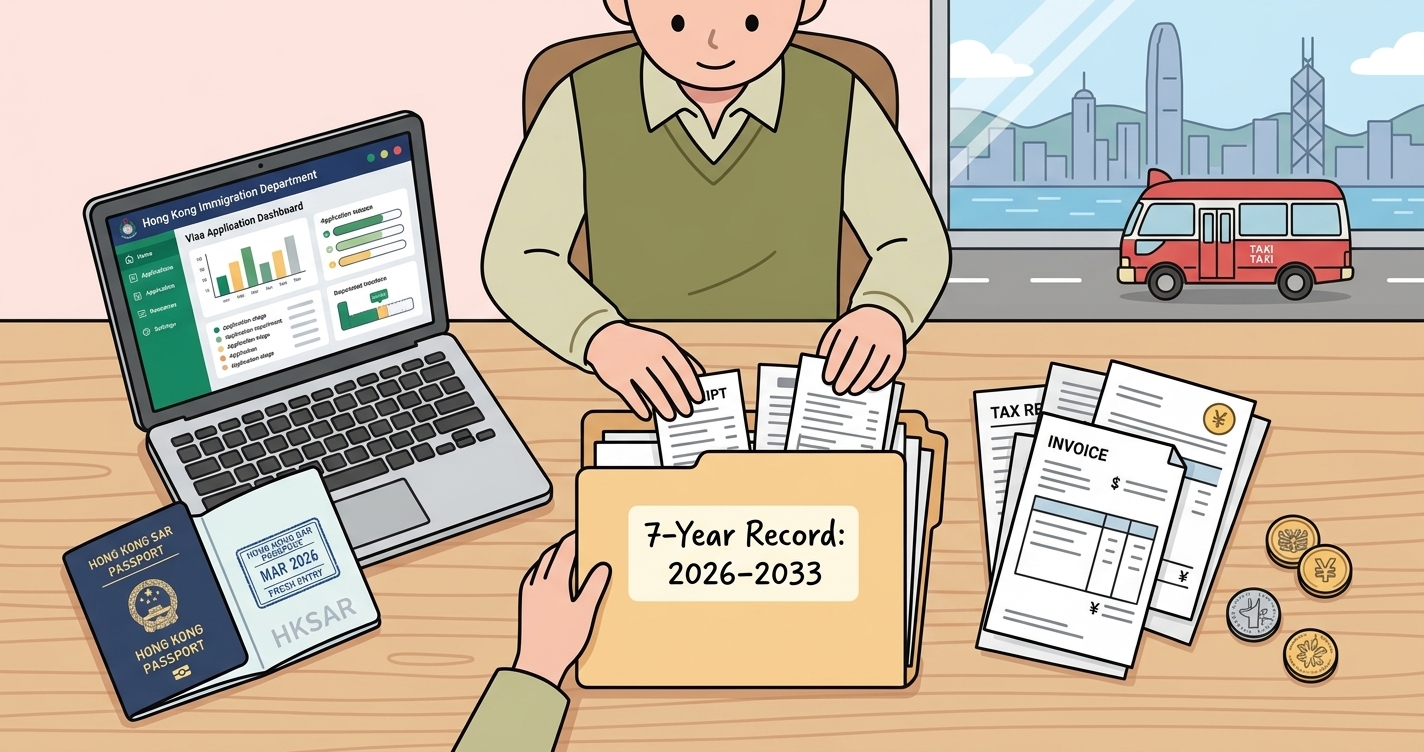
- Set up bookkeeping. Hong Kong requires “sufficient records” for 7 years — invoices, receipts, bank statements, contracts, and payment confirmations. Tools like Denpyo auto-extract vendor, date, and amount from a receipt photo, which meaningfully reduces the pain of the 7-year retention rule.
- Watch for your first BIR60/Profits Tax Return. The IRD typically issues profits tax returns on the first working day of April. New businesses usually receive their first return 18 months in, covering from commencement to the first 31 March year-end. File within 1 month of issue, or request the standard extension to 15 November if filing electronically via eTAX.
- Make provisional tax payments. Hong Kong charges provisional profits tax in two instalments: 75% in January, 25% in April of the year following the year of assessment.
Practical examples
Scenario A — Marketing consultant on TTPS. Mei moved to Hong Kong in August 2025 on a Category B TTPS visa. She consults for Singapore and UK clients. For the year of assessment 2025/26 (her first partial year), her assessable profits are HK$1.4 million. Under the two-tier rate, she pays 7.5% = HK$105,000. Because her income is below HK$2 million, she stays entirely in the lower bracket. She also claims HK$15,000 in apportioned home-office rent and HK$8,000 in professional development.
Scenario B — Developer with a HK limited company. Daniel incorporates a HK Ltd and pays himself a salary plus dividends. His company earns HK$2.8 million. The first HK$2M is taxed at 8.25% (HK$165,000); the balance of HK$800K at 16.5% (HK$132,000). Total: HK$297,000. Dividends to himself are tax-free in HK (no dividend tax), though he should confirm his home country’s rules.
Denpyo helps nomads survive the 7-year rule
Keeping 7 years of receipts, invoices, and mileage logs sounds painless — until it isn’t. Most nomads end up with screenshots, paper receipts from three continents, and a shoebox of unmatched credit-card charges by April. Denpyo auto-extracts the fields IRD cares about (date, vendor, amount, category) from a single photo, tags everything by assessment year, and exports a clean CSV at filing time. Try our free expense deductibility checker to see which line items qualify as “wholly, exclusively and necessarily” incurred for your trade under Section 16(1).
Summary
Hong Kong is nomad-friendly by substance (low tax, no VAT, territorial system, English administration), if not by visa label. TTPS is the fastest route for most qualified professionals; QMAS is the patient alternative. Once you are in, the mechanics are straightforward: register your BR, keep 7 years of records, file BIR60 on time, and enjoy one of the world’s flattest, simplest profits tax regimes.
For related reading, see our guides to HK profits tax for freelancers, the BIR60 filing walkthrough, and HK record-keeping requirements.

Track expenses, maximize deductions
Denpyo scans your receipts and finds tax savings automatically.