
Personal Assessment in Hong Kong 2026: Can It Lower Your Tax Bill?
Personal Assessment lets Hong Kong sole proprietors combine income and claim personal allowances against business profits. This guide explains who benefits, how to elect on your BIR60, and a worked example for the 2025/26 year of assessment.
This article is general information current as of June 2026 and is not individual tax advice. Confirm your position with a tax professional and the latest guidance from the Hong Kong Inland Revenue Department (Personal Assessment).
If you run an unincorporated business in Hong Kong, your profits are normally charged to Profits Tax at a flat rate with no personal allowances applied. But many sole proprietors and partners can elect for Personal Assessment, an option that may reduce the total tax you pay by bringing your business profits into a single, allowance-friendly calculation. This guide explains how Personal Assessment works for the 2025/26 year of assessment, who benefits, and how to elect.
What Is Personal Assessment?
Personal Assessment is not a separate tax. It is an elective method of computing your liability that aggregates your income from different sources, applies personal allowances and certain deductions, and then charges the total at the progressive rates that normally apply to Salaries Tax. Without Personal Assessment, your business profits are taxed under Profits Tax at the two-tiered rates for unincorporated businesses, which do not give you personal allowances.
Because Profits Tax does not allow personal allowances such as the basic allowance, married person allowance, or child allowance, a freelancer with modest profits can sometimes pay less by electing Personal Assessment and using those allowances.
Who Can Elect for Personal Assessment?
According to the Inland Revenue Department, you may elect if you are an individual aged 18 or above (or under 18 with deceased parents), and you are either a permanent or temporary resident of Hong Kong. Married couples may need to elect jointly in certain situations. The election is made for each year of assessment, so you can choose it in a year it helps and skip it in a year it does not.
How Personal Assessment Can Save Tax
There are several reasons Personal Assessment may lower your bill:
- Personal allowances apply. Your aggregated income is reduced by the basic allowance and any other allowances you qualify for before tax is charged.
- Progressive rates may be lower. If your total income is modest, the progressive rates can produce a lower effective rate than the standard Profits Tax rate.
- Home loan interest deduction. Interest on a loan to acquire a property that produces rental income can be deducted more fully under Personal Assessment.
- Business losses can be set off. A loss from your business can be offset against other income, such as rental or salary, reducing the overall charge.
When Personal Assessment Does Not Help
Personal Assessment is not always beneficial. If your total income is high, the progressive rates may exceed the two-tiered Profits Tax rate, so electing could increase your tax. The Inland Revenue Department will only apply Personal Assessment when it reduces your tax, but it is wise to compare both outcomes before you rely on it. A quick calculation each year is the safest approach.
How to Elect on Your BIR60
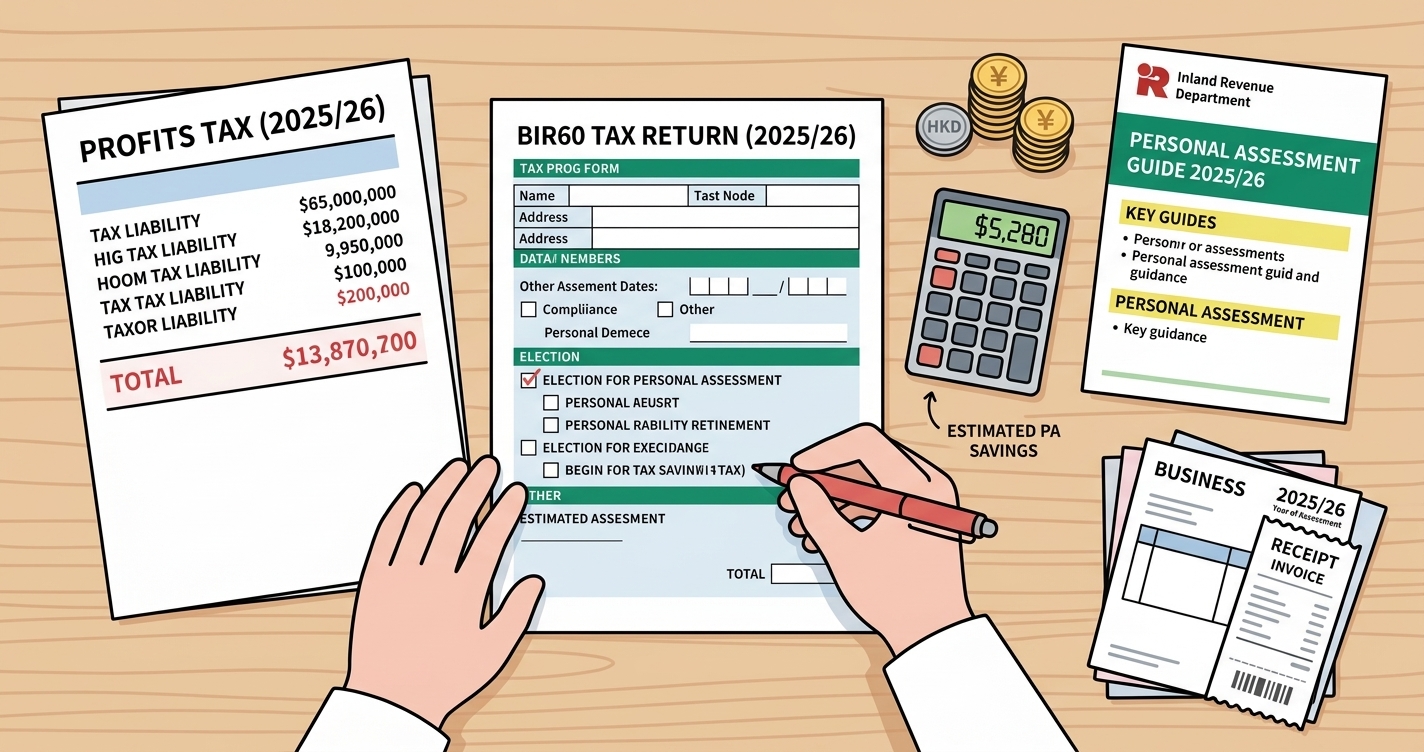
You make the election on your individual tax return (BIR60). There is a dedicated section asking whether you wish to elect for Personal Assessment, where you tick the box and complete the relevant parts. If you file online through eTAX, the system guides you through the same election. The deadline follows your normal BIR60 filing deadline, so do not leave it to the last day.
Worked Example
Suppose a freelance designer has assessable profits of HK$300,000 for 2025/26 and no other income. Under Profits Tax alone, the profits are charged at the unincorporated two-tiered rate with no personal allowances. Under Personal Assessment, the basic allowance is deducted first, and the remaining amount is charged at progressive rates that start low. For many freelancers at this income level, Personal Assessment produces a smaller bill. The exact saving depends on your allowances and any deductions, which is why an annual comparison matters.
Keep Clean Records to Make the Election Worthwhile
Whichever method you use, your assessable profits must be accurate, which means every deductible expense should be captured. Tools like Denpyo let you photograph receipts and have AI extract the date, amount, and category automatically, so your profit figure is correct before you compare Profits Tax against Personal Assessment. You can also estimate the impact of your deductions with the tax savings estimator and project your liability with the income tax calculator.
Summary
Personal Assessment is an elective calculation that combines your income, applies personal allowances, and charges the total at progressive rates. For Hong Kong sole proprietors and partners with modest profits, it can be a genuine tax saver, especially when you have home loan interest or business losses to set off. It does not help everyone, so compare both outcomes each year, elect on your BIR60 when it benefits you, and keep accurate expense records so your profit figure is right. For official details, see the Inland Revenue Department guide to Personal Assessment.

Track expenses, maximize deductions
Denpyo scans your receipts and finds tax savings automatically.