
7-Year Record Keeping in Hong Kong: Organize Receipts and Invoices (2026)
Hong Kong's Inland Revenue Ordinance requires freelancers and SMEs to keep business records for at least 7 years. Here is a practical guide to staying compliant in 2026 — including digital storage rules, what counts as a 'sufficient record', and a system that actually works.
Disclaimer: This article is for general information only and does not constitute tax or legal advice. Consult the Hong Kong Inland Revenue Department (IRD) at ird.gov.hk or a qualified tax advisor for guidance on your specific circumstances.
If you run a business in Hong Kong — whether as a sole proprietor, freelancer, partner, or director of a limited company — you are legally required to keep business records for at least seven years. The rule applies even if you closed the business, even if you are below the profits tax threshold, and even if you operate entirely from home or a co-working desk.
That seven-year window is one of the longest in Asia. It is longer than Singapore (5 years) and matches Malaysia (7 years). And the IRD takes it seriously — failure to keep sufficient records can attract a fine of up to HK$100,000 under section 51C of the Inland Revenue Ordinance (IRO).
This guide explains exactly what you need to retain, how long the clock runs, what 'sufficient' means in practice, and how to build a digital-first system that survives an IRD audit without filling a closet with shoeboxes.
The Legal Basis: Section 51C of the Inland Revenue Ordinance
Section 51C of the IRO requires every person carrying on a trade, profession or business in Hong Kong to keep sufficient records of income and expenditure in English or Chinese to enable the assessable profits to be readily ascertained. The records must be retained for not less than 7 years after the completion of the transactions to which they relate.
The IRD's official guidance — Departmental Interpretation and Practice Notes No. 11 — sets out what the Commissioner regards as 'sufficient'. Big Four accountants such as PwC Hong Kong and Deloitte Hong Kong publish similar checklists every filing season.
The 7-year clock starts from the date the transaction is completed — not from the year of assessment, not from when you filed your BIR60 or BIR51, and not from the date you paid the tax. A receipt for a March 2026 client meeting must therefore be kept until at least March 2033.
What Counts as a Business Record?
Section 51C uses the deliberately broad term 'sufficient records'. In practice, the IRD expects to see anything that lets an inspector reconstruct your assessable profits without guesswork. That includes:
Income Records
- Sales invoices issued to clients (including PDF invoices sent by email)
- Service contracts and statements of work
- Receipts for cash transactions, including platform payouts (Stripe, PayPal, Wise, Airwallex)
- Bank statements showing deposits
- Records of bartered services or non-cash consideration
- Foreign currency conversions and the rate used
Expenditure Records
- Supplier invoices and itemised receipts (not just credit-card slips)
- Rent receipts, MPF contribution records, and utility bills (proportioned for home office use)
- Travel records: Octopus statements, taxi receipts, flight bookings, hotel folios
- Equipment and software purchases (with depreciation schedules)
- Subcontractor and freelancer payments, with their HKID or business registration number
Supporting Documentation
- A general ledger or cash book reconciling income and expenditure
- Bank statements and credit card statements
- Stock or inventory lists if you sell physical goods
- Asset registers for fixed assets (computers, cameras, furniture)
- Working papers behind your tax computation
Practical note: A credit-card slip is not sufficient on its own. The IRD expects an itemised receipt or tax invoice that shows what was purchased, the supplier name, and the date.
Digital vs Paper: What the IRD Actually Accepts
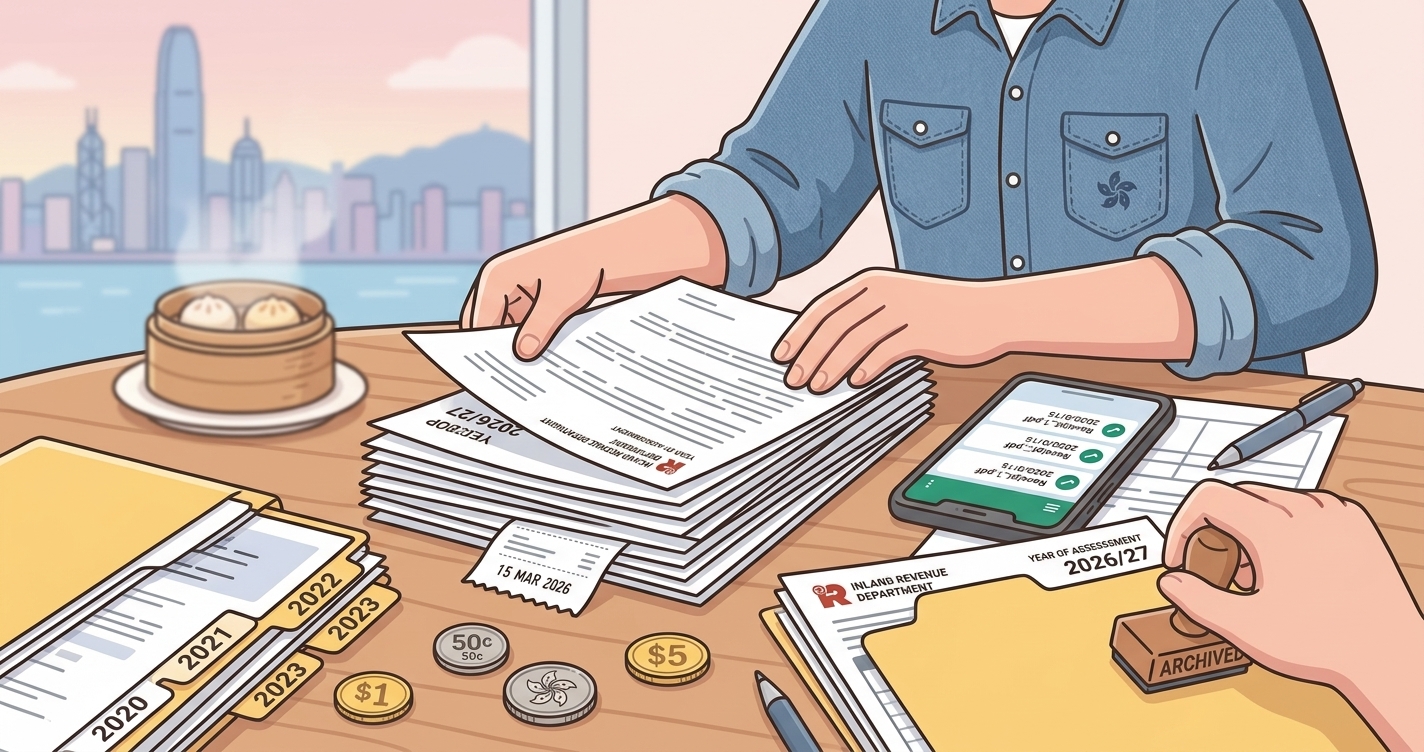
Hong Kong has been pragmatic about digital records for over a decade. The IRD accepts records kept in any medium — paper, microfilm, or electronic — provided they can be readily retrieved and produced in legible form.
In practice, that means a high-resolution photograph of a thermal-paper receipt is acceptable, as long as you can produce it on demand and it remains legible for the full 7 years. This is important because thermal paper (the kind used by most cafes, taxis, and convenience stores) fades within 6–18 months. A faded receipt is not a sufficient record.
Requirements for Electronic Records
- Legibility: Scans and photos must be clear enough to read all details
- Integrity: Records must not be alterable after the fact (or any changes must be tracked)
- Retrievability: You must be able to produce a specific record within a reasonable time when asked
- Backup: Storing only on one laptop is risky — IRD inspectors will not wait for data recovery
Building a Compliant System (Without a Filing Cabinet)
Most Hong Kong freelancers and SME owners we speak to start with the same problem: a drawer full of crumpled paper, a phone full of receipt photos, and a Gmail folder of PDF invoices that nobody can search. Here is a four-step system that actually scales.
Step 1: Capture Every Receipt the Moment You Get It
Photograph paper receipts immediately. Do not wait until the weekend — by then the thermal print may already be fading and the context will be gone. Tools like Denpyo can auto-extract the vendor, date, amount and category from a receipt photo, so the data lands in a structured database rather than a camera roll.
Step 2: Tag Each Record with Its Purpose
The IRD wants to see business purpose, not just amounts. A HK$480 dinner receipt means very little on its own; tagged as 'client meeting — Acme Ltd. — proposal review', it becomes a defensible deduction. Capture the purpose while the meeting is fresh in your memory.
Step 3: Reconcile Monthly, Not Annually
Match every bank and credit card line to a corresponding income or expense record at least once a month. Year-end reconciliation is where most freelancers lose receipts and inflate stress. Monthly reconciliation also flags missing invoices early, while you can still chase a duplicate from the supplier.
Step 4: Back Up to Two Locations
Keep your records in cloud storage plus an external drive or a second cloud provider. A single point of failure during a 7-year retention window is too long a bet. Many SMEs use a primary system (an accounting platform or Denpyo) plus a quarterly export to encrypted Google Drive or OneDrive folders.
Practical Examples
Example 1: The Fading Taxi Receipt
Wai-Kit, a freelance video editor, takes a taxi from Mong Kok to a client shoot in Tsim Sha Tsui in April 2026. He photographs the HK$95 thermal-paper receipt the same evening and notes the client name in the image caption. By 2030 the original receipt has faded to nothing — but the photo, with its EXIF timestamp and notes, is still a perfectly sufficient record under section 51C.
Example 2: The Email-Only Invoice
Priya runs a marketing consultancy as a Hong Kong limited company. Her SaaS suppliers (Notion, Figma, Slack) only send PDF invoices by email. She forwards each invoice to her bookkeeping inbox the day it arrives, where it is parsed into her ledger. Seven years later, an IRD inspector asks for proof of her 2026 software stack — she pulls up a complete searchable archive in under a minute.
Example 3: Mixing Personal and Business on One Card
Jonathan, a sole-proprietor architect, occasionally uses his personal credit card for business purchases. To stay compliant, he highlights each business line on the monthly statement, attaches the corresponding itemised receipt, and journals the reimbursement from his business account. The audit trail is intact, even though the card is not in the business name.
How Denpyo Helps Hong Kong Freelancers Stay Audit-Ready
Building a 7-year archive sounds intimidating, but most of the work is collapsing the gap between a receipt being issued and that receipt landing in a structured, searchable system. Denpyo is built for exactly that gap: snap a photo, and the AI extracts vendor, date, amount, tax breakdown, and a suggested expense category. Multiple categories such as travel, client entertainment, software subscriptions, and office supplies are recognised out of the box, and you can add custom categories that match your own chart of accounts.
For Hong Kong users specifically, Denpyo helps with three pain points: keeping faded thermal receipts legible forever (the photo is what you keep, not the paper), separating business and personal spending without rewriting your bank feed, and exporting a clean record for your accountant or for an IRD enquiry. To get a sense of how much your captured deductions are worth in real terms, run them through the Denpyo Tax Savings Estimator or check whether a particular receipt is likely deductible with the Expense Deductibility Checker.
Common Mistakes to Avoid
- Throwing receipts away after filing. The 7-year clock starts from the transaction, not from the filing date. Keep them.
- Relying on bank statements alone. The IRD wants to see the underlying invoice or receipt — a bank line is just evidence of payment.
- Storing only on one device. A lost laptop or stolen phone can wipe years of records overnight.
- Mixing currencies without notes. If you invoice in USD or EUR, record the conversion rate and date used for HKD reporting.
- Skipping the home-office allocation. If you claim a portion of rent or electricity, keep the calculation worksheet for the same 7 years.
Penalties for Non-Compliance
Under section 80(1A) of the IRO, failure to keep sufficient records is a criminal offence punishable by a fine of up to HK$100,000. In addition, if the IRD cannot reconstruct your profits because records are missing, it can issue an estimated assessment — usually skewed against you — which is much harder to challenge than a return supported by clean documentation.
Even when no penalty is issued, missing records during an IRD field audit lengthen the process by months and often result in disallowed deductions. The cost of a lost dinner receipt is rarely the HK$500 of tax — it is the half-day of professional fees spent reconstructing what happened.
Key Takeaways
- Section 51C of the Inland Revenue Ordinance requires 7 years of business records, measured from the transaction date
- 'Sufficient records' covers income, expenditure, and the supporting ledger that ties them together
- Electronic records are accepted as long as they are legible, retrievable, and backed up
- Thermal-paper receipts fade — photograph them on the day, not at year-end
- Penalties for inadequate records reach HK$100,000, plus the risk of estimated assessments
- A monthly reconciliation habit is the single highest-leverage change most freelancers can make
Resources

Track expenses, maximize deductions
Denpyo scans your receipts and finds tax savings automatically.