

GST Registration in Singapore at S$1 Million: When and How to Register in 2026
Complete guide to GST registration in Singapore for freelancers and SMEs. Learn the S$1 million threshold rules, compulsory vs voluntary registration, and InvoiceNow requirements for 2026.
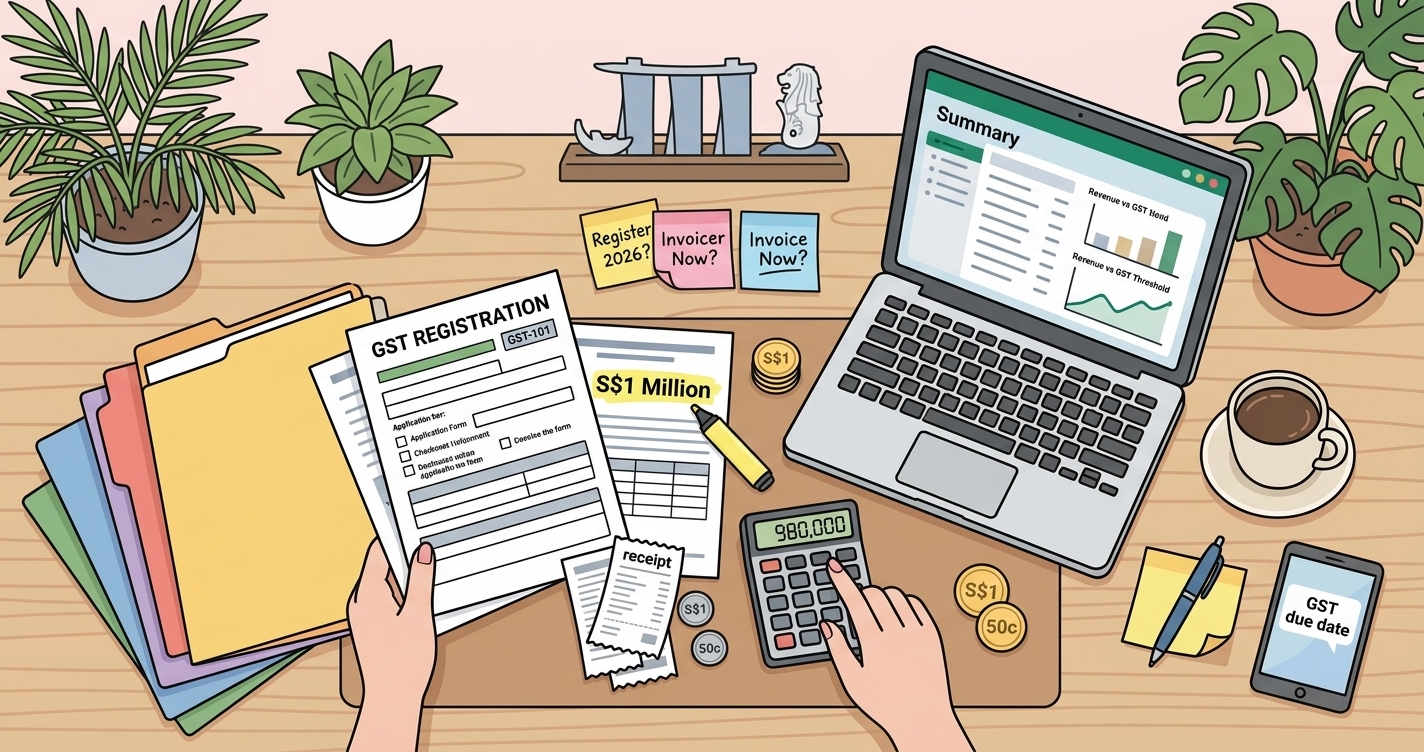
Disclaimer: This article provides general information about GST registration in Singapore. It is not professional tax advice. For specific guidance on your situation, consult the Inland Revenue Authority of Singapore (IRAS) or a qualified tax professional. Always refer to official IRAS GST resources for the most current regulations.
GST Registration in Singapore at S$1 Million: When and How to Register in 2026
If you're a freelancer or small business owner in Singapore, understanding GST (Goods and Services Tax) registration is crucial to staying compliant and avoiding penalties. The S$1 million turnover threshold is a key trigger point that many business owners miss until it's too late. In this guide, we'll walk you through exactly when you need to register, how the process works, and what common pitfalls to avoid.
What is GST and Why Does It Matter?
GST is a 9% tax on most goods and services supplied in Singapore (the rate increased from 7% to 9% on 1 January 2024). It's a consumption tax that businesses collect on behalf of the government and remit quarterly. Think of yourself as a tax collector—you charge GST on your invoices, but you also claim back GST you paid on business expenses (called "input tax").
As a GST-registered business, you're required to:
- Charge GST on your supplies (unless they're exempt)
- File quarterly GST returns with IRAS
- Keep detailed records of all transactions
- Issue invoices with GST amounts clearly stated
The benefit? You only pay the net GST to the government—not the full 9%. For example, if you invoice S$10,000 in services and have S$2,000 in deductible business expenses, you'd pay GST on S$8,000, not S$10,000. This makes GST registration particularly valuable for businesses with high material costs.
The S$1 Million Threshold: Compulsory Registration Rules
IRAS has a simple rule: if your business turnover exceeds S$1 million in a calendar year, you must register for GST, whether you like it or not. This is called "compulsory registration."
Key points about the threshold:
- Calendar year basis: The S$1 million is measured on a calendar year basis (January to December), not your accounting period
- Turnover definition: Turnover includes all revenue from your business, including exempt supplies (like professional services that might be GST-exempt)
- Timing of registration: If you exceed S$1 million by, say, July, you must register from that month—not wait until January
- Retrospective basis: You're required to register "retrospectively" from the date your turnover exceeded the threshold, meaning your first GST invoice must include GST from that date backward
- No choice: Unlike voluntary registration, compulsory registration is non-negotiable. Failure to register is a serious compliance issue
Compulsory vs. Voluntary Registration: What's the Difference?
Not all GST registration is mandatory. Businesses with turnover below S$1 million can choose to register voluntarily. This is where it gets strategic.
Compulsory Registration (over S$1 million):
- No choice—you must register
- Applies from the month you exceed the threshold
- Can deregister only if turnover drops below S$500,000
Voluntary Registration (below S$1 million):
- You choose whether to register
- Useful if you make mostly zero-rated supplies (like exporting goods—yes, exports are GST-exempt in Singapore, which is fantastic for digital service providers selling globally)
- Allows you to reclaim input tax on business expenses immediately, rather than waiting for revenue
- Once registered, you're locked in for a minimum of 5 years before you can deregister (unless your turnover genuinely drops)
The 5-year lock-in is important: if you voluntarily register and then realize GST compliance is a headache, you can't easily exit. Think carefully before registering early.
Retrospective vs. Prospective Basis: A Critical Distinction
When you're required to register for GST, the question of timing matters enormously. There are two scenarios:
Retrospective Registration (most common): You must register from the date your turnover actually exceeded S$1 million, even if you didn't know it yet. This means:
- Your first GST invoice goes retroactively to cover all sales made since you hit the threshold
- You're liable for GST on past supplies, even if you haven't issued revised invoices
- This can create a surprise GST bill if you didn't set aside the money
Prospective Registration (rare): In exceptional cases, IRAS may allow you to register from a future date (e.g., next month) instead of backdating. This requires written permission from IRAS and is only granted if there's a legitimate reason you couldn't register earlier.
Practical tip: If you suspect your turnover is close to S$1 million, contact IRAS immediately or consult a tax advisor. Waiting until December to register could trigger a massive retrospective GST liability.
Step-by-Step: How to Register with IRAS
Once you've crossed the threshold (or decided to register voluntarily), here's the registration process:
Step 1: Gather Your Documents
- NRIC (or passport if foreign national)
- Proof of business address (utility bill, lease agreement)
- Proof of business registration (ACRA certificate, sole proprietorship evidence)
- Your latest accountant's statement or financial records showing turnover calculation
- If you have employees, their employment details
Step 2: Apply via IRAS Online Services
Most businesses apply through IRAS's online portal at iras.gov.sg. You'll log in using your SingPass credentials and fill in the GST registration form (Form GST 1). The form asks for:
- Your business details (name, address, industry)
- Turnover for the current and previous years
- Details of any associated entities
- Your accounting records and turnover calculation
Step 3: Wait for IRAS Response
IRAS typically processes applications within 7–14 days. They'll send you:
- Your UEN (Unique Entity Number) for GST purposes
- Your GST registration certificate
- Details of your first accounting period (usually monthly, but quarterly is possible)
Step 4: Update Your Systems
Once registered, you must:
- Update your invoicing software to include GST (9% as of January 2024)
- Start issuing GST invoices immediately
- Begin tracking input tax on all business expenses
- Set up quarterly filing reminders
InvoiceNow Requirements: The New Mandatory e-Invoicing Standard (2025–2026)
If you're registering in 2026, be aware of Singapore's new InvoiceNow mandate. IRAS has introduced mandatory e-invoicing for GST-registered businesses. Here's what you need to know:
- What it is: InvoiceNow is a standardized digital invoicing framework that requires invoices to be issued in a specific XML format and transmitted directly to IRAS
- Timeline: Businesses must comply by a phased deadline (large businesses first, SMEs following)
- Your invoicing software: You'll need to use IRAS-approved invoicing software that supports InvoiceNow, or a cloud accounting platform integrated with it
- Impact: This means no more paper invoices—everything must be digital and submitted to IRAS's system in real-time or batch mode
When you register, ask IRAS which InvoiceNow compliance deadline applies to your business and ensure your accounting software is ready.
GST Filing and Returns: The Quarterly Cycle
After registration, you'll file quarterly GST returns with IRAS. Here's the rhythm:
Filing Schedule:
- Quarter 1 (Jan–Mar) filed by end of April
- Quarter 2 (Apr–Jun) filed by end of July
- Quarter 3 (Jul–Sep) filed by end of October
- Quarter 4 (Oct–Dec) filed by end of January (next year)
What You Report:
- Output tax: The GST you charged on your sales
- Input tax: The GST you paid on deductible business expenses
- Net GST payable: Output tax minus input tax (the amount you owe IRAS)
Example: If you invoiced S$50,000 (plus S$4,500 GST) and had S$10,000 in deductible expenses (plus S$900 GST), you'd owe IRAS S$3,600 (S$4,500 – S$900).
You file the GST return and settle the amount due online. Late filing or payment results in penalties, so set calendar reminders.
Common GST Registration Mistakes to Avoid
After working with hundreds of SME owners and freelancers, here are the biggest GST registration blunders I see:
Mistake #1: Ignoring the S$1 Million Threshold Until December
Many businesses realize in November that they've exceeded S$1 million and try to register hurriedly. This creates a mess: retroactive invoicing, unexpected tax bills, and compliance gaps. Solution: track your turnover monthly and register as soon as you're likely to breach the threshold.
Mistake #2: Not Separating Business and Personal Expenses
Once you're GST-registered, you must meticulously track which expenses are business-related (and qualify for input tax credit) and which are personal. Mixing them up results in audit flags. Keep receipts organized by category.
Mistake #3: Claiming Input Tax on Disallowed Items
Not all expenses qualify for input tax credit. Meals and entertainment are partially disallowed (only 50% of GST is claimable), and some items like private vehicle usage are not deductible at all. Be precise about what you claim.
Mistake #4: Missing Quarterly Filing Deadlines
Even if you owe S$0 GST in a quarter, you must still file a GST return. Missing the deadline triggers penalties (S$50+ per month, capped at S$500). Set automated reminders.
Mistake #5: Not Updating Invoices to Include GST
If you're now GST-registered, every invoice must show GST clearly. Customers expect this, and IRAS audits check it. Forgetting to add GST to invoices is a red flag for non-compliance.
Mistake #6: Retaining Inadequate Records
IRAS requires you to keep invoices, receipts, and GST returns for 5 years. Digital records are fine, but they must be retrievable. Losing records during an audit is catastrophic.
How Denpyo Helps with GST Compliance
Managing GST as a freelancer or SME owner can feel overwhelming, especially when dealing with multiple expenses across categories. This is where Denpyo comes in. The app is designed to help you digitize receipts and extract expense details automatically—exactly what you need for clean, audit-ready GST records.
Here's how it helps:
- Automatic receipt capture: Photograph a receipt, and Denpyo extracts the vendor, date, amount, and category using AI. No manual data entry.
- GST-aware categorization: The app understands GST-eligible expense categories, so you're not accidentally claiming meals as fully deductible.
- Quarterly summaries: Denpyo groups expenses by quarter, making it easy to prepare your GST return.
- Tax savings transparency: The app calculates estimated tax deductions, helping you see exactly how GST registration benefits your bottom line.
- Export for accountants: Generate clean CSV or PDF reports to hand to your tax advisor or accountant.
For freelancers and SME owners, this transforms GST compliance from a bureaucratic nightmare into a manageable monthly habit. You can even use Denpyo's expense deductibility checker to validate whether specific expenses qualify for GST input tax credits.
Summary: Your GST Registration Checklist
Here's a quick checklist to keep you on track:
- ☐ Monitor your annual turnover—don't wait until December to notice you've hit S$1 million
- ☐ Understand the difference between compulsory and voluntary registration
- ☐ Register with IRAS immediately once you breach the S$1 million threshold (or decide to register voluntarily)
- ☐ Prepare for retrospective GST liability if you register mid-year
- ☐ Ensure your invoicing software supports InvoiceNow e-invoicing requirements
- ☐ Set up a quarterly filing calendar and never miss a deadline
- ☐ Keep organized expense records, separating business and personal costs
- ☐ Claim input tax carefully, avoiding disallowed categories
- ☐ Use tools like Denpyo to automate expense tracking and GST record-keeping
- ☐ Consult IRAS or a tax professional if your situation is complex
GST registration is a milestone in your business journey. It signals that you've crossed into the bigger leagues and need to think like a tax-compliant operator. But with the right systems and knowledge, it's entirely manageable. Start tracking your turnover today, and you'll never be caught off guard.

Track expenses, maximize deductions
Denpyo scans your receipts and finds tax savings automatically.