
2-Line vs 4-Line Statement: Reporting Business Income to IRAS 2026
Singapore self-employed persons must report business income using a 2-line or 4-line statement, decided by the S$200,000 revenue threshold. This guide explains both formats, which one you use, and how clean records make filing easy.
This article is general information current as of June 2026 and is not individual tax advice. Confirm your filing obligations with the Inland Revenue Authority of Singapore (IRAS).
If you are a sole proprietor, freelancer, or partner in Singapore, you do not just declare a single profit figure at tax time. IRAS asks you to report your business income using either a 2-line statement or a 4-line statement, and which one you must use depends on your revenue. Getting this right keeps your filing smooth and your records audit-ready. This guide explains both formats for the 2026 filing season and how to prepare.
What Are the 2-Line and 4-Line Statements?
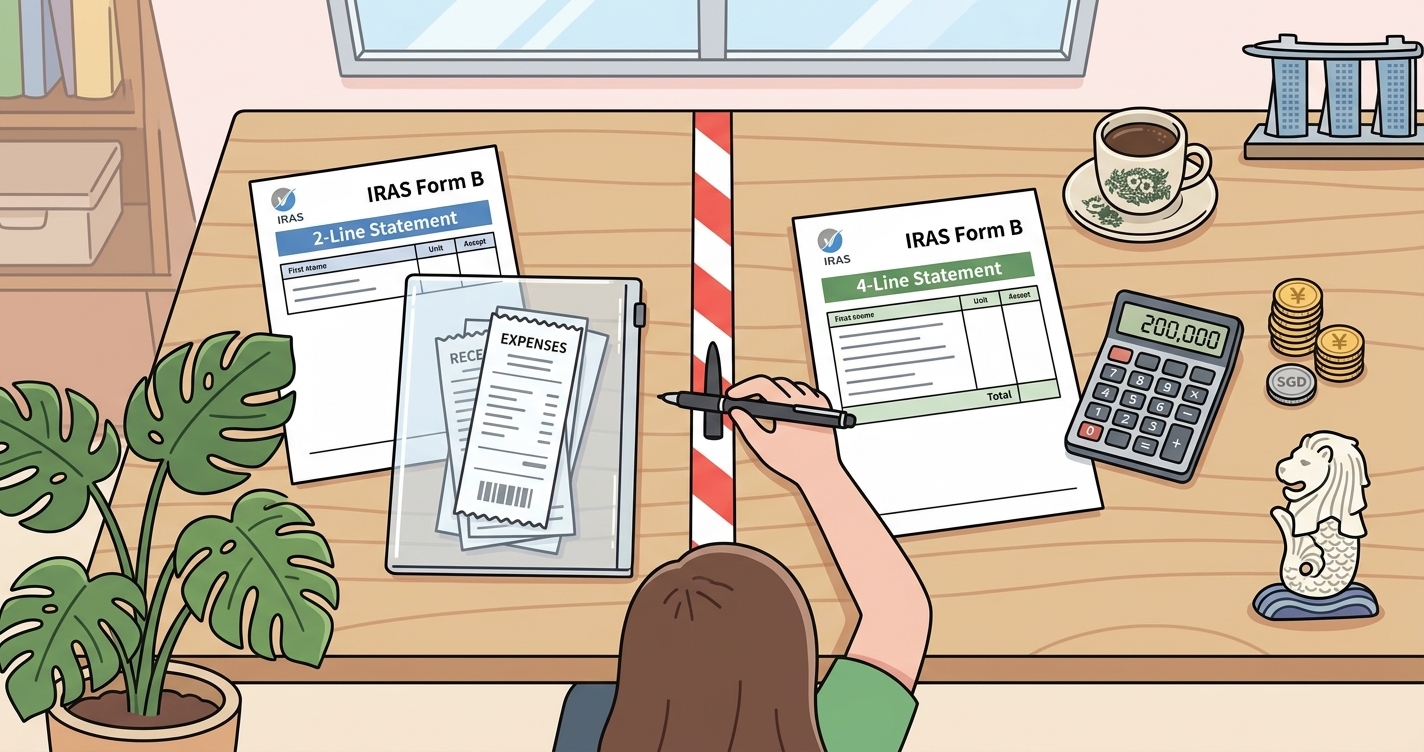
The statement is simply the level of detail IRAS wants about your business income. The 2-line statement reports just two figures: your revenue and your adjusted profit or loss. The 4-line statement breaks the same business down into four figures: revenue, gross profit or loss, allowable business expenses, and adjusted profit or loss. Both end at the same adjusted profit, but the 4-line version shows the working behind it.
The S$200,000 Revenue Threshold
According to IRAS, the dividing line is your annual revenue. If your revenue is S$200,000 or less, you report using the 2-line statement. If your revenue is more than S$200,000, you must use the 4-line statement. Revenue here means your gross income or sales from the business before deducting any expenses, not your profit. Even a freelancer with a small profit can cross the threshold if turnover is high.
The 2-Line Statement Explained
For most freelancers below the threshold, the 2-line statement is refreshingly simple. You report:
- Revenue: your total business income for the year.
- Adjusted profit or loss: your revenue minus allowable business expenses, after any tax adjustments.
You do not submit a detailed expense breakdown with the return, but you must still keep the underlying records in case IRAS asks to see them.
The 4-Line Statement Explained
Once revenue exceeds S$200,000, IRAS wants the full picture:
- Revenue: total income or turnover from the business.
- Gross profit or loss: revenue minus the direct cost of goods or services sold.
- Allowable business expenses: deductible costs such as rent, utilities, and professional fees.
- Adjusted profit or loss: the final taxable figure after tax adjustments.
This format demands well-organised accounts, because each line must reconcile with your books.
Why Accurate Records Matter Either Way
Whether you file two lines or four, IRAS requires you to keep proper records for at least five years. Under-recording expenses inflates your adjusted profit and your tax; over-claiming risks penalties. The safest position is a complete, tidy set of receipts and invoices that supports every figure you report. Many freelancers underclaim simply because a year of paper receipts is hard to assemble at filing time.
Tools like Denpyo let you photograph each receipt as you go, with AI extracting the date, amount, and category automatically. By the time the filing season arrives, your revenue and expense totals are already organised, making either statement straightforward to complete. You can also sanity-check whether a cost is claimable using the expense deductibility checker and project your tax with the income tax calculator.
Worked Example
Imagine a freelance photographer with S$150,000 in revenue and S$40,000 in expenses. Because revenue is below S$200,000, she files a 2-line statement: revenue S$150,000 and adjusted profit S$110,000. Now imagine her studio grows to S$260,000 in revenue with S$90,000 in costs. She crosses the threshold and must file a 4-line statement: revenue S$260,000, gross profit, allowable expenses, and the final adjusted profit. The tax outcome flows from the same numbers, but the reporting detail differs.
Summary
Singapore self-employed persons report business income with a 2-line statement when revenue is S$200,000 or less, and a 4-line statement when revenue exceeds S$200,000. The 2-line format shows revenue and adjusted profit; the 4-line format adds gross profit and allowable expenses. Either way, keep five years of accurate records so every figure is supported. Digitising receipts throughout the year turns filing season into a quick, confident task. For official guidance, see the IRAS page on calculating business income.
Track expenses, maximize deductions
Denpyo scans your receipts and finds tax savings automatically.