

Hong Kong Provisional Tax Explained: A Complete Guide for Freelancers and SMEs 2026
Hong Kong's provisional tax system means you pay this year's confirmed tax and next year's estimated tax simultaneously. Learn how it works, how it's calculated, and how to apply for holdover if your income drops.
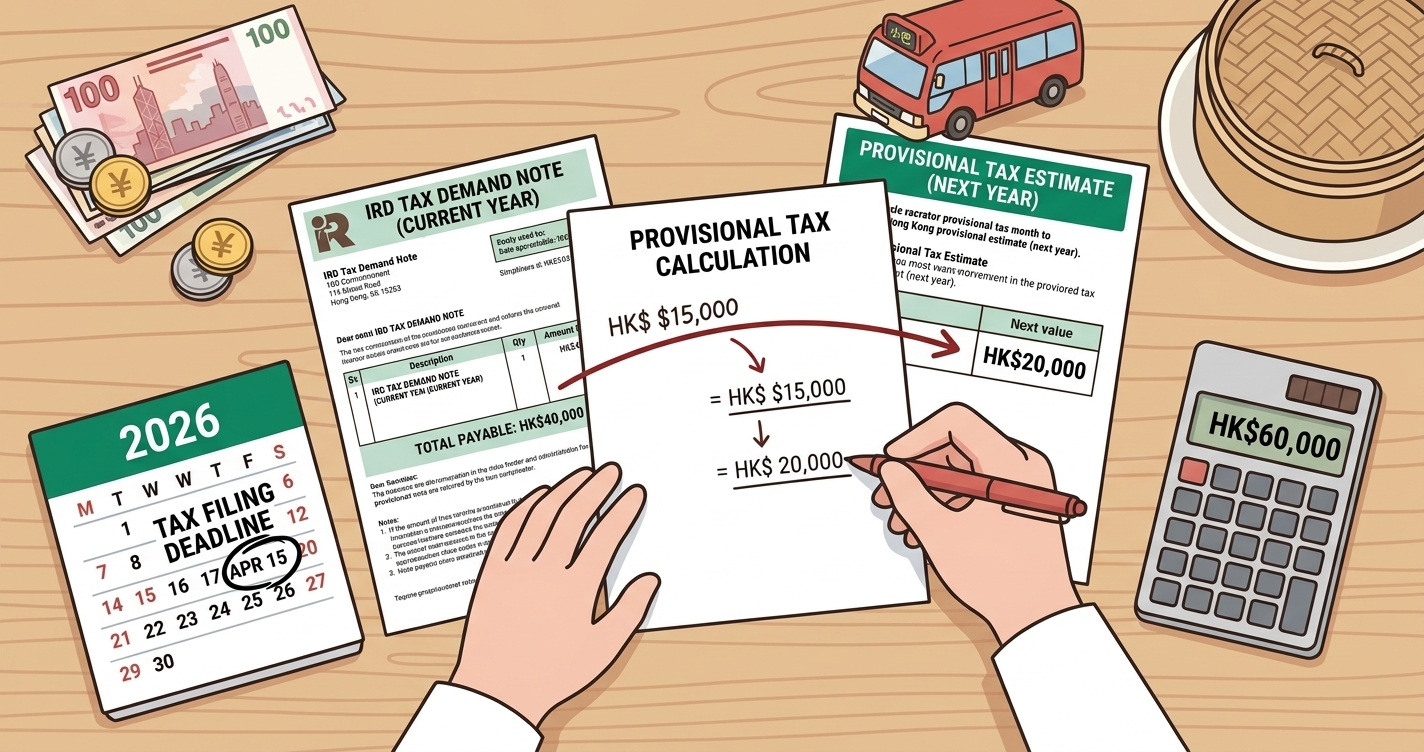
⚠️ This article is for general information only and does not constitute tax advice. For your specific situation, consult the Inland Revenue Department (IRD) or a licensed tax professional. All figures in Hong Kong dollars (HK$).
What Is Hong Kong Provisional Tax?
One of the most confusing aspects of being self-employed in Hong Kong is the provisional tax system. Unlike salaried employees, freelancers must pay their own taxes — and Hong Kong's system effectively asks you to pay this year's tax bill and next year's estimated tax at the same time. Many first-year self-employed individuals receive a tax demand far larger than expected.
How Provisional Tax Is Calculated
The IRD calculates provisional tax using your current-year assessable profits as a proxy for next year. For sole proprietors and individual freelancers, the profits tax rate is:
- 7.5% on the first HK$2,000,000 of assessable profits
- 15% on assessable profits above HK$2,000,000
Example: Assessable profits of HK$800,000 → Current year tax = HK$60,000. Provisional tax for next year = ~HK$60,000. Total demanded: ~HK$120,000 paid in two installments.
When Is Provisional Tax Paid?
| Installment | Percentage | Typical Due Date |
|---|---|---|
| 1st installment | 75% of provisional tax | January |
| 2nd installment | 25% of provisional tax | April (approx 3 months later) |
Payment can be made via the eTAX portal, bank transfer (PPS, e-banking), post office, or convenience stores.
Holdover of Provisional Tax: Reduce Your Bill if Income Drops
If your income for the coming year is expected to be significantly lower, you can apply to hold over (defer or reduce) your provisional tax. Grounds include:
- Estimated assessable profits for the coming year are less than 90% of the current year
- You have ceased or are about to cease to be chargeable to tax
- You have a genuine objection to the current year's assessment
Apply via eTAX or Form IR1121 before the due date of the provisional tax payment (or within 28 days before). If actual income turns out higher than your estimate, you pay the balance plus possible interest — so estimate realistically.
Planning Tips for HK Freelancers
- Set aside 15–20% of monthly gross income in a dedicated tax reserve account
- Maximize deductible expenses: professional subscriptions, home office proportion of rent, equipment depreciation, professional development, business travel
- Apply for holdover early if you know income will drop significantly
Denpyo automatically extracts and categorizes expenses from receipt photos, helping you identify every legitimate deduction and reduce your assessable profits. Use the Expense Deductibility Checker to verify which costs qualify.
FAQ
Is provisional tax paid on top of my confirmed tax?
Yes. Your Notice of Assessment shows both the final tax for the current year AND the provisional tax for the coming year. You pay both amounts, typically in two installments.
What if I overpay provisional tax?
Overpaid provisional tax is credited against your confirmed assessment for the following year — not refunded in cash.
Summary
Provisional tax is an advance estimate of next year's tax, issued alongside your confirmed current-year tax bill. Set aside 15–20% of gross income monthly, maximize deductions, and apply for holdover if income drops. For full details, see the IRD Profits Tax guide and IRD Provisional Tax FAQ.

Track expenses, maximize deductions
Denpyo scans your receipts and finds tax savings automatically.
More Articles
View All Articles
CP500 Tax Instalments for Malaysian Freelancers 2026: Pay, Revise, Avoid Penalties
4 min read
Zakat as Tax Rebate: Complete Guide for Muslim Malaysian Freelancers 2026
2 min read