
Japan's 20% Consumption Tax Rule Ends September 2026: What Freelancers Must Do Now
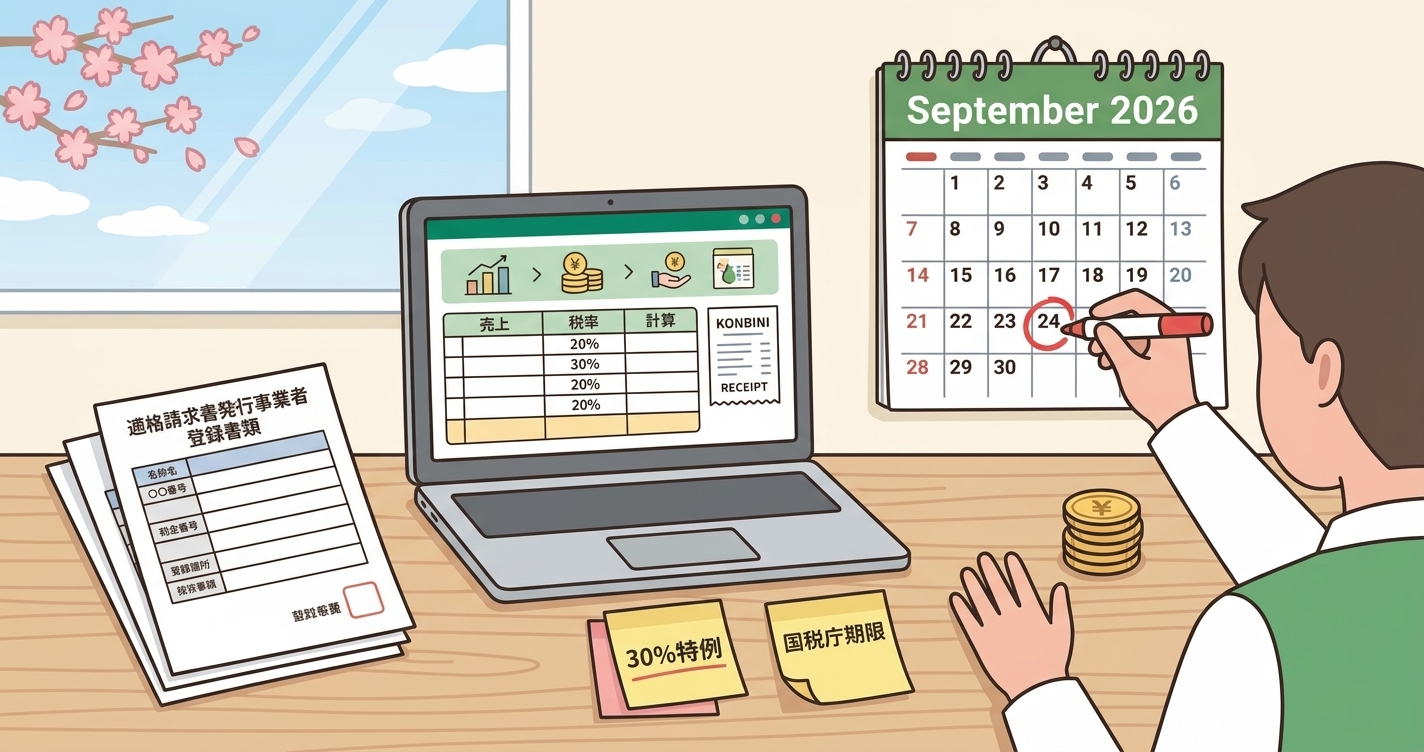
Japan's 20% consumption tax special rule (2割特例) expires September 30, 2026. Here's what freelancers need to know about the new 30% individual rule and the December 31 election deadline.
Disclaimer: This article provides general information only and does not constitute individual tax advice. For the latest rules, consult the National Tax Agency (NTA) or a licensed tax accountant (zeirishi).
Since Japan's qualified invoice (インボイス) system launched in October 2023, the 20% Special Rule (2-wari tokurei) has been a vital lifeline for newly registered freelancers and sole traders. Under this rule, businesses transitioning from tax-exempt status could remit just 20% of their output consumption tax — a dramatic saving. That relief expires September 30, 2026, and it is time to plan your transition.
This guide explains the new 30% Special Rule available to individual sole traders through 2028, how to choose between simplified and standard tax accounting, and the critical filing deadlines you must not miss.
What Was the 20% Special Rule?
The 2-wari tokurei was introduced as a transitional measure alongside the invoice system. It applies to businesses that were previously tax-exempt and voluntarily registered as qualified invoice issuers.
- Benefit: Pay only 20% of your output consumption tax (sales tax collected from clients)
- Coverage: Any tax period containing a date from October 1, 2023 through September 30, 2026
- For sole traders: The final eligible return covers fiscal year 2026 (filed in March 2027)
- No registration required: Simply note the election on your annual tax return
In practice, a freelancer with ¥10 million in sales (plus ¥1 million consumption tax) only remitted ¥200,000 under this rule — compared to ¥500,000–¥1,000,000 under other methods. This advantage disappears in October 2026.
Your Three Options After October 2026
Standard Tax Accounting (Honsoku Kazei)
Calculate actual input tax credits by subtracting the consumption tax embedded in your business expenses from your output tax. Best for businesses with substantial costs — subcontractors, equipment, materials — but requires meticulous invoice retention and bookkeeping for every transaction.
Simplified Tax Accounting (Kanizei Kazei)
Apply a fixed notional purchase rate (みなし仕入れ率) to estimate your input tax credits. Available to businesses with annual taxable sales under ¥50 million. Most freelancers and service providers fall under Category 5 (50% notional rate), meaning they remit 50% of output tax.
- Category 1 – Wholesale: 90%
- Category 2 – Retail / Agriculture: 80%
- Category 3 – Manufacturing / Construction: 70%
- Category 4 – Food service / Other: 60%
- Category 5 – Services / Freelancers / Professionals: 50%
- Category 6 – Real estate: 40%
New 30% Special Rule for Individuals (2026–2028) — Key Update
In December 2025, the Japanese government confirmed a follow-up relief measure exclusively for individual sole traders. The 3-wari tokurei (30% special rule) allows you to pay just 30% of your output tax for any tax period containing a date between October 1, 2026 and September 30, 2028.
- Eligible: Individual sole traders only — corporations do NOT qualify
- Rate: Pay 30% of output consumption tax
- Coverage: Fiscal years 2026 and 2027 for sole traders
- No registration required: Note the election on your tax return
Comparing All Four Methods
Scenario: ¥11M annual revenue (¥10M + ¥1M tax) with ¥2.2M in expenses (¥2M + ¥200K tax):
- 20% Special Rule: ¥1,000,000 × 20% = ¥200,000
- 30% Special Rule (individuals only): ¥1,000,000 × 30% = ¥300,000
- Simplified Tax – Category 5 (50%): ¥1,000,000 × 50% = ¥500,000
- Standard Tax Accounting: ¥1,000,000 − ¥200,000 = ¥800,000
In this example the 30% rule is most advantageous. If your expenses are very high (e.g., a studio outsourcing 60%+ of revenue), standard accounting could beat simplified. Use Denpyo's Tax Savings Estimator to model your own situation.
Three Actions to Take Now
1. File the Simplified Tax Election Form if Needed
To use simplified accounting from fiscal year 2027 onwards, you must submit the Shōhi-zei Kanizei Seido Sentaku Todoke-sho (消費税簡易課税制度選択届出書) by December 31, 2026. Miss this deadline and you default to standard accounting for 2027. File at your local Tax Office or online via e-Tax. See the NTA's simplified tax election guide.
2. Organize Your Invoice Records
If you may switch to standard accounting in the future, start systematically collecting and storing all qualified invoices (適格請求書) received from suppliers. Electronic invoices must be retained under the Electronic Bookkeeping Act (Denshi-chōbo Hozon-hō). Tools like Denpyo make it straightforward to photograph, tag, and archive receipts — keeping you audit-ready for any accounting method.
3. Confirm Your Business Category
For simplified accounting, the notional purchase rate varies from 40% to 90% depending on business type. Misclassification is a common and costly error. Review the NTA's 2-wari tokurei overview pamphlet, and consult a tax accountant if you operate across multiple business types.
Key Dates at a Glance
- Until September 30, 2026: 20% Special Rule available to all eligible registrants
- October 1, 2026 – September 30, 2028 (individuals only): 30% Special Rule
- December 31, 2026: Deadline to file simplified tax election for FY2027
- From October 2028: Full transition to standard or simplified accounting
The expiry of the 20% rule is one of the most significant consumption tax changes for Japan's freelance community in recent years. Whether you leverage the 30% extension as an individual or transition to simplified accounting now, early planning prevents a sudden spike in your tax bill. Accurate expense tracking gives you the data to make the best choice — Denpyo's free tools can help you compare all four scenarios.

Track expenses, maximize deductions
Denpyo scans your receipts and finds tax savings automatically.
More Articles
View All Articles
Malaysia Tax Filing Deadline 15 July 2026: What Happens If You File Form B Late
6 min read![Malaysia Personal Tax Relief RM9,000: How Every Freelancer Can Reduce Their Tax Bill [2026 Guide]](https://api.denpyo.com/storage/v1/object/public/blog-images/covers/1778511615835-my-cover.jpg)
Malaysia Personal Tax Relief RM9,000: How Every Freelancer Can Reduce Their Tax Bill [2026 Guide]
7 min read