

Capital Allowances in Malaysia: Claiming Your Laptop, Camera & Equipment (2026)
Bought a laptop, camera or other gear for your freelance work? You usually can't deduct the full cost in one go like a coffee receipt—but you can claim capital allowances to write it off over time. This guide explains how capital allowances work for Malaysian freelancers and SMEs, the 2026 rates, the small-value-asset shortcut, and a worked example.
Disclaimer: This article is general information as of June 2026 and is not professional tax advice. Rates and rules change. For your situation, refer to the Inland Revenue Board of Malaysia (LHDN) or a qualified tax adviser.
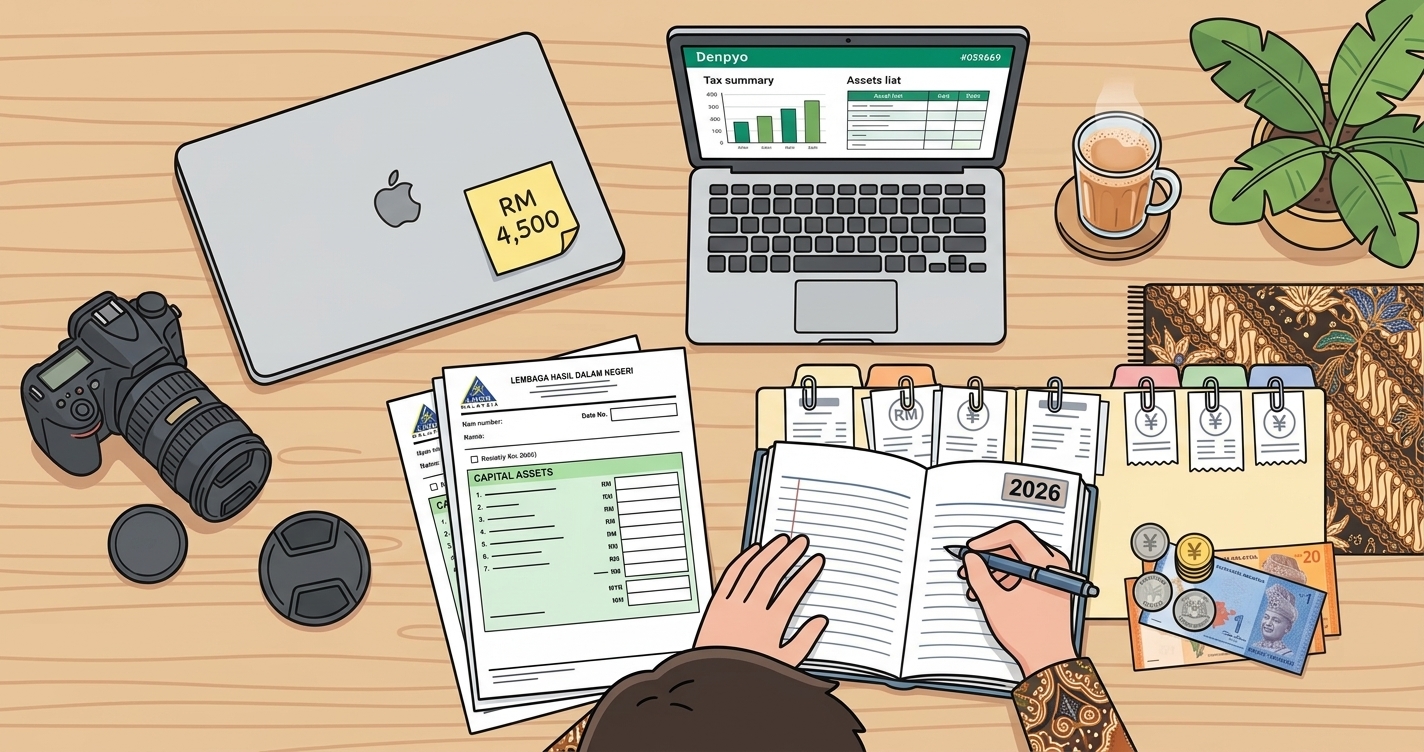
When you buy something small for your freelance business—a stack of notebooks, a month of cloud storage—you simply deduct the cost as an expense. But what about the bigger purchases: a RM4,500 laptop, a RM6,000 camera, an office desk and chair? These are capital assets, and Malaysian tax law treats them differently. You generally cannot expense the whole amount in the year you buy it. Instead, you claim capital allowances—LHDN's version of tax depreciation—which let you write the cost off against your business income over several years. Done right, capital allowances meaningfully reduce the tax you pay; ignored, they leave money on the table.
Capital expense vs revenue expense
The first thing to get straight is the difference between two kinds of spending:
- Revenue (operating) expenses are day-to-day running costs—internet, software subscriptions, stationery, marketing. These are fully deductible in the year incurred.
- Capital expenses are purchases of long-lasting assets used to generate income—laptops, cameras, machinery, furniture, vehicles. These are not deducted in full immediately; instead you claim capital allowances over time.
Capital allowances are available to all businesses, including sole proprietors and partnerships reporting business income, as long as the asset is used for the purpose of the business and you incurred the qualifying expenditure.
How the allowance works: IA + AA
A capital allowance has two parts:
- Initial Allowance (IA) — a one-off allowance granted in the year you incur the expenditure and the asset is in use.
- Annual Allowance (AA) — given every year the asset remains in use, calculated on the original cost, until the asset is fully written off.
In the first year you claim IA + AA together; in later years you claim AA only. The rates depend on the type of asset.
2026 capital allowance rates
The commonly used rates set out by LHDN (and summarised by firms such as PwC Malaysia) include:
- ICT equipment & computer software (including customised software): IA 40%, AA 20% — this covers laptops, computers and most digital tools freelancers rely on.
- General plant and machinery: IA 20%, AA 14%.
- Office equipment, furniture and fixtures: IA 20%, AA 10%.
- Heavy machinery and motor vehicles: IA 20%, AA 20% (note: qualifying expenditure on private vehicles is capped).
- Industrial building: IA 10%, AA 3%.
The accelerated 40%/20% rate on ICT equipment is good news for digital freelancers—your laptop is written off faster than a desk.
The small-value-asset shortcut
There is a handy shortcut for low-cost gear. A small value asset costing not more than RM2,000 each can be written off in full (100%) in the year of purchase, rather than depreciated over years. For individuals, this is subject to a total cap of RM20,000 per year of assessment; that cap is lifted for qualifying SMEs. So a RM1,500 monitor or a RM900 office chair can be claimed in one go—much simpler than tracking annual allowances on each item.
A worked example
Say you are a freelance videographer and in 2026 you buy a laptop for RM4,500 (ICT equipment) and a monitor for RM1,500 (small value asset).
- Laptop (RM4,500): Year 1 allowance = IA 40% + AA 20% = 60% × RM4,500 = RM2,700. Year 2 onward = AA 20% × RM4,500 = RM900 each year until fully claimed.
- Monitor (RM1,500): As a small value asset, you claim 100% = RM1,500 in 2026.
That is RM4,200 of capital allowances in your first year, deducted from your business income before tax is calculated. To see what that saves you at your marginal rate, run your figures through the income tax calculator.
Key rules to remember
- Keep the purchase records. You need the invoice and proof of payment to support every asset and the date it was put to use.
- Business use matters. If an asset is used partly for private purposes, the allowance should reflect the business-use proportion.
- Unabsorbed allowances carry forward. If your allowances exceed your income in a year, the unutilised capital allowance can be carried forward—but only against income from the same business source.
- Balancing charge on disposal. If you sell an asset you've claimed allowances on, there may be a balancing adjustment to account for.
Keep your asset register effortless with Denpyo
Capital allowances only work if you have clean records of what you bought, when, and for how much. Tools like Denpyo let you photograph the invoice for that laptop or camera and automatically capture the vendor, date and amount—building the paper trail you'll need when you (or your accountant) compute allowances at filing time. Not sure whether a purchase is a deductible expense or a capital asset? The expense checker is a quick first step before you file.
Summary
In Malaysia, small running costs are expensed immediately, but bigger purchases—laptops, cameras, furniture, machinery—are written off through capital allowances. Claim the Initial Allowance plus Annual Allowance at the rate for each asset type (40%/20% for ICT gear, 20%/14% for general plant and machinery, and so on), use the RM2,000 small-value shortcut for low-cost items, and carry forward anything you can't absorb. Above all, keep the invoices: every allowance you claim must be backed by a record. Capture them as you buy, and you'll claim every ringgit you're entitled to.

Track expenses, maximize deductions
Denpyo scans your receipts and finds tax savings automatically.
![Malaysia Personal Tax Relief RM9,000: How Every Freelancer Can Reduce Their Tax Bill [2026 Guide]](https://api.denpyo.com/storage/v1/object/public/blog-images/covers/1778511615835-my-cover.jpg)