
EPF for Self-Employed in Malaysia: i-Saraan Plus Tax Relief Guide (2026)
EPF's i-Saraan scheme lets self-employed Malaysians make voluntary retirement contributions, earn a government matching incentive, and claim up to RM4,000 in income tax relief. Here is how the 2026 version works.
Disclaimer: This article is for general information only and does not constitute tax, legal, or financial advice. Please refer to the Employees Provident Fund (EPF/KWSP) at kwsp.gov.my and the Inland Revenue Board of Malaysia (LHDN) at hasil.gov.my, or speak to a licensed tax agent, for advice on your specific circumstances.
If you are a freelance designer in Bangsar, a Grab driver in Penang, a TikTok creator in Johor Bahru, or a sole proprietor running a kedai runcit in Sabah, one common reality binds you together: your retirement is entirely your own responsibility. Salaried workers in Malaysia get an automatic 23% to 24% combined EPF contribution every month (11% from the employee, 12% to 13% from the employer). The self-employed get nothing automatic.
That gap is what the EPF's i-Saraan scheme — and its expanded 2024 successor often referred to as i-Saraan Plus — was created to close. It is a voluntary contribution programme that lets self-employed Malaysians build a retirement fund inside EPF, qualify for a government matching incentive, and claim a meaningful slice of those contributions back as income tax relief.
This 2026 guide explains how i-Saraan works, who qualifies, what the matching rules look like after recent enhancements, and exactly how to claim the relief on Form B or Form BE. Numbers and caps are aligned with the most recent EPF and LHDN guidance available at the time of writing — always confirm the live figures on the official portals before you contribute.
Why EPF Matters for the Self-Employed
Malaysia's social safety net for the self-employed has improved dramatically in the last decade. PERKESO's Self-Employment Social Security Scheme (SKSPS) covers occupational injury for several gig categories. EPF i-Saraan covers retirement. Neither is automatic — you have to opt in.
Two facts make i-Saraan worth understanding even if retirement feels distant:
- Government matching: The government tops up your contribution by a fixed percentage, capped per year. That is a guaranteed return you cannot get anywhere else.
- Tax relief: Voluntary EPF contributions qualify for income tax relief alongside life insurance and takaful, with a combined cap that has been progressively raised in recent budgets.
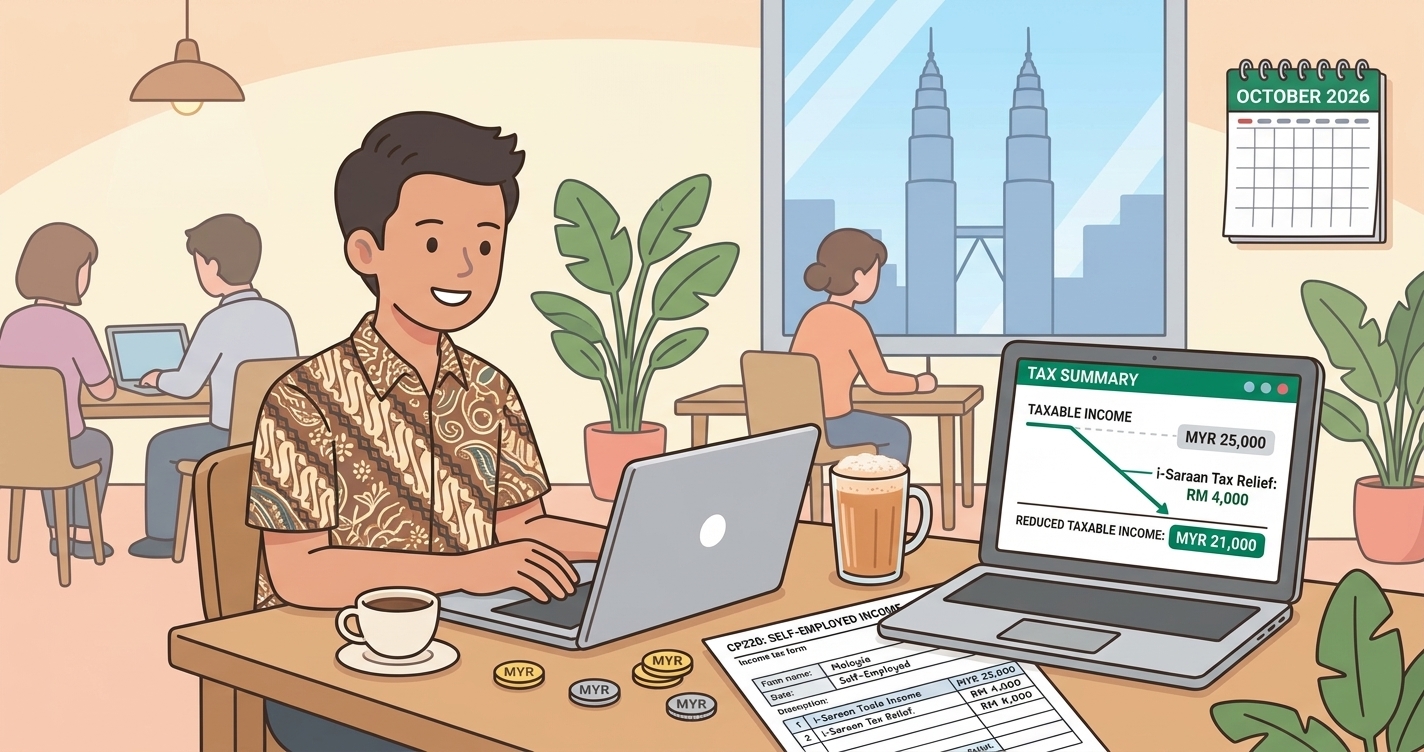
For a freelancer in the 24% marginal income tax bracket, claiming the full RM4,000 EPF/life insurance relief is worth roughly RM960 in cash tax savings — before you even count the EPF dividend or the government matching.
i-Saraan vs i-Saraan Plus: What Changed
The original i-Saraan scheme launched as 1Malaysia Retirement Scheme (SP1M) and was rebranded to i-Saraan in 2018. It offered a 15% matching contribution, capped at RM250 per year. Successive Budget announcements (Budget 2023 and Budget 2024 in particular) raised the matching cap and broadened eligibility, with the enhanced version commonly marketed as i-Saraan Plus.
Headline 2026 features (always cross-check live figures at kwsp.gov.my/member/savings/i-saraan):
- Government matching of 15% of your voluntary contribution
- Annual matching cap raised in stages — confirm the current cap on the EPF i-Saraan page before contributing
- Eligible until age 60
- Open to Malaysian self-employed persons, gig workers, housewives, and informal-sector workers
- Contributions earn the same EPF dividend as Account 1 / Account 2 (Akaun Persaraan / Akaun Sejahtera under the new three-account structure)
Big Four firms such as PwC Malaysia and KPMG Malaysia publish annual Budget commentaries that summarise i-Saraan changes alongside the broader personal tax updates — useful reading the week after each Budget.
Who Qualifies
You are eligible to contribute to i-Saraan if you are:
- A Malaysian citizen aged below 60
- Self-employed, including sole proprietors, partners in a partnership, freelancers, e-hailing/p-hailing riders, online sellers, content creators, agents, and most other non-salaried earners
- Holding an active EPF membership number (you can register online at the EPF i-Akaun portal if you do not have one)
You do not need to be earning above any specific threshold. A part-time tutor earning RM800 a month can contribute RM50 and still qualify for the matching incentive, subject to the annual cap.
How Voluntary Contribution Mechanics Work
How to Pay In
- Online: EPF i-Akaun (Member) → Self Contribution → choose i-Saraan
- Bank transfer: via Maybank2u, CIMB Clicks, RHB, Public Bank, AmOnline, etc., using the EPF biller code
- Over the counter: at any EPF branch or selected bank counters
- FPX / DuitNow: directly from the EPF portal or app
Minimum and Maximum Contribution
- Minimum: RM10 per transaction
- Maximum: RM100,000 per year across all voluntary EPF schemes (subject to current EPF rules — confirm on the i-Saraan page)
The Matching Incentive
The government matches 15% of your i-Saraan contribution, capped at the prevailing annual limit. The matching is credited to your EPF account at the end of the contribution year, typically in the following year. To qualify for the maximum match, you simply need to contribute enough to reach the cap.
Tax Relief Under the Income Tax Act 1967
Under Section 49 of the Income Tax Act 1967, individual taxpayers in Malaysia may claim a tax relief for life insurance premiums, takaful contributions, and EPF voluntary contributions. The relief is grouped, and the headline cap relevant to most self-employed contributors is up to RM4,000 for the EPF / life insurance / takaful basket (for non-public-sector individuals). Recent Budgets have separated some categories — always confirm the latest split on the LHDN Tax Reliefs page.
Key practical points:
- Voluntary EPF contributions made under i-Saraan count toward the EPF portion of the relief
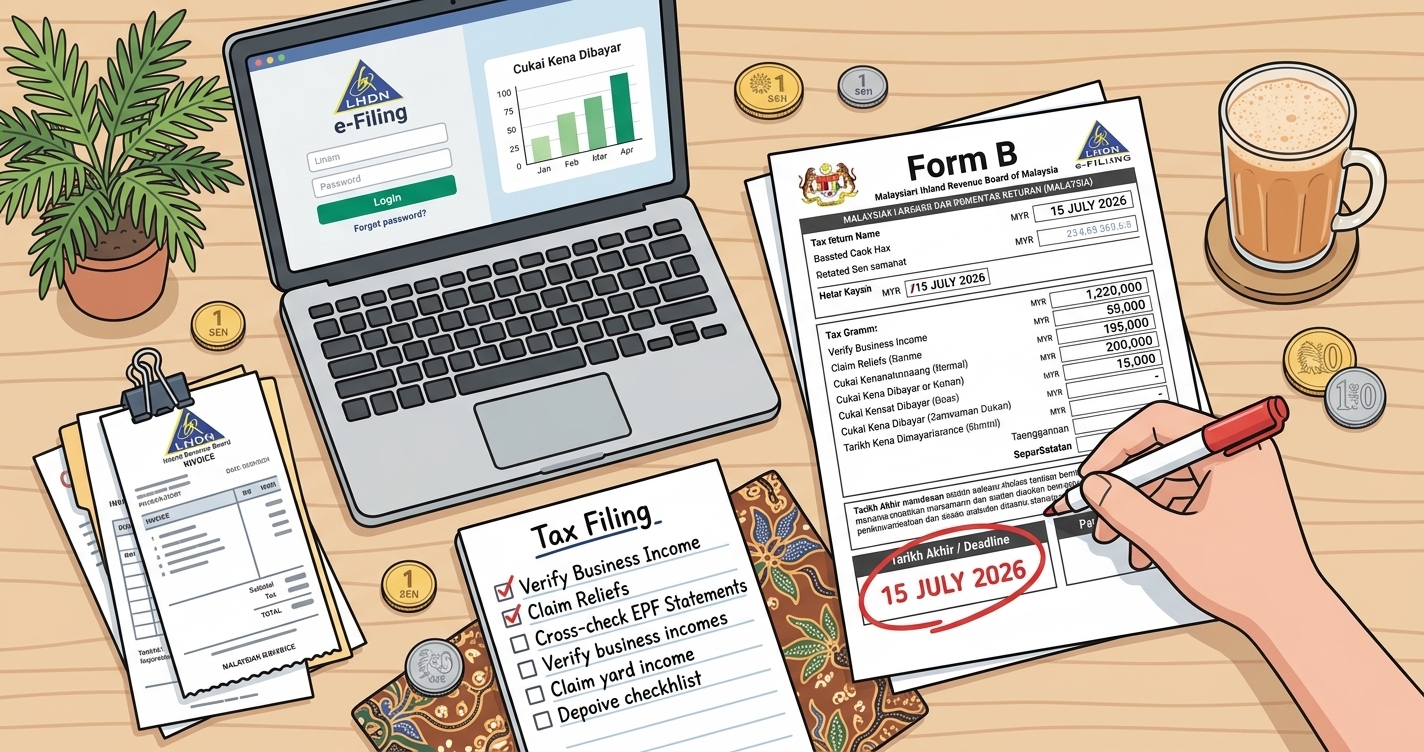
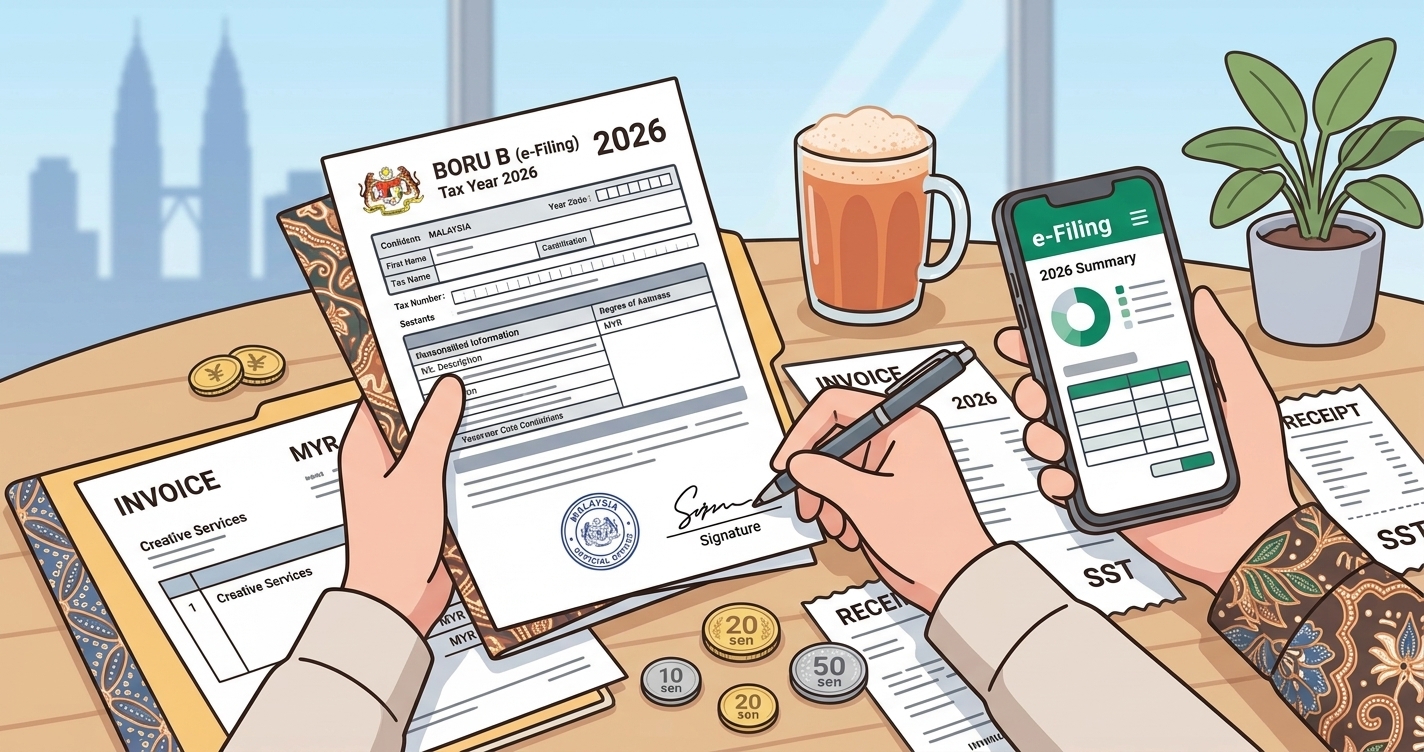
- You claim the relief on Form B (sole proprietors / business income) or Form BE (no business income)
- EPF will issue an annual contribution statement via i-Akaun that you keep as supporting evidence
- Government matching contributions are not personally claimable as your own contribution for relief purposes — only the amount you actually paid in
Practical Examples
Example 1: The Freelance Graphic Designer
Aisyah is a 32-year-old freelance graphic designer in Petaling Jaya earning around RM85,000 net per year. She contributes RM4,000 to i-Saraan in 2026. She gets the government matching credited in 2027 (subject to the prevailing cap), the full RM4,000 counts toward her EPF / life insurance tax relief, and her marginal-rate cash tax saving is roughly RM960 (24% of RM4,000). Net effective cost of her RM4,000 retirement contribution is closer to RM3,040 — and she has built RM4,000+ of EPF balance that will continue to compound at the EPF dividend rate.
Example 2: The Grab Driver Building Slowly
Faizal, 45, drives full-time for Grab in Kuala Lumpur. Cash flow is tight, so he commits to RM200 per month into i-Saraan via standing FPX instruction — RM2,400 over the year. He claims the RM2,400 alongside his RM900 takaful premium for a combined RM3,300 relief (still inside the RM4,000 cap). At a 19% marginal rate, that is roughly RM627 in tax savings, plus the government matching incentive plus EPF dividend.
Example 3: The TikTok Creator With Lumpy Income
Mei, 27, earns most of her income from two viral months a year. She waits until December, totals her annual creator income, and makes a single i-Saraan contribution that maxes out her EPF/insurance tax relief. The lump-sum approach is fine — i-Saraan does not require regular instalments, and the matching is calculated on the calendar-year total, not on contribution frequency.
How Denpyo Helps Malaysian Freelancers Stay Tax-Ready
Claiming i-Saraan tax relief is straightforward; knowing what your taxable income actually is, on the other hand, is where most self-employed Malaysians lose money. If you under-track expenses, you over-pay tax — and the i-Saraan relief shrinks in proportion to your remaining marginal rate. Denpyo is designed for exactly this gap. Snap a photo of any receipt, invoice, or transfer voucher (including 振替伝票 if you work with Japanese clients), and the AI extracts the vendor, date, total, SST/GST component if applicable, and a suggested category — petrol, telekomunikasi, peralatan pejabat, langganan perisian, perjalanan, jamuan pelanggan, and so on. Custom categories let you mirror your accountant's chart of accounts.
For Malaysian users specifically, Denpyo helps with three pain points: keeping faded thermal receipts legible across LHDN's 7-year retention window (the photo, not the paper, is the durable record), separating personal and business spending so the LHDN's wholly and exclusively test is defensible, and producing a clean expense export at the end of each Year of Assessment for your tax agent or for direct entry on Form B. To estimate how much your captured expenses are worth in tax terms, run them through the Denpyo Tax Savings Estimator; to sanity-check whether a particular expense is likely deductible, use the Expense Deductibility Checker; and to project your final income tax bill before you file, try the Income Tax Calculator.
Common i-Saraan Mistakes
- Contributing past the matching cap and assuming the government still tops up. The match is capped — anything above the cap still earns EPF dividend, but no matching.
- Forgetting to download the annual contribution statement. LHDN can ask for it during a desk audit. Save the PDF from i-Akaun each January.
- Confusing i-Saraan with PRS (Private Retirement Scheme). PRS has its own RM3,000 tax relief slot under a different category. They are stackable, not interchangeable.
- Trying to claim the government matching as your own contribution for relief. Only your own paid-in contribution counts toward the Section 49 relief.
- Waiting until 31 December and being unable to log into i-Akaun. The portal gets congested at year-end — make the contribution by mid-December at the latest.
What Happens if You Do Not Contribute
Unlike statutory employee EPF, i-Saraan is voluntary. There is no penalty for not contributing. The cost is opportunity cost: no government matching, no tax relief on that slot, and no compounded EPF dividend on a contribution you never made. For a 30-year-old self-employed Malaysian, contributing at the matching cap each year compounds into a meaningful retirement balance over a 30-year horizon at typical EPF dividend rates.
Key Takeaways
- i-Saraan is voluntary EPF for the self-employed, with a 15% government matching incentive up to an annual cap
- Eligibility runs to age 60 and covers freelancers, gig workers, sole proprietors, online sellers, and informal-sector earners
- Voluntary contributions count toward the EPF / life insurance / takaful tax relief under Section 49 ITA 1967, capped around RM4,000 (confirm the current split on LHDN)
- Claim the relief on Form B (business income) or Form BE (employment only); keep the EPF annual statement as evidence
- Lump-sum contributions are fine — frequency does not affect either the matching or the relief
- Track your business expenses well: lower taxable income makes every relief slot work harder
Resources

Track expenses, maximize deductions
Denpyo scans your receipts and finds tax savings automatically.