
Malaysia Record Keeping for 7 Years: Documentation and Digital Storage Requirements
Under Malaysia's Income Tax Act 1967, freelancers and businesses must retain records for 7 years. Learn what LHDN requires, how digital storage works, and best practices for compliance.
Disclaimer: This article is for informational purposes only and does not constitute tax advice. For official guidance on Malaysia record-keeping requirements, consult the Inland Revenue Board (LHDN) or a qualified tax professional. Regulations may change; always verify current requirements with LHDN.
Introduction
Malaysia's Inland Revenue Board (LHDN) requires businesses and freelancers to maintain comprehensive records for a 7-year retention period. This requirement applies to all income earners—from sole proprietors to corporations—and is enforced under Section 82 and 82A of the Income Tax Act 1967.
Keeping organized records isn't just a bureaucratic checkbox. It protects you during audits, substantiates claimed deductions, and demonstrates tax compliance. With the rise of digital invoicing via MyInvois, storage practices have evolved significantly.
Legal Basis: Why 7 Years?
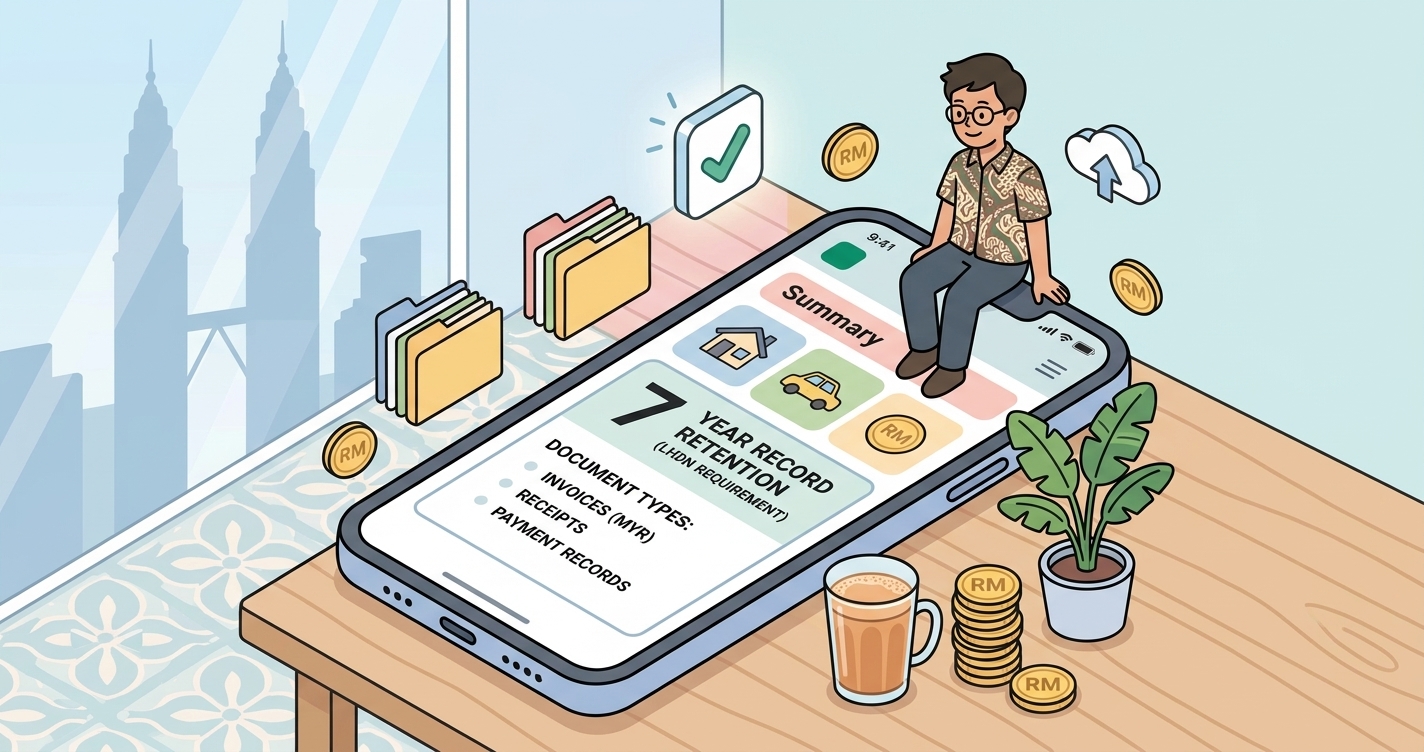
Section 82 of the Income Tax Act 1967 mandates that taxpayers maintain records for a minimum of 7 years from the date they are created or received. This timeline aligns with Malaysia's statute of limitations for tax assessments and allows LHDN sufficient opportunity to conduct audits and investigations.
The 7-year rule covers:
- Original receipt and invoice documents
- Bank statements and payment records
- Contracts and agreements
- Correspondence with suppliers and clients
- Payroll and employee records
- Tax return copies and supporting schedules
What Records Does LHDN Require?
LHDN expects a comprehensive audit trail. The specific documents required depend on your business type, but the core set includes:
- Sales Documents: Invoices, delivery notes, sales orders, credit notes
- Expense Documentation: Receipts, invoices from vendors, petty cash records, expense claims
- Financial Records: Bank statements, cheque books, payment vouchers, cash registers
- Contracts & Agreements: Service contracts, purchase agreements, loan documents
- Payroll: Salary slips, attendance records, leave forms (if employed staff)
- Tax Records: Filed tax returns, correspondence with LHDN, assessment notices
For freelancers specifically, LHDN focuses on income substantiation—invoices sent to clients and receipts for business expenses that reduce net income.
Digital vs. Paper Storage: What LHDN Accepts
LHDN does accept digital copies of records, provided they meet strict legibility and accessibility standards. However, this doesn't mean scanning anything and deleting the original is automatically compliant.
Digital Records Must Be:
- Legible: No blurred text, missing sections, or corrupted files
- Retrievable: Organized with clear naming conventions and stored long-term (not on temporary media)
- Authentic: Unaltered from the original; any edits must be clearly documented
- Complete: All pages of multi-page documents preserved
- Accessible: Stored in formats LHDN can reasonably open (PDF, JPEG, etc.)
Best Practice:
Many compliance advisors recommend a hybrid approach: keep originals for critical documents (contracts, large transactions), but digitize routine receipts and invoices for convenience. Tools like Denpyo can digitize paper receipts instantly, creating searchable records that satisfy LHDN's 7-year retention requirement without cluttering your office.
MyInvois Impact on Record Keeping
MyInvois, Malaysia's e-invoicing system, is transforming how records are kept. If you issue e-invoices via MyInvois, the electronic version becomes the primary record for those transactions—you don't need a separate paper copy, though downloadable PDFs for your records are wise.
MyInvois records are automatically retained in the system and timestamped by LHDN. This simplifies compliance for sellers but doesn't change the 7-year retention obligation for supporting documents (bank statements, customer payment proofs, etc.).
Organizing Records by Category
A well-organized record system is half the battle. Suggested structure:
- Year/Month folders: e.g.,
2026/01-January
- Subcategories: Sales, Expenses, Payroll, Contracts, Tax Returns
- Consistent naming: e.g.,
INV-20260416-ClientName.pdforRCP-Groceries-20260410.jpg
- Master index: Optional spreadsheet linking document ID to stored path
Cloud storage (Google Drive, OneDrive, Dropbox) is acceptable to LHDN if passwords are secure and access logs are maintained. Local backup copies are recommended for redundancy.
Penalties for Non-Compliance
LHDN takes record-keeping seriously. Penalties for failing to maintain records under Section 112 of the Income Tax Act 1967 include:
- Fine of RM200 to RM20,000 (or both fine and imprisonment)
- Imprisonment up to 1 year for severe violations
- During an audit, LHDN may estimate income based on assumptions if records are incomplete—often resulting in higher assessed taxes
The financial and reputational cost of non-compliance far exceeds the effort of maintaining organized records.
Best Practices for Freelancers and SMEs
- Use accounting software: Cloud-based tools (QuickBooks, Xero, Wave) auto-save records with timestamps and version history
- Digitize receipts immediately: Don't wait until year-end; batch-scan monthly to avoid backlog
- Implement a filing system: Whether physical or digital, consistency matters more than perfection
- Back up regularly: Use cloud or external drives to prevent data loss
- Reconcile bank statements monthly: Catch discrepancies early and confirm all transactions are documented
- Keep an expense journal: A simple spreadsheet logging cash expenses (transport, meals, supplies) with dates and categories
- Retain email correspondence: Save important customer and supplier communications as PDFs
- Set a calendar reminder: Check what records can be safely archived/deleted after the 7-year mark
Denpyo: Simplifying Digital Record Keeping
For Malaysian freelancers managing dozens of receipts monthly, Denpyo streamlines the digitization process. Upload a photo of your receipt, and Denpyo's AI instantly extracts the vendor, date, amount, and category—creating a searchable, organized digital record that meets LHDN standards. No more shoebox of crumpled receipts.
Ready to tighten your expense tracking? Try Denpyo free today, or explore our Expense Deductibility Checker and Tax Savings Estimator to see how much you might be leaving on the table.
Summary
Malaysia's 7-year record-keeping requirement is non-negotiable. By understanding what LHDN expects, organizing documents systematically, and leveraging digital tools, you can stay compliant without sacrificing productivity. Whether you maintain paper originals or purely digital copies, consistency and legibility are key. Start your system today—your future audit-self will thank you.

Track expenses, maximize deductions
Denpyo scans your receipts and finds tax savings automatically.