

Philippines Freelancer Tax Guide 2026: BIR Registration, Filing Deadlines, and the 8% Rule
Disclaimer: This article provides general information only and is not individual tax or legal advice. Tax laws change frequently. Always verify requirements with the Bureau of Internal Revenue (BIR) or a licensed Certified Public Accountant (CPA) in the Philippines.
Freelancing in the Philippines is booming — from remote workers serving international clients to local content creators, consultants, and online sellers. Yet many Filipino freelancers remain unregistered with the Bureau of Internal Revenue (BIR), leaving them exposed to penalties that can far exceed the taxes they would have owed. Whether you bill in pesos or receive USD through PayPal, your income is taxable in the Philippines.
This guide walks you through everything you need to know: BIR registration, your tax options, filing deadlines, and how to reduce your tax burden — all explained in plain language for freelancers and small business owners.
Who Needs to Register with the BIR?
If you earn income from freelancing, consulting, online selling, or any self-employed activity — even part-time — you are legally required to register with the BIR and pay income tax. This applies regardless of whether your clients are local or overseas.
Key registration requirements:
- Fill out BIR Form 1901 (Application for Registration for Self-Employed)
- Submit to the Revenue District Office (RDO) where your business is located
- Provide a valid government ID and proof of address
- Pay the ₱30 documentary stamp tax (the ₱500 annual registration fee was abolished in 2024)
- Apply for Authority to Print (ATP) official receipts if issuing receipts to clients
Once registered, you receive a Certificate of Registration (COR) listing your tax obligations, registration deadlines, and official receipt details.
Choosing Your Tax Option: 8% vs Graduated Rates
This is the single most important tax decision you will make as a freelancer. The Philippines offers two main income tax options for self-employed individuals with gross annual receipts not exceeding ₱3,000,000:
Option 1: 8% Flat Income Tax Rate
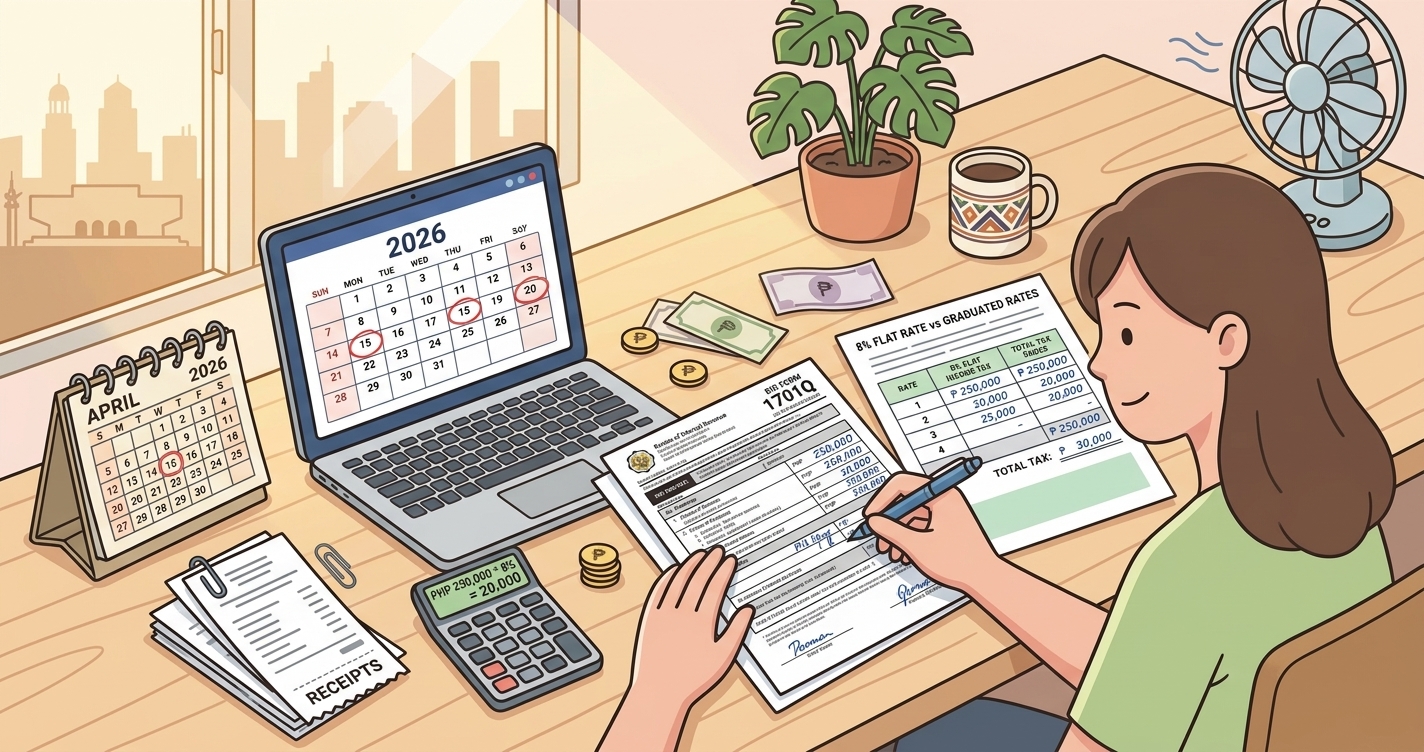
Pay a flat 8% on your gross receipts or sales in excess of ₱250,000. This is the simpler option — no itemized deductions, no separate Percentage Tax (3%) to file, and far less bookkeeping.
- Eligibility: Gross receipts do not exceed ₱3,000,000 for the year
- Rate: 8% on gross receipts minus ₱250,000 (the annual exemption)
- Advantage: Simple calculation, no need to track expenses for deductions
- Disadvantage: Cannot deduct business expenses; you pay tax on gross, not net income
- File using: BIR Form 1701A (Annual Income Tax Return for Self-Employed)
Example: If your gross receipts total ₱600,000 in a year, your income tax is 8% × (₱600,000 − ₱250,000) = ₱28,000.
Option 2: Graduated Tax Rates with Itemized Deductions
Use the progressive tax brackets (0%–35%) on your net taxable income after deducting allowable business expenses. You must also file and pay 3% Percentage Tax quarterly unless you opt for the 8% flat rate.
- Tax brackets (2026):
- Up to ₱250,000 — 0%
- ₱250,001–₱400,000 — 20% of excess over ₱250,000
- ₱400,001–₱800,000 — ₱30,000 + 25% of excess over ₱400,000
- ₱800,001–₱2,000,000 — ₱130,000 + 30% of excess over ₱800,000
- ₱2,000,001–₱8,000,000 — ₱490,000 + 32% of excess over ₱2,000,000
- Over ₱8,000,000 — ₱2,410,000 + 35% of excess over ₱8,000,000
Advantage: Can deduct actual business expenses, lowering your taxable base significantly if costs are high.
For most freelancers with gross receipts under ₱3M and moderate expenses, the 8% option is simpler and often advantageous. Once receipts exceed ₱3M, you must use the graduated rates.
Filing Deadlines You Must Know
Missing tax deadlines in the Philippines results in a 25% surcharge on unpaid tax, plus 12% annual interest and a compromise penalty. Keep these dates in your calendar:
- Quarterly Income Tax Return (BIR Form 1701Q):
- Q1 (Jan–Mar): due May 15
- Q2 (Apr–Jun): due August 15
- Q3 (Jul–Sep): due November 15
- Annual Income Tax Return (BIR Form 1701A or 1701): due April 15 of the following year
- Quarterly Percentage Tax (BIR Form 2551Q, if NOT on 8% option): due on the 25th day of the month following each quarter end
- Annual Registration (BIR Form 0605): due January 31 each year (₱500 fee was waived in 2024; confirm with your RDO)
For the latest official deadline calendar, see the BIR's tax calendar.
Deductible Business Expenses (Graduated Rate Filers)
If you choose the graduated rate with itemized deductions, the following ordinary and necessary business expenses are deductible:
- Home office expenses (proportional rent, electricity, internet)
- Computer, equipment, and software costs
- Professional development: courses, certifications, books
- Communication costs: phone plans, video conferencing subscriptions
- Subcontractor and freelancer payments
- Professional fees: accountant, lawyer
- Marketing and advertising expenses
- Travel expenses for business purposes
- Bank fees and PayPal transaction fees
Keep all official receipts and invoices. The BIR requires 5-year record retention for all supporting documents. Using a receipt management tool like Denpyo to photograph and categorize receipts makes this process far less burdensome — especially if your clients are overseas and you receive digital invoices.
Social Contributions: SSS, PhilHealth, Pag-IBIG
As a self-employed freelancer, you are responsible for both the employee and employer shares of these mandatory contributions:
- SSS (Social Security System): Monthly contributions based on your declared monthly salary credit. Self-employed members can enroll online at sss.gov.ph.
- PhilHealth: 5% of monthly income (shared equally between employee and employer portions, both paid by self-employed). Maximum contribution is capped annually.
- Pag-IBIG (HDMF): ₱200 per month minimum for self-employed, with higher voluntary contributions allowed.
Good news: these contributions are deductible from your gross income when computing taxable income under the graduated rate option.
Handling Foreign-Source Income
Filipino freelancers working for overseas clients — whether through Upwork, Fiverr, direct contracts, or platforms like Toptal — must declare all income received, regardless of currency. Foreign income earned by a Philippine resident is taxable in the Philippines.
Practical tips:
- Convert foreign income to pesos using the BSP reference rate on the date of receipt
- PayPal and Payoneer transfers count as income when received, not when withdrawn
- Keep records of all wire transfers and remittances as proof of income
Common Mistakes to Avoid
- Not registering at all: BIR conducts operations to identify unregistered businesses; penalties can be severe
- Missing quarterly filings: Even if you owe zero tax, you must file the return
- No official receipts: You must issue official receipts (OR) to clients; not doing so is a violation even if income is declared
- Not tracking expenses: Without records, you lose the ability to claim deductions under the graduated rate option
Getting Started: Your First Steps
- Register at your RDO using BIR Form 1901 — bring your TIN, valid ID, and proof of address
- Decide between 8% flat rate and graduated rates — consult a CPA if unsure
- Apply for Authority to Print official receipts
- Set aside 8–15% of every invoice payment for taxes and contributions
- Use a receipt/expense tracking tool to stay organized year-round
Tools like Denpyo help freelancers capture and categorize receipts digitally — reducing the risk of losing expense records and making tax time less stressful. Combine Denpyo's receipt scanning with our free tax savings estimator to project your annual tax liability and plan ahead.
Philippine tax compliance doesn't have to be overwhelming. Start with registration, pick your tax option, and build the habit of recording every business expense from day one.

Track expenses, maximize deductions
Denpyo scans your receipts and finds tax savings automatically.
More Articles
View All Articles
CP500 Tax Instalments for Malaysian Freelancers 2026: Pay, Revise, Avoid Penalties
4 min read
Zakat as Tax Rebate: Complete Guide for Muslim Malaysian Freelancers 2026
2 min read