
Singapore Freelancer Tax Calculator 2026: Income Brackets and Reliefs Explained
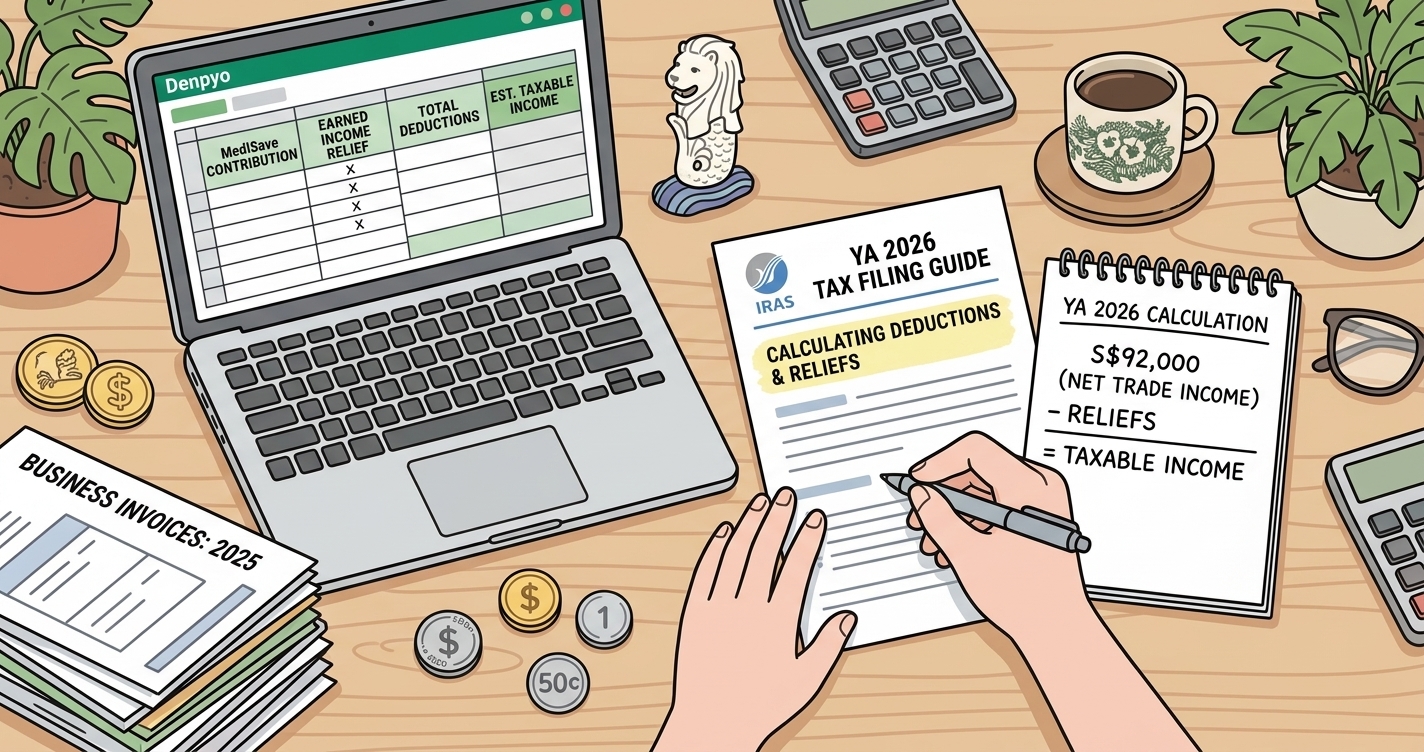
A plain-English guide to Singapore's YA 2026 resident income tax brackets, the reliefs self-employed people actually use (Earned Income, CPF/MediSave, SRS, Course Fees, family), how MediSave on net trade income works, and a worked example of a freelance designer paying under S$2,700 on S$92,000 net trade income.
Disclaimer: This article is general information, not tax advice. Singapore tax rules, rates, reliefs, and filing deadlines change year to year — for the current Year of Assessment (YA) you are filing, always confirm figures at the Inland Revenue Authority of Singapore (IRAS) and speak to a licensed Singapore tax agent for your specific situation.
Why Singapore freelancers need to understand the tax brackets in 2026
Most employees in Singapore hardly think about income tax — their employer files the IR8A, they receive the assessment, they pay. But the moment you invoice a client directly — as a freelance designer, a part-time tutor, a private-hire driver, a consultant with a UEN — you become a self-employed person in the eyes of IRAS, and income tax stops being automatic. You are responsible for computing chargeable income, claiming reliefs, paying MediSave contributions, and filing Form B or Form B1 before the 18 April e-filing deadline.
Understanding how Singapore's progressive resident income tax brackets interact with personal reliefs is how you turn "I earned $120,000 as a freelancer" into a precise tax liability — and how you spot the reliefs you might be missing. This guide walks through YA 2026 brackets, the main reliefs self-employed Singaporeans use, MediSave on net trade income, and a worked example.
YA 2026 Singapore resident income tax rates
For the Year of Assessment 2026 (income earned in calendar year 2025), Singapore tax residents pay progressive personal income tax on their chargeable income. The same schedule applies to employment income, trade income, and rental income — there is no separate self-employed rate.
- First S$20,000: 0%
- Next S$10,000 (up to S$30,000): 2%
- Next S$10,000 (up to S$40,000): 3.5%
- Next S$40,000 (up to S$80,000): 7%
- Next S$40,000 (up to S$120,000): 11.5%
- Next S$40,000 (up to S$160,000): 15%
- Next S$40,000 (up to S$200,000): 18%
- Next S$40,000 (up to S$240,000): 19%
- Next S$40,000 (up to S$280,000): 19.5%
- Next S$40,000 (up to S$320,000): 20%
- Next S$180,000 (up to S$500,000): 22%
- Next S$500,000 (up to S$1,000,000): 23%
- Above S$1,000,000: 24%
Two things to note. First, the first S$20,000 of chargeable income is tax-free — most Singaporeans never pay tax on their starting income. Second, brackets are marginal: a freelancer with S$90,000 chargeable income doesn't pay 11.5% on the whole amount. They pay 0% / 2% / 3.5% / 7% on the first S$80,000 and 11.5% only on the S$10,000 above S$80,000.
From gross fees to chargeable income
Your tax bill isn't calculated on the fees you invoiced. It is calculated on chargeable income, which is net trade income minus personal reliefs. The chain looks like this:
- Gross revenue: everything you invoiced and received during the calendar year.
- Allowable business expenses: expenses wholly and exclusively incurred in producing that income — covered in Singapore self-employed deductions 2026.
- Net trade income: revenue minus allowable expenses. This is the figure IRAS uses to compute MediSave.
- Assessable income: net trade income plus any other income (employment, rental, etc.).
- Chargeable income: assessable income minus personal reliefs.
Tax is then computed bracket by bracket on chargeable income. That is the number that actually sits on the progressive schedule above.
The main reliefs a Singapore freelancer should know
Personal reliefs are the second half of the equation. Miss one and you pay more tax than you owe. Singapore caps total personal income tax reliefs at S$80,000 per YA (Earned Income Relief and most common reliefs all sit inside that cap). The big ones for self-employed Singaporeans are:
Earned Income Relief
If you have earned income — employment or trade income — you get Earned Income Relief automatically. The base amount is S$1,000 for those under 55, S$6,000 for 55–59, and S$8,000 for 60 and above. Handicapped individuals receive higher amounts.
CPF Relief (for MediSave top-ups and SRS)
Self-employed people don't get CPF Relief for regular CPF contributions the way employees do, but you can claim relief for:
- Compulsory MediSave contributions on net trade income (see next section). These are deductible in the same YA.
- Voluntary CPF contributions up to the CPF Annual Limit — useful if you want to put more into your Ordinary, Special, or Retirement Account.
- MediSave voluntary top-ups up to the Basic Healthcare Sum, subject to overall CPF Annual Limit.
Course Fees Relief
Up to S$5,500 per YA for courses, seminars, or conferences leading to qualifications, or that are relevant to your current trade. A freelance developer taking an AWS Solutions Architect course, or a translator pursuing a NAATI accreditation, typically qualifies.
SRS Relief
Supplementary Retirement Scheme contributions reduce chargeable income dollar for dollar, subject to an annual cap — S$15,300 for Singapore citizens and PRs, S$35,700 for foreigners. SRS is one of the most efficient tax shelters for high-earning freelancers.
Family reliefs
- Qualifying Child Relief (QCR): S$4,000 per qualifying child.
- Working Mother's Child Relief (WMCR): from YA 2025 onwards, a fixed amount per child (S$8,000 for the first child, S$10,000 for the second, S$12,000 for the third and beyond) rather than the previous percentage-based formula.
- Parent Relief: S$9,000 (staying with you) or S$5,500 (not staying with you) per qualifying parent.
- Grandparent Caregiver Relief, Handicapped Dependent reliefs and others exist if they apply to your household.
NSman and other reliefs
Operationally ready NSmen receive NSman Self relief; wives and parents of NSmen have their own reliefs. These are automatically applied based on MINDEF records.
MediSave contributions on net trade income
Self-employed persons earning more than S$6,000 in net trade income for the year must contribute to MediSave. Rates for 2025/YA 2026 depend on age:
- Below 35: 8% of net trade income.
- 35 to below 45: 9%.
- 45 to below 50: 10%.
- 50 and above: 10.5%.
Contributions are capped at the MediSave Contribution Ceiling (MCC) for the year, and only the portion of net trade income up to the CPF Annual Limit attracts MediSave. IRAS issues a Notice of Computation telling you exactly how much to pay; the payment goes to CPF Board, not IRAS, but the amount is deductible against your income tax for the same YA.
Worked example: a freelance designer on S$110,000 revenue
Let's put this together. Imagine Hui Ling, 32, a freelance UX designer in Singapore, single, with no children:
- Gross revenue 2025: S$110,000.
- Allowable business expenses (software subscriptions, laptop depreciation, coworking, internet, client meals): S$18,000.
- Net trade income: S$92,000.
- Voluntary SRS contribution: S$10,000.
- Course Fees Relief (advanced motion design course): S$3,000.
MediSave (at 8% for under-35, on net trade income up to ceiling): 8% × S$92,000 ≈ S$7,360. In practice the amount is computed by IRAS per the MCC, but we'll use the full-rate figure for illustration.
Chargeable income:
- Net trade income: S$92,000.
- Less Earned Income Relief (under 55): S$1,000.
- Less MediSave compulsory contribution: S$7,360.
- Less SRS: S$10,000.
- Less Course Fees: S$3,000.
- Chargeable income: S$70,640.
Tax on S$70,640:
- First S$20,000 at 0%: S$0.
- Next S$10,000 at 2%: S$200.
- Next S$10,000 at 3.5%: S$350.
- Next S$30,640 at 7%: S$2,144.80.
- Total: approximately S$2,694.80 before any rebate.
If a Personal Income Tax Rebate is announced for YA 2026 (the Budget regularly announces one for resident individuals), the final amount drops further. Compare this to the same designer who forgot SRS and Course Fees: chargeable income S$83,640, tax around S$3,754.80. The S$13,000 of reliefs saved about S$1,060 in tax — a direct 8% return on the relief amount.
How to use a tax calculator with these brackets
A good Singapore freelancer tax calculator does three jobs: it estimates tax liability from revenue and expenses, it shows how each relief shrinks chargeable income, and it helps you decide how much more SRS / voluntary CPF / MediSave top-up to make before 31 December to reduce your YA 2026 bill. Try these two free tools on Denpyo:
- Income Tax Calculator — plug in revenue, deductions, reliefs and see chargeable income and tax across the progressive brackets.
- Tax Savings Estimator — enter an expense and see how much tax you save at your marginal bracket. Useful when deciding whether a S$3,000 course is worth expensing.
Why keeping clean records makes the brackets work for you
Brackets and reliefs only help if you can actually prove your net trade income and expenses when IRAS asks. IRAS requires self-employed persons to keep business records for at least five years. That means invoices, receipts, bank statements, and mileage logs for every expense you claim.
Denpyo is a receipt scanner built for Asia-Pacific freelancers: scan a receipt with your phone, and Denpyo extracts vendor, date, amount, GST portion, and suggested category (including Singapore-specific categories like "Home office" or "Subcontractor"). At tax time, export a CSV or PDF that drops cleanly into your Form B worksheet. Fewer missed deductions, lower chargeable income, and a smaller tax bill.
Common mistakes when applying the brackets
- Forgetting that gross ≠ chargeable. Tax is not 7% of S$110,000 just because S$110,000 falls in the 7% band. It's 7% only on the slice above S$40,000 — and only after reliefs.
- Missing the S$80,000 relief cap. Stacking large reliefs (SRS + Foreign Domestic Worker Levy + CPF voluntary + WMCR) can exceed S$80,000; anything above is forfeited for that YA.
- Treating MediSave as optional. It isn't. Non-payment delays your next Form B filing and can block vehicle/passport renewals.
- Mixing YA and calendar year. YA 2026 = income earned in calendar 2025 = filing in Apr 2026.
- Not paying estimated tax. If you expect chargeable income above the threshold, IRAS may issue GIRO instalments — plan cash flow around them.
When to talk to a tax agent instead of a calculator
A calculator covers the 80% case. Talk to a licensed tax agent if you have: significant foreign-sourced income brought into Singapore; a mix of employment and trade income with CPF implications; rental properties under a business vehicle; stock option income; crossing the S$1M chargeable income threshold; or a GST-registered business with input-tax complexity. The fee for one annual consult usually pays for itself in reliefs the agent finds that a DIY calculator won't.
Summary
Singapore's progressive resident brackets reward freelancers who track expenses carefully, claim every relief they are entitled to, and treat MediSave as a mandatory — but deductible — expense. The first S$20,000 is tax-free; the effective rate on moderate freelance incomes (S$60K–S$120K chargeable) is well below 10%. A good calculator, clean receipts, and a handful of reliefs applied correctly usually beat worrying about the rates themselves.

Track expenses, maximize deductions
Denpyo scans your receipts and finds tax savings automatically.
More Articles
View All Articles
Capital Allowances in Malaysia: Claiming Your Laptop, Camera & Equipment (2026)
5 min read
CP500 Tax Instalments for Malaysian Freelancers 2026: Pay, Revise, Avoid Penalties
4 min read