
Filing Taxes in Singapore with Multiple Income Streams: A 2026 Guide for Freelancers and Moonlighters
Juggling a full-time job with freelance work, platform gigs, rental income or overseas clients? Here's how IRAS wants you to report every stream on one tax return — with 2026 rules, reliefs and a worked example.
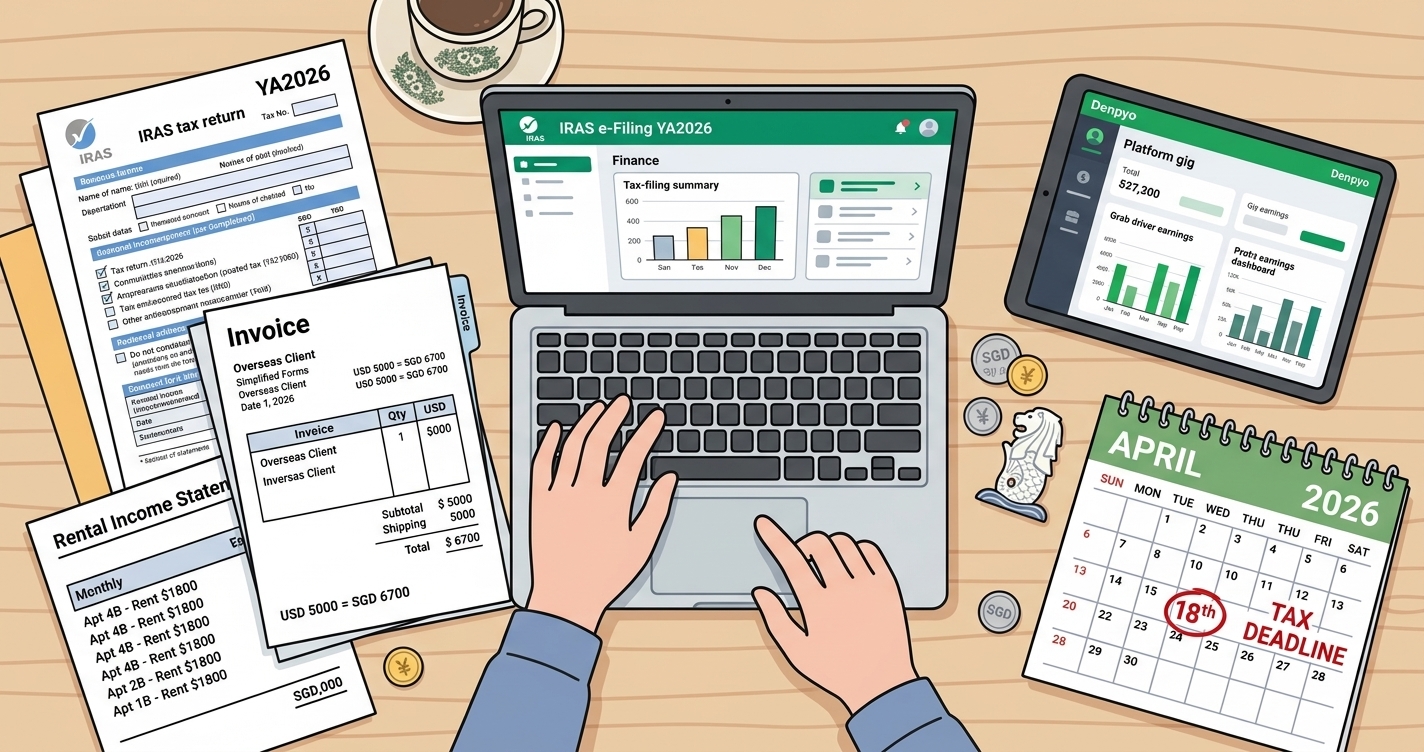
Disclaimer: This article is general guidance for Singapore tax residents with multiple sources of income during Year of Assessment 2026 (income earned in 2025). It is not tax or legal advice. Always confirm your specific situation with the Inland Revenue Authority of Singapore (IRAS) or a qualified tax adviser before filing. E-filing for YA2026 closes on 18 April 2026.
The reality of modern Singapore careers
A 2025 MOM workforce survey estimated that roughly 1 in 10 Singapore residents earn income from more than one source each year — salaried employees moonlighting on Upwork and Carousell, GrabFood riders with a day job, property owners renting out a spare room, and founders taking director's fees alongside their main business. IRAS is perfectly fine with this. What it is not fine with is missing streams on your return.
All income streams received by the same tax resident individual are aggregated onto a single tax return (Form B for self-employed, Form B1 for employed individuals with additional non-employment income). They then pass through one progressive rate table, one set of personal reliefs, and one assessment. Miss a stream and you can trigger a 200% penalty under Section 95 of the Income Tax Act in addition to the tax due.
What counts as a separate income stream
For YA2026, IRAS recognises these common stream types:
- Employment income — salary, bonus, stock options, allowances, benefits-in-kind (typically reported via the Auto-Inclusion Scheme, or AIS).
- Trade, business, profession or vocation income — freelance fees, consulting, coaching, platform work, e-commerce, influencer deals.
- Rental income from Singapore property, net of deductible expenses (property tax, mortgage interest, agent fees, repairs).
- Dividend and interest income — most Singapore-sourced dividends are exempt, but foreign dividends remitted into Singapore may be taxable depending on circumstances.
- Royalty, annuity and estate/trust distributions.
- Overseas income received in Singapore — usually exempt for individuals, but with important exceptions for partnerships.
- Director's fees — taxed on a receipt basis rather than accrual.
Step 1 — Map each stream to the right section
Open your Form B/B1 in myTax Portal and confirm the four relevant groups:
- Section “Employment”: pre-populated from employer AIS. Cross-check your IR8A.
- Section “Trade, Business, Profession or Vocation”: freelance, gig, platform and sole-proprietor income.
- Section “Other Income”: rental, royalties, annuities, commissions.
- Section “Reliefs”: Earned Income Relief, CPF/MediSave reliefs, Parenthood, NSman, Course Fees, etc.
Each section has its own rules for what expenses you can deduct before the income flows into the progressive rate table.
Step 2 — Consolidate your self-employment income correctly
If your combined revenue from self-employment (freelance + gig + e-commerce) is under S$200,000 for the year, you file a 2-line statement (Revenue, Adjusted Profit). Above S$200,000 you need a 4-line statement (Revenue, Gross Profit, Allowable Business Expenses, Adjusted Profit). IRAS explains both formats in its reporting income guide.
Key rules for YA2026:
- One aggregated trade profit figure — you cannot report each platform separately; combine Upwork + Fiverr + Grab + your own clients into one P&L.
- Business expenses must be wholly and exclusively incurred to earn the income (mirrors the HK test but is a separate Singapore concept).
- Capital expenditure goes through capital allowances, usually three-year straight line, or Enhanced IA for eligible items.
- GST-registered sole proprietors file income net of output GST collected, which is paid separately on their GST return.
Step 3 — Handle employment + freelance carefully
This is the most common scenario. Your employer already reports your salary via AIS, so that part is pre-filled. Your freelance P&L sits separately. Three traps to avoid:
- Do not double-claim CPF relief. Your employer CPF contributions are already deducted through the AIS entry. Only claim additional voluntary CPF or MediSave contributions you made as a self-employed person.
- Watch the Earned Income Relief cap. The cap applies to the combined earned income figure (employment + trade). You won't double the relief by having two streams.
- Benefits-in-kind (e.g., company laptop) that you also use for your side business. You cannot deduct the laptop's “cost” against freelance income because it was never your expense.
Step 4 — Rental income done right
Singapore gives rental landlords two options: deduct actual deductible expenses, or claim 15% of gross rent as a simplified deemed expense (plus mortgage interest, which is separately deductible). Most multi-stream filers with a single rental pick the 15% route because it eliminates receipt tracking.
If you are renting out a room (not the whole unit) and continue to live in the property, you can still deduct proportionate expenses but the 15% option is tighter — check the IRAS rental income guide.
Step 5 — Overseas income, remittance and tax residency
Foreign-sourced income received in Singapore by a resident individual is generally exempt under Section 13(7A), except income received through a partnership. So if a Singapore tax-resident freelancer invoices a US client and receives payment directly into their Singapore bank, that income is still treated as Singapore-sourced if the work was performed in Singapore — it is not “foreign-sourced”. The exemption is narrower than many people think. When in doubt, report and apply relief.
Step 6 — Aggregate and apply the YA2026 progressive rates
After each stream is quantified, IRAS adds them up to produce chargeable income. The tax resident progressive rates for YA2026 remain:
- First S$20,000: 0%
- Next S$10,000: 2%
- Next S$10,000: 3.5%
- Next S$40,000: 7%
- Next S$40,000: 11.5%
- Next S$40,000: 15%
- Next S$40,000: 18%
- Next S$40,000: 19%
- Next S$40,000: 19.5%
- Next S$40,000: 20%
- Next S$180,000 up to S$500,000: 22%
- Next S$500,000 up to S$1,000,000: 23%
- Above S$1,000,000: 24%
These live in IRAS's official individual income tax rates schedule.
Step 7 — Worked example: Priya, a marketing manager moonlighting on Upwork
Priya is a Singapore citizen. YA2026 numbers:
- Employment: S$108,000 base, S$15,000 bonus (AIS pre-filled)
- Mandatory CPF (employee share, already deducted): S$24,000
- Freelance (Upwork copywriting): S$42,000 revenue, S$9,000 expenses
- Voluntary MediSave as self-employed: S$5,760 (under the S$37,740 Annual Contribution Cap)
- Rental of spare HDB room: S$18,000 gross, S$2,700 property tax + S$6,000 mortgage interest
- Foreign dividend received in SG (quarterly): S$1,200 (exempt)
Working through the return:
- Employment (post-CPF relief): S$123,000
- Trade (42,000 − 9,000): S$33,000
- Rental: 18,000 − (15% × 18,000 = 2,700) − 6,000 interest = S$9,300
- Foreign dividend: S$0 taxable
- Gross income subtotal: S$165,300
Reliefs claimed: Earned Income Relief S$1,000, CPF/MediSave S$5,760, Course Fees S$2,000, Parenthood S$4,000. Total reliefs: S$12,760.
- Chargeable income: S$152,540
- Progressive tax (0 + 200 + 350 + 2,800 + 4,600 + 6,000 + 7,200 + 890) ≈ S$14,640
Priya runs the same numbers in our free income tax calculator before filing to validate her liability and plan a MediSave top-up that would push her into a lower bracket.
Step 8 — Avoid the top five filing mistakes
- Forgetting to declare side-gig income because it arrived via PayNow to your personal account.
- Claiming freelance expenses that were really personal spending (phone, streaming subs, dining).
- Treating rental expenses at 100% when you also live in the property — you must apportion.
- Double-counting CPF contributions already in the employer AIS feed.
- Missing the 18 April e-filing deadline and incurring the S$200 late-filing fee under Section 94.
Record keeping for five years
IRAS requires you to keep all supporting records for five years from the Year of Assessment. For multi-stream filers, that means employment tax form (IR8A), invoices issued to clients, platform payout statements, rental agreements, mortgage statements, receipts for deductions, and bank statements showing the deposits. Paper or digital is fine as long as the records are complete, organised and legible.
How Denpyo fits into a multi-stream workflow
The biggest pain of multi-stream filing is pulling receipts and statements from five different apps, wallets and email inboxes once a year. Denpyo auto-captures receipts and invoices as you go, tags each one to the correct income stream (freelance, rental, personal) and holds digital copies for the full five-year IRAS retention. When April rolls around you export a clean summary per stream that slots straight into your 4-line or 2-line statement. Pair it with our free tax savings estimator to see how much top-up reliefs can shave off your YA2026 bill.
Key takeaways
- All income streams of one resident individual live on one tax return and pass through one progressive rate table.
- Employment, self-employment, rental, royalty and overseas income each have different deduction rules before aggregation.
- Do not double-claim CPF — employer CPF is already handled through AIS.
- Rental landlords can simplify with the 15% deemed expense option, plus mortgage interest.
- E-file before 18 April 2026 and keep records for five years.

Track expenses, maximize deductions
Denpyo scans your receipts and finds tax savings automatically.
More Articles
View All Articles
Capital Allowances in Malaysia: Claiming Your Laptop, Camera & Equipment (2026)
5 min read
CP500 Tax Instalments for Malaysian Freelancers 2026: Pay, Revise, Avoid Penalties
4 min read