
Singapore Tax Deadlines Calendar 2026: YA2026 Complete
Full calendar of Singapore tax deadlines for 2026. e-filing, GST, CPF, estimated tax, and key dates for self-employed and SMEs.
Disclaimer: This article provides general information about Singapore tax obligations. It is not professional tax, legal, or financial advice. For your specific situation, please consult a qualified tax advisor or certified public accountant. Disclosure: This article is published on the Denpyo blog. Denpyo provides receipt management and expense tracking services.
Introduction
Missing a tax deadline in Singapore can result in hefty fines (S$200–S$1,000 for late filing, plus 5% penalty on unpaid tax). For self-employed individuals and small-to-medium enterprises, staying on top of multiple deadlines — income tax, GST, CPF, estimated tax payments — is critical. This complete 2026 calendar lists every key date you need to know, from when myTax Portal opens (March 1) to filing deadline (April 18), quarterly GST filing dates, CPF payment schedules, and estimated tax due dates.
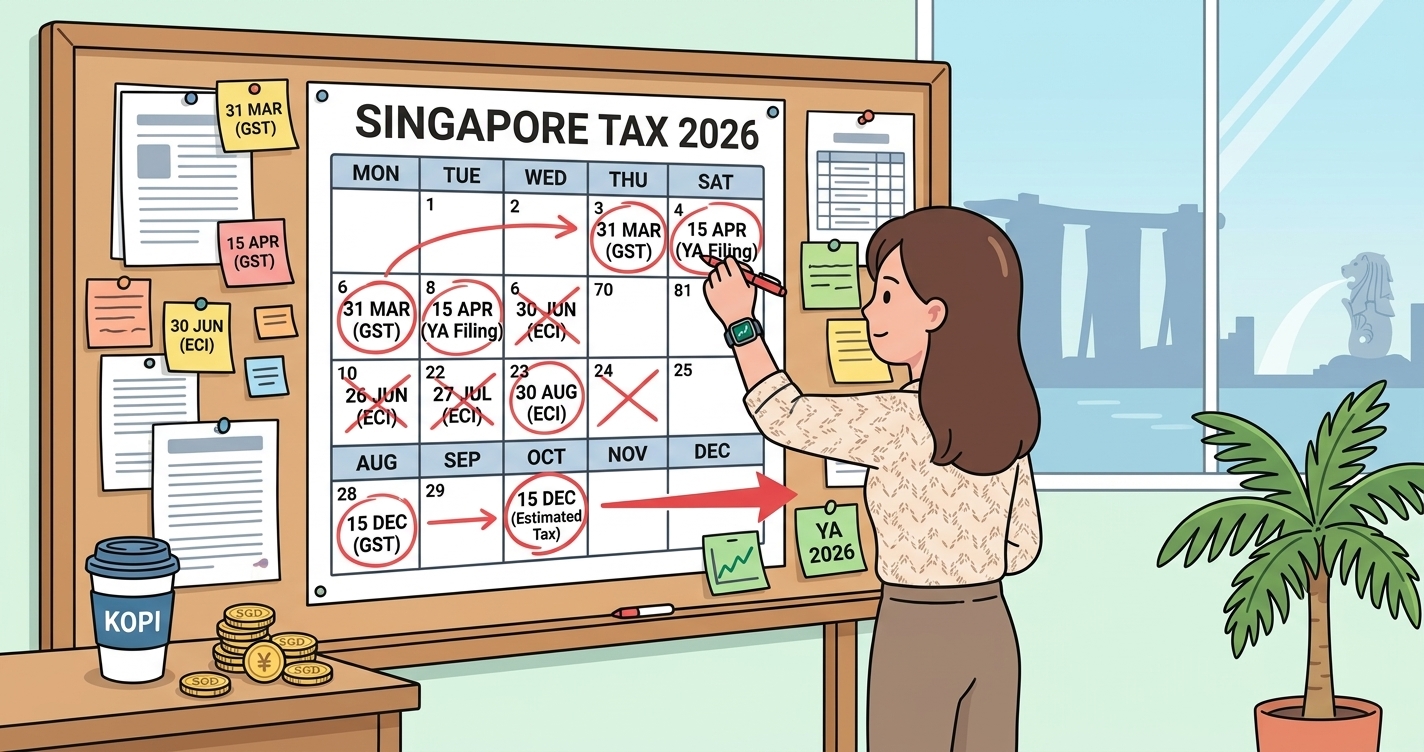
Singapore Tax Calendar 2026
Q1 2026: March – April (Income Tax Filing Season)
| Date | Deadline | Who It Affects | Action Required |
|---|---|---|---|
| 1 March 2026 | myTax Portal Opens | All self-employed & employees | Start preparing your tax return. Organize receipts and gather income documents. |
| 1 March 2026 | Form IR8A Distribution | Employees not in AIS | Employers must provide Form IR8A (employment income statement) by this date. |
| 18 April 2026 | Income Tax e-Filing Deadline | All individuals required to file | Submit your YA2026 tax return via myTax Portal. Late filing = S$200–S$1,000 penalty + 5% unpaid tax. |
| 15 April 2026 | Paper Filing Deadline | Those filing on paper (rare) | Must postmark by this date. Not recommended — e-filing is faster. |
| Mid-March 2026 | D-NOA (Direct Notice of Assessment) Issued | Auto-Inclusion Scheme (AIS) taxpayers | You'll receive your assessed tax bill directly. Review and pay if owed. |
| End April – Sept 2026 | NOA Issued (RFI & NFS Taxpayers) | Those who filed or are required to file | Check your notice. Verify amounts. Pay by the due date (1 month from NOA). |
Q2 2026: May – June
| Date | Deadline | Who It Affects | Action Required |
|---|---|---|---|
| 30 June 2026 | Bulk Extension Deadline (Tax Agents) | Those granted bulk extension | Tax agents can file on behalf of clients by this date if extension was approved. |
| Q2 (April–June) | GST Return Deadline (Quarterly) | GST-registered businesses with turnover S$1M+ | File GST return for Q2 (April–June) by the due date (usually end of month following quarter). |
Q3 2026: July – September
| Date | Deadline | Who It Affects | Action Required |
|---|---|---|---|
| Q3 (July–Sept) | GST Return Deadline (Quarterly) | GST-registered businesses | File GST return for Q3. InvoiceNow (e-invoicing) becomes mandatory for Phase 1 registrants by end of 2026. |
| End July 2026 | CPF Contribution Deadline (Self-Employed) | Self-employed persons | Ensure CPF contributions for Q2–Q3 are paid. Self-employed must contribute to CPF by specified dates. |
Q4 2026: October – December
| Date | Deadline | Who It Affects | Action Required |
|---|---|---|---|
| Q4 (Oct–Dec) | GST Return Deadline (Quarterly) | GST-registered businesses | File GST return for Q4. This is the final quarterly return for YA2026. |
| 31 Dec 2026 | Year-End Financial Records Deadline | All businesses | Close your books for YA2026. Finalize profit/loss, asset values, and prepare for next year's filing. |
| Ongoing (Monthly/Quarterly) | CPF Contributions Due | Self-employed persons | Make regular CPF contributions throughout 2026. Non-payment triggers penalties. |
Critical Dates at a Glance
YA2026 Income Tax Filing:
- myTax opens: 1 March 2026
- e-Filing deadline: 18 April 2026
- Paper filing deadline: 15 April 2026
- Late filing penalty: S$200–S$1,000 + 5% unpaid tax
GST (For Registered Businesses with S$1M+ Turnover):
- Q1 (Jan–Mar): Due end of April
- Q2 (Apr–Jun): Due end of July
- Q3 (Jul–Sep): Due end of October
- Q4 (Oct–Dec): Due end of January 2027
CPF Contributions (Self-Employed):
- Monthly/Quarterly installments throughout 2026
- Maximum deductible: S$7,257/year
- Non-payment penalties apply
What Is Estimated Tax & Do You Need to Pay It?
Estimated tax (also called Estimated Chargeable Income or ECI) is a pre-payment of tax you calculate yourself based on projected earnings. Most self-employed individuals in Singapore don't need to file for estimated tax unless you expect your chargeable income to exceed S$80,000 in the current year and you haven't been assessed yet. If required, contact IRAS for an estimated tax notice. Payment is usually due in 4 installments (Jan, Apr, Jul, Oct). If you're uncertain, consult your accountant.
Key Changes for 2026 Tax Year
Tax Rebate: A 60% tax rebate capped at S$200 will be granted to eligible residents for YA2026. This is automatically applied when your assessment is issued.
InvoiceNow (e-Invoicing) Mandate: GST-registered businesses must transition to InvoiceNow (PEPPOL) by the prescribed date. Phase 1 applies to businesses with annual turnover above S$5M (voluntary for new registrants starting April 2026). Ensure your systems are ready by Q2 2026.
Platform Workers (Gig Economy): Gig workers and platform workers (Grab, Foodpanda, etc.) will see changes to CPF requirements and filing obligations. Track your earnings carefully and register for CPF if self-employed.
Penalties for Missing Deadlines
| Offense | Penalty |
|---|---|
| Late Income Tax Filing (after 18 April) | S$200–S$1,000 + 5% of unpaid tax |
| Late GST Filing | S$500–S$2,500 + interest on unpaid GST |
| Late CPF Payment (Self-Employed) | Interest on overdue amount; potential legal action |
| Failure to Keep Records (5-year requirement) | Up to S$10,000 fine + criminal penalties |
| Inaccurate Deductions (Intentional Fraud) | Up to S$20,000 fine + 7 years imprisonment |
How to Stay on Top of Deadlines
1. Set Calendar Reminders: Mark all deadlines in your phone or computer calendar 2 weeks in advance. Don't rely on memory.
2. Create a Master Tax Checklist: For your business, list all filing obligations (income tax, GST, CPF, estimated tax). Review quarterly.
3. Organize Records Throughout the Year: Don't wait until March to gather receipts. Use Denpyo to log expenses as they happen, so when filing season arrives, your numbers are ready.
4. Consult an Accountant Early: If you're unsure about obligations or deadlines, book a consultation in Q4 2025 (before filing season) rather than waiting until March when they're busy.
5. Build in a Buffer: File 2–3 weeks before the deadline, not the day before. This gives you time to correct errors and resubmit if needed.
6. Track Estimated Tax Payments: If you're required to pay estimated tax, save the invoice and mark each payment date in your calendar as it comes due.
Frequently Asked Questions
Q: What happens if I miss the April 18 filing deadline?
A: You'll receive a late filing penalty of S$200–S$1,000, plus 5% of any unpaid tax. File immediately if you've missed the deadline to minimize penalties.
Q: Do I need to file if I earned less than S$6,000?
A: Self-employed individuals must file if they earned more than S$6,000 in chargeable income. Below that threshold, filing is optional (but you may want to claim rebates if eligible).
Q: When should I register for GST?
A: GST registration is mandatory if your annual turnover exceeds S$1 million. You should register within 30 days of reaching that threshold. Contact IRAS for GST registration.
Q: Can I extend the filing deadline?
A: Yes, but only through a tax agent filing for bulk extension by 30 June. Individual extensions are rarely granted. It's better to file on time.
Q: What documents do I need to keep for 5 years?
A: All receipts, invoices, bank statements, payroll records, and proof of business expenses. Keep them organized by category and year.
How Denpyo Helps Meet Deadlines
One reason people miss tax deadlines is disorganized financial records. Denpyo automatically captures and categorizes your receipts throughout the year, so when tax season arrives, you have a complete, organized expense report ready to file. You can generate monthly or quarterly summaries anytime, catch missing receipts early, and avoid the last-minute scramble to find documents. By tracking expenses digitally as they happen, you're always filing-ready.
Summary: Your 2026 Tax Deadline Checklist
- Mark 1 March (myTax opens) in your calendar NOW
- Mark 18 April (filing deadline) as your target submission date
- If GST-registered: Set quarterly filing deadlines (end of month following quarter)
- If self-employed: Track CPF contribution due dates (monthly/quarterly)
- Set a reminder for 30 March to review pre-filled myTax data
- Gather all 2025 income documents and expense receipts by 31 March
- Review the Denpyo tax savings estimator to forecast your tax liability
- File your YA2026 return by 18 April (don't wait until the last day)
- Within 1 month of receiving your NOA, pay any tax owed
- Keep all supporting documents for 5 years
- On 1 Jan 2027, start fresh with YA2027 record-keeping

Track expenses, maximize deductions
Denpyo scans your receipts and finds tax savings automatically.
More Articles
View All Articles
Capital Allowances in Malaysia: Claiming Your Laptop, Camera & Equipment (2026)
5 min read
CP500 Tax Instalments for Malaysian Freelancers 2026: Pay, Revise, Avoid Penalties
4 min read