
MyInvois RM1M Threshold 2026: Who Must Comply & How to Prepare
Malaysia's e-invoicing Phase 4 brings new requirements for businesses earning RM1M–RM5M annually. Here's what changed, who's affected, and how to prepare.
Disclaimer: This article provides general information about Malaysia’s MyInvois e-invoicing requirements and is for educational purposes only. It is not professional tax advice. Tax laws change frequently—always verify with a qualified tax advisor and the Inland Revenue Board of Malaysia (LHDN) for your specific situation.
Disclosure: Denpyo is a receipt digitization and expense tracking platform. This article may reference Denpyo’s features where relevant to the topic discussed.
The MyInvois RM1M Threshold: What Changed?
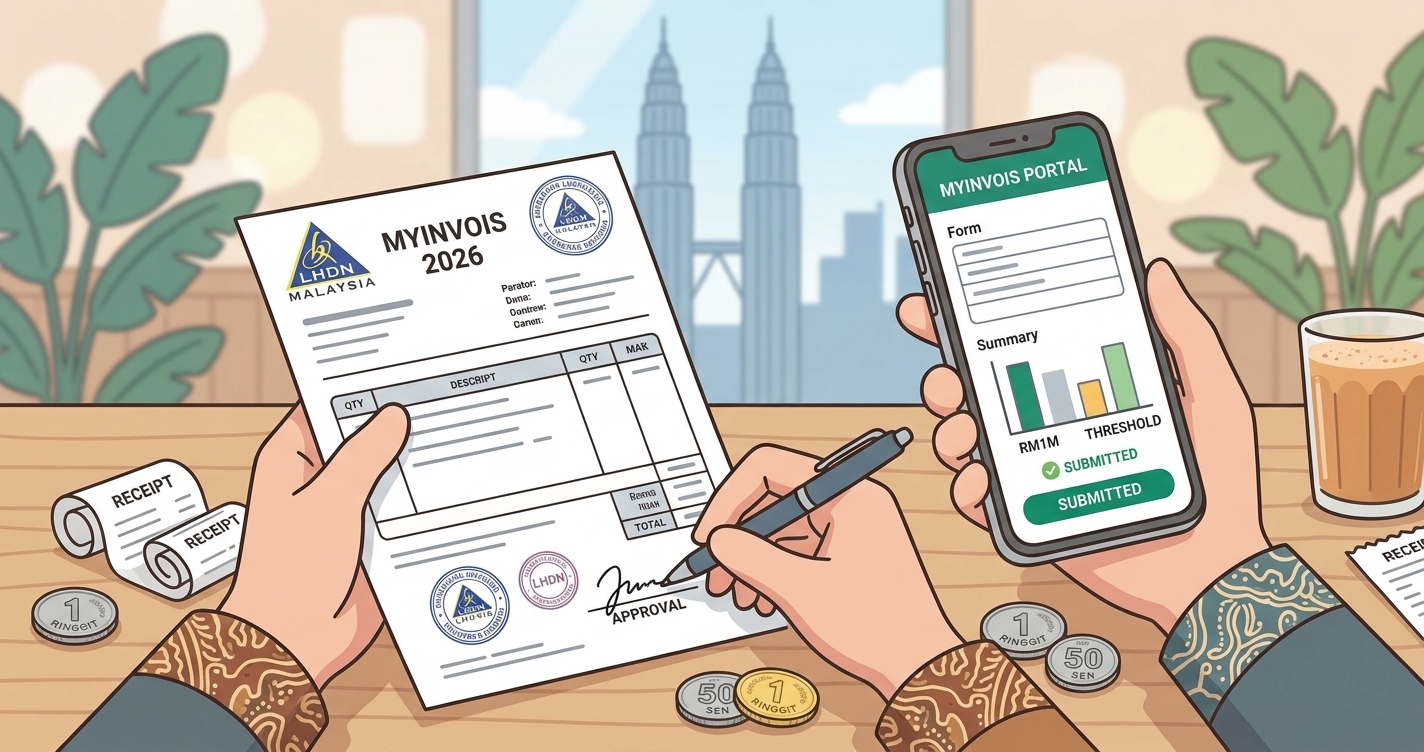
On 6 December 2025, Malaysia’s Cabinet approved a significant change to the country’s e-invoicing rollout. The minimum annual sales threshold for mandatory e-invoicing increased from RM500,000 to RM1 million. This means businesses earning less than RM1M are now fully exempt from the MyInvois requirement—a major relief for micro-businesses and sole proprietors.
However, if you earn between RM1M and RM5M annually, the change brings both good news and new obligations. Phase 4 of MyInvois takes effect on 1 January 2026, with a 12-month interim relaxation period running through 31 December 2026. During this period, penalties for non-compliance are suspended—but compliance is still mandatory.
Who Falls Into the RM1M–RM5M Bracket?
Phase 4 targets small and growing businesses that represent a critical segment of Malaysia’s economy: freelancers scaling up, small trading companies, professional services (consultants, accountants, lawyers), and service providers (contractors, digital agencies, e-commerce merchants).
Example: A digital marketing consultant earns RM2.5M annually from client fees. She invoices 15–20 clients monthly. Under Phase 4, starting 1 January 2026, every invoice must be submitted to MyInvois as an e-invoice (or consolidated e-invoice if fewer than 30 invoices daily). During 2026, she has until 31 December 2026 to achieve full compliance without penalty risk.
If you earned RM1M–RM5M in the preceding financial year, or you crossed RM1M in 2025 and expect to maintain that level, Phase 4 applies to you.
Phase 4 Requirements: What Must You Do?
1. Individual E-Invoices for Transactions Over RM10,000
Starting 1 January 2026, every transaction exceeding RM10,000 must be recorded as an individual e-invoice—no consolidated invoices allowed for large transactions. Transactions under RM10,000 can still be grouped into consolidated invoices.
2. Digital Certificate Requirement
All e-invoices must be digitally signed using a certificate issued by the Inland Revenue Board of Malaysia (LHDN). This ensures data integrity and authenticity. LHDN provides guidance on obtaining digital certificates on its portal.
3. 55 Mandatory Data Fields
Each e-invoice must include specific data fields covering:
- Seller and buyer details (name, registration number, address)
- Transaction date and invoice number
- Item descriptions, quantities, unit prices
- Tax calculations (Sales & Service Tax / SST breakdown)
- Payment terms and total amount due
- Currency denomination
4. Submission to MyInvois
Two options:
- Free MyInvois Portal: Suitable for businesses issuing fewer than 30 invoices daily with no ERP/POS system. Upload invoices manually through the web interface.
- API Integration: Connect your accounting software, ERP, or billing system directly to MyInvois via application programming interface for real-time, automated submissions.
Phase 4 vs. Previous Phases: A Comparison
Phase 1 (Aug 2024): Businesses >RM100M
Immediate compliance required. Penalties applied from day one.
Phase 2 (Jan 2025): Businesses RM25M–RM100M
Full compliance enforced. 6-month interim relaxation period expired.
Phase 3 (Jul 2025): Businesses RM5M–RM25M
Full compliance enforced. Interim relaxation period expired.
Phase 4 (Jan 2026): Businesses RM1M–RM5M — NEW 12-Month Relaxation
Mandatory e-invoicing begins, but penalties are suspended until 1 January 2027 if you demonstrate "reasonable efforts to comply." This extended grace period is unique to Phase 4.
Below RM1M: Fully Exempt
Unless your business is a subsidiary or related entity of a RM1M+ company—in which case you must comply from 1 July 2026.
Preparation Checklist for Phase 4 Compliance (2026)
Now (Before 31 Dec 2025):
- Verify your 2024 turnover to confirm Phase 4 eligibility
- Audit your current invoicing process (manual spreadsheets vs. software)
- Check if your accounting software supports MyInvois API integration (Xero, QuickBooks Online, Zoho Books, FreshBooks all have plugins)
- Obtain your digital certificate from LHDN or an approved certificate provider
- Test the MyInvois portal with a few sample invoices
1 Jan – 30 Jun 2026 (Interim Relaxation):
- Begin submitting all qualifying invoices to MyInvois (individual >RM10K, consolidated <RM10K)
- Monitor submission confirmations and error logs
- Train your team on the new process
- Set up backup procedures (e.g., manual uploads if API integration fails)
- Maintain detailed records of submission attempts (proof of "reasonable effort")
1 Jul – 31 Dec 2026 (Final Preparation):
- Resolve any outstanding submission errors
- Ensure 100% compliance by year-end
- Audit invoice records and digital signatures
- Review LHDN MyInvois FAQs for updates
Common Mistakes to Avoid
Mistake 1: Assuming Below RM1M = No e-Invoicing Ever
If you’re currently below RM1M but expect to grow, plan ahead. Once you cross RM1M, you have a 12-month grace period but must begin submissions immediately. Delayed action risks penalties from 1 January 2027.
Mistake 2: Consolidating All Small Invoices Without Checking Phase 4 Rules
Phase 4 requires individual e-invoices for transactions >RM10K, regardless of how many you issue daily. Consolidation is only for transactions under RM10K.
Mistake 3: Neglecting the Digital Certificate
Without a valid digital certificate, your e-invoices cannot be signed and submitted. Obtain and store it securely before 1 January 2026.
Mistake 4: Relying on Manual Uploads for High Invoice Volume
If you issue 30+ invoices daily, API integration is more efficient and reduces submission errors. Invest in accounting software integration now.
How Denpyo Helps Phase 4 Businesses
Denpyo automatically categorizes your scanned receipts and expenses into the tax-deductible categories recognized by LHDN, helping you maintain clean financial records. When preparing for MyInvois submissions, organized expense data ensures your invoice totals are accurate and auditable. Use Denpyo to track all business expenditures (supplies, services, equipment, professional fees) throughout 2026—this strengthens your compliance posture and supports your tax filing when the time comes.
Key Takeaways: Phase 4 Readiness
- ✓ RM1M–RM5M businesses must comply with Phase 4 starting 1 January 2026
- ✓ 12-month interim relaxation period (2026) suspends penalties—but compliance is mandatory
- ✓ Individual e-invoices required for transactions >RM10K; consolidation allowed for <RM10K
- ✓ Two submission methods: free MyInvois portal (manual) or API integration (automated)
- ✓ Obtain your digital certificate and test MyInvois before 31 December 2025
- ✓ If you cross RM1M during 2025–2026, start Phase 4 compliance on day one of exceeding the threshold
- ✓ Track expenses meticulously in 2026 to support MyInvois submissions and tax deduction claims
Ready to audit your 2024 turnover and prepare for Phase 4? Use Denpyo's expense checker to validate your deductible business costs, and our income tax calculator to forecast your 2026 tax position. Preparation starts now.
Track expenses, maximize deductions
Denpyo scans your receipts and finds tax savings automatically.