
How to Hold Over Provisional Profits Tax in Hong Kong (2026 Guide)
If your income is falling, you can apply to reduce or defer Hong Kong's provisional profits tax. Learn the 90% rule, the deadline, Form IR1121, and the records you need.
This article is general information for freelancers and small businesses, not professional tax advice. Provisional tax rules are administered by the Inland Revenue Department (IRD). Confirm your own position with the IRD or a qualified tax adviser before applying.
If you are a Hong Kong sole proprietor or freelancer, your tax demand note can come as a shock: it asks you to pay tax on profits you have already earned plus a "provisional" amount for the year ahead. When you expect to earn less this year, paying provisional tax in full can squeeze your cash flow unnecessarily. The good news is that you can apply to hold over (reduce or defer) your provisional profits tax — if you act within the deadline and meet one of the recognised grounds. This guide explains when and how.
What provisional profits tax is
Hong Kong charges Profits Tax on business profits — 7.5% on the first HK$2 million of assessable profits and 15% above that for unincorporated businesses such as sole proprietorships. Because tax is collected partly in advance, when the IRD assesses your 2025/26 profits it also raises a provisional charge for 2026/27, usually based on the profits it just assessed. You typically pay in two instalments, with the larger first instalment commonly due around January 2027.
This works smoothly when your income is stable. But if your business slows, you have effectively prepaid tax on profits you may never make. That is exactly what a holdover application addresses.
Grounds for holding over
You cannot hold over provisional tax simply because you would rather not pay. The IRD accepts an application on specific grounds, the most common being:
- The 90% rule (lower profits): your assessable profits for 2026/27 are, or are likely to be, less than 90% of the profits for the preceding year (or of the provisional amount charged). This is the usual ground for freelancers whose income has dropped.
- Cessation or reduced activity: you have stopped or will stop your business, or scaled it back, before the end of the year of assessment.
- Pending objection: you have lodged an objection against the assessment for the preceding year on which the provisional tax is based.
- New or increased deductions/allowances: for example, losses brought forward that were not taken into account.
- Electing personal assessment: where doing so would reduce your overall liability.
The deadline — do not miss it
An application to hold over provisional tax must be made in writing and lodged no later than the later of:
- 28 days before the due date of the provisional tax payment; or
- 14 days after the date the provisional tax demand note was issued.
Miss the window and you generally must pay first; holdover is not guaranteed afterward. If your first instalment is due in January 2027, the practical time to prepare and lodge is late 2026 — which is why getting your accounts in order well before then matters.
How to apply
There are two routes:
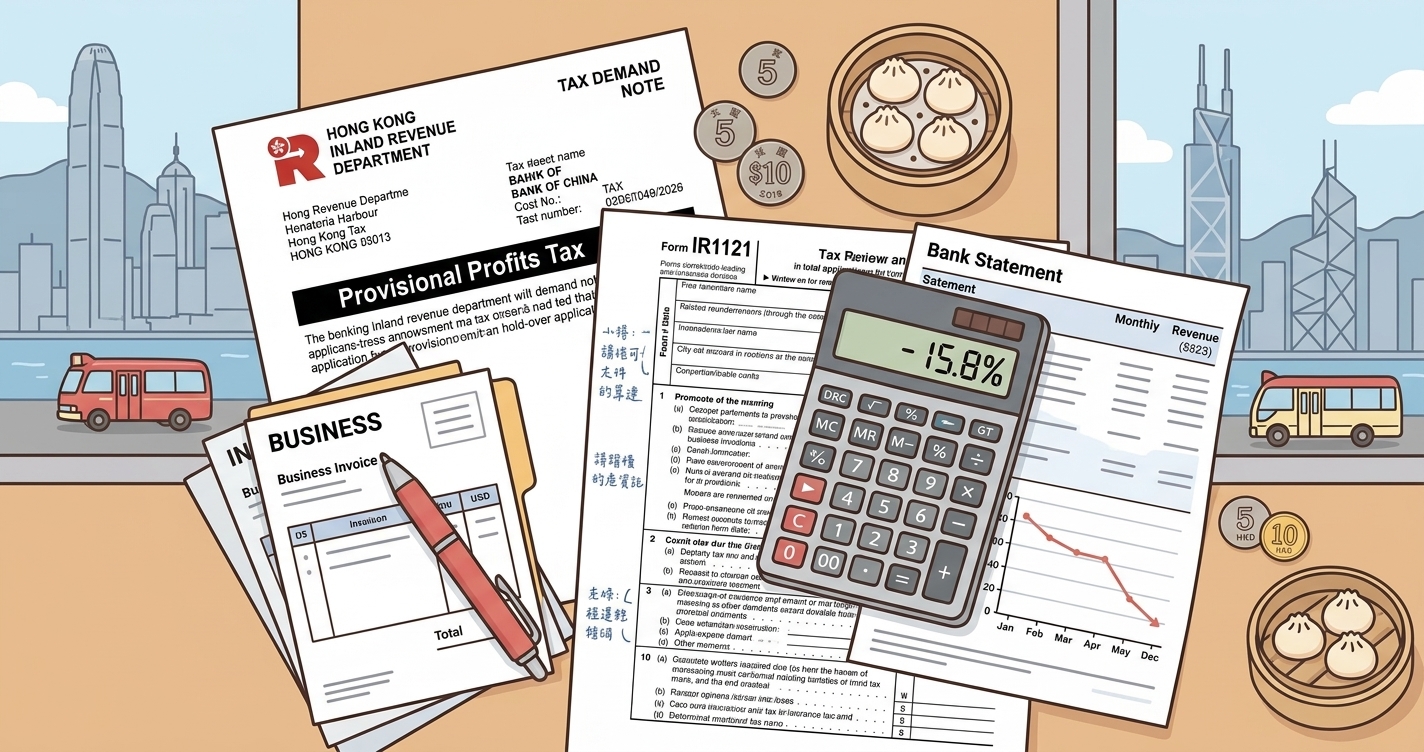
- Form IR1121: download the "Application for Holdover of Provisional Tax" from the IRD website, complete your details, state your estimated profits for 2026/27, and tick the ground(s) you are relying on. Submit by post or fax to the IRD.
- Online via eTAX: if you hold an eTAX/"Tax Position" account, you can submit the holdover application electronically and receive an instant acknowledgement.
For a 90%-rule application based on falling profits, the IRD generally expects you to show your working. Supporting documents such as properly signed draft accounts covering a period of not less than eight months of the year, together with a computation demonstrating the drop of more than 10%, make approval far more likely. Full details of the IRD process are set out on GovHK.
A worked example
Suppose May runs a freelance design studio. Her 2025/26 assessable profits were HK$600,000, so the IRD raises provisional tax for 2026/27 on that figure. In 2026/27 a major client leaves and she estimates profits of only HK$480,000 — a fall of 20%, comfortably more than the 10% needed.
- Because HK$480,000 is less than 90% of HK$600,000 (HK$540,000), May qualifies under the 90% rule.
- She prepares eight-month draft accounts, completes Form IR1121 with her HK$480,000 estimate, and lodges it before the deadline.
- If approved, her provisional tax is recalculated on the lower estimate, easing her cash flow until the final 2026/27 assessment trues everything up.
To sanity-check the numbers, a quick run through an income tax calculator helps you see the rough liability before you file the estimate.
Why clean records make or break your application
A holdover application lives or dies on evidence. To produce credible eight-month draft accounts at short notice, you need every invoice issued and every deductible expense captured and categorised — not buried in a drawer. The same records also let you confirm which costs are genuinely deductible against your assessable profits.
This is where digital record-keeping earns its keep. Tools like Denpyo let you photograph receipts and invoices as they arrive, automatically extracting the date, amount, vendor, and category, so your books are close to assessment-ready all year. When the provisional demand lands, you are compiling draft accounts in hours, not scrambling for weeks.
Summary
Provisional profits tax is a prepayment, not an extra tax — and if your income is falling you do not have to overpay. Apply to hold over on the 90% rule (or another accepted ground), in writing, by the later of 28 days before the due date or 14 days after the demand note, using Form IR1121 or eTAX, and back it with at least eight months of draft accounts. Keep your records current throughout the year, and confirm the latest requirements on the IRD website before you lodge.

Track expenses, maximize deductions
Denpyo scans your receipts and finds tax savings automatically.