
10 Common Tax Mistakes Hong Kong Freelancers Make in 2026 (And How to Avoid Them)
From missing BIR60 deadlines to under-claiming allowable deductions, these are the costliest tax mistakes Hong Kong freelancers and SME owners make — and practical fixes for each.
Disclaimer: This article provides general guidance for Hong Kong freelancers and small business owners based on publicly available Inland Revenue Department (IRD) information. It is not professional tax advice. Tax rules change, and individual circumstances vary — consult a licensed Hong Kong tax advisor or the IRD for advice specific to your situation.
Why tax mistakes hurt Hong Kong freelancers more than they realise
Hong Kong has one of the simplest profits tax regimes in Asia — 7.5% on the first HK$2 million of assessable profits and 15% above that, with no GST or VAT to worry about. But simple does not mean foolproof. Every year, the IRD issues compound penalties, additional tax assessments, and field audit notices to freelancers and sole proprietors who made preventable errors. The good news: most of these mistakes fall into a predictable set of patterns, and once you know them, avoiding them takes minutes, not hours.
This guide walks through the ten most common tax mistakes we see among Hong Kong freelancers and SMEs in the 2025/26 year of assessment — from missed deadlines to under-claimed deductions — and gives you a practical fix for each. Whether you run a design studio, consult independently, or operate a two-person trading company, these are the traps worth knowing before you file.
Mistake 1: Missing the BIR60 filing deadline
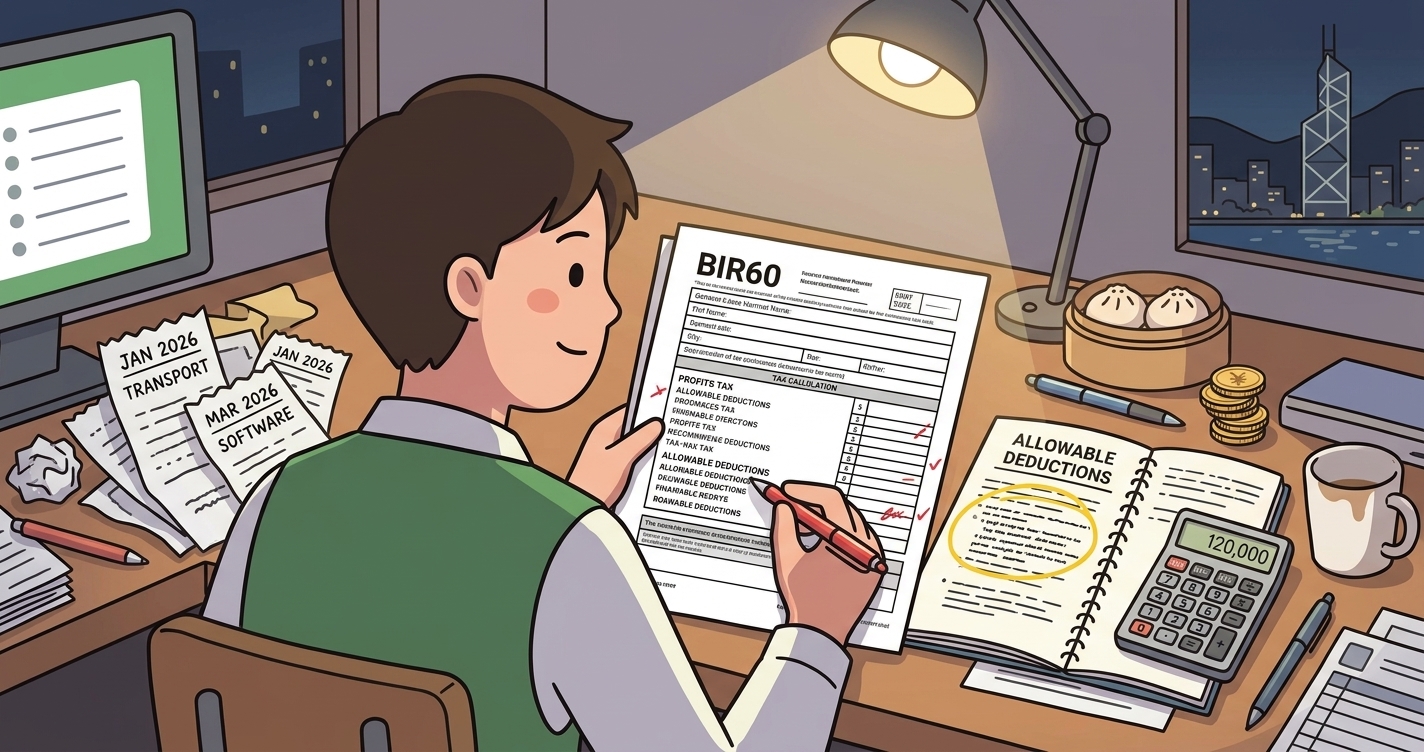
Hong Kong's tax year runs 1 April to 31 March. The IRD typically issues Individual Tax Return BIR60 forms on the first working day of May. For sole proprietors, the filing deadline is usually extended to early August (with an extra one-month extension available for e-filing via eTAX), but many freelancers still miss it — either because they confuse the deadline with their calendar-year bookkeeping or because they assume filing is optional below a certain income threshold.
The fix: Set two calendar reminders — one when BIR60 arrives in May, another two weeks before your deadline. If you think you may miss it, request an extension before the due date via the IRD's online services. Late filing incurs a fine up to HK$10,000 plus potential additional tax assessed at 3× the tax undercharged. See the IRD's Completion of Tax Return guide for deadline specifics.
Mistake 2: Forgetting that "no tax bill" doesn't mean "no filing obligation"
A surprising number of freelancers assume that if their assessable profits are below the personal allowance threshold, they don't need to file. That is wrong. Once BIR60 is issued, you must complete and return it within the stated period, regardless of whether you owe any tax. The IRD uses the return to determine your allowances and carry-forward positions, not just to collect tax.
The fix: If you receive BIR60, file it. Even a "nil" return protects you from penalties and preserves your record-keeping position with the IRD.
Mistake 3: Under-claiming allowable business expenses
This is probably the single biggest money-losing mistake in Hong Kong. The IRD allows deduction of expenses "incurred in the production of chargeable profits" — a broad standard covering everything from co-working space fees and cloud software subscriptions to client entertainment and MTR fares to meetings. But many freelancers claim only the obvious (rent, phone bill) and skip categories they could legitimately deduct.
Commonly missed deductions include:
- Home office portion of rent, electricity, and broadband if you work from home regularly
- Professional memberships (HKICPA, HKIA, industry associations)
- Continuing education directly related to your current trade (courses, certifications, conferences)
- Travel between client sites (taxi, MTR, ferry receipts)
- Depreciation (capital allowance) on laptops, cameras, office furniture
- Bank charges on your business account and merchant processing fees
- Mandatory Provident Fund (MPF) contributions as a self-employed person, up to HK$18,000 per year
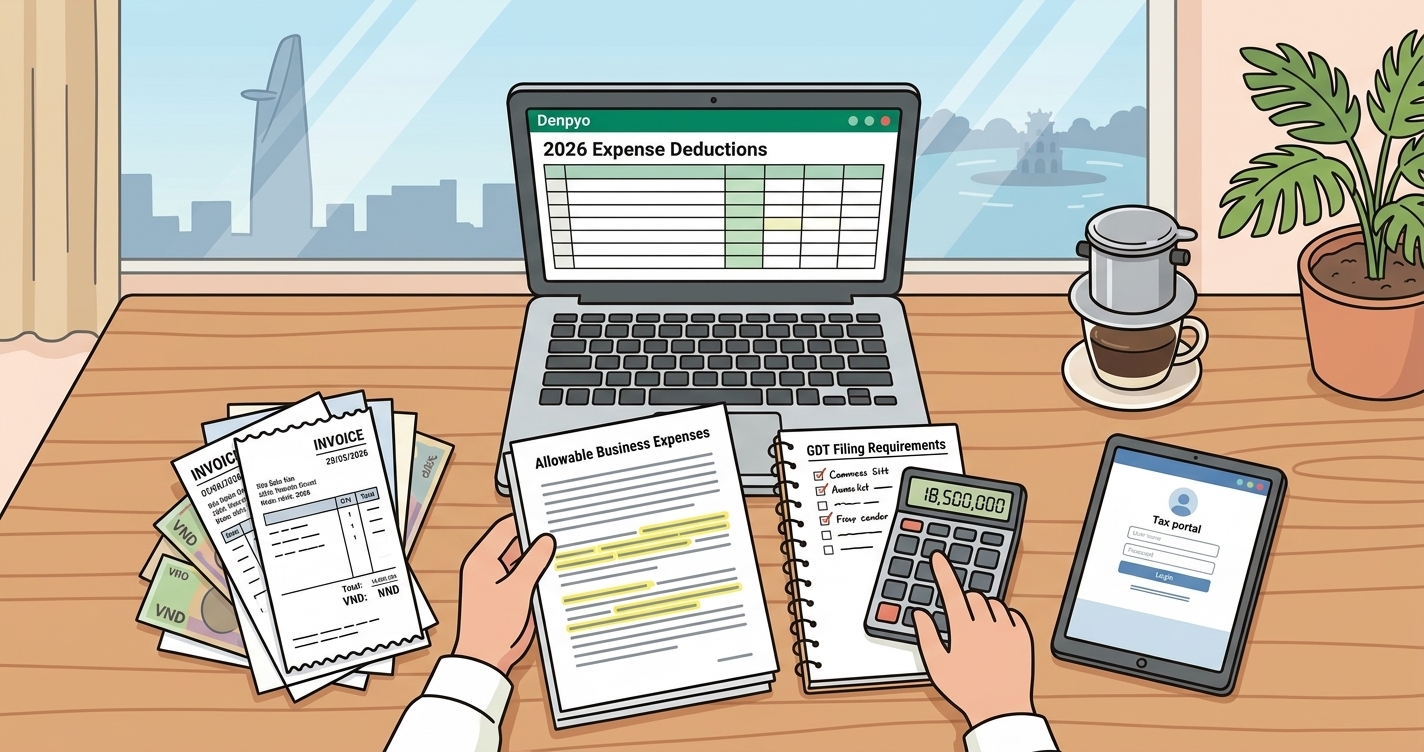
The fix: Build a simple monthly checklist of expense categories and run through it before each filing. Tools like Denpyo can auto-extract vendor, date, amount, and category from receipt photos, making it easier to capture small expenses you would otherwise forget. Our free expense deductibility checker also walks you through whether a specific expense is likely to qualify.
Mistake 4: Mixing personal and business bank accounts
The IRD can request bank statements during an audit, and if your business income flows into the same account as your personal salary, rent payments, and grocery spending, untangling what is and isn't business-related becomes painful — and expensive if you pay an accountant to do it for you.
The fix: Open a dedicated business account (HSBC Business, ZA Business, Statrys, WeLab, and others offer freelancer-friendly options). Route all client payments in and all business expenses out through that account. It is also strong evidence of a "separate trade" if IRD ever questions whether your activity is a business at all.
Mistake 5: Losing receipts or keeping them only as paper
Hong Kong requires you to retain business records for at least 7 years under section 51C of the Inland Revenue Ordinance. Thermal paper receipts — the kind you get from taxis, cafes, and most retail — fade in as little as 12 months. If the IRD requests substantiation during an audit and your receipts are illegible, the deduction can be denied.
The fix: Digitise every business receipt within a week of receiving it. A photo on your phone with a clear timestamp is acceptable to IRD as long as the image is readable. Store the digital copies in a backed-up system (cloud drive, receipt app, or accounting software) and organise them by year of assessment. See our 7-year record keeping guide for detailed best practices.
Mistake 6: Ignoring provisional tax
After your first year of assessable profits, the IRD will issue a provisional profits tax demand estimated on the previous year's figures. This catches many new freelancers by surprise because it can effectively double the bill in year two — you pay last year's final tax plus next year's provisional tax in the same demand note.
The fix: As soon as you receive your first tax demand, set aside 25–35% of new income each month as you earn it. If your next year's income will be materially lower (e.g., you're winding down or taking parental leave), you can apply to hold over provisional tax by filing Form IR1121 before the due date.
Mistake 7: Misclassifying capital vs revenue expenditure
You generally can't deduct the full cost of a laptop, camera, or piece of equipment in the year of purchase — instead, you claim depreciation allowance over the asset's useful life (initial allowance 60% plus annual allowance). Claiming the full HK$20,000 laptop as a revenue expense is a common error that flags the return for review.
The fix: Keep a simple asset register: date purchased, item, cost, and allowance category. The IRD's Profits Tax guide lists standard depreciation rates. If in doubt, your accountant can classify it correctly at year-end.
Mistake 8: Not claiming MPF self-employed contributions
If you are a sole proprietor earning HK$7,100+ per month, MPF contributions are mandatory — yet many freelancers either don't know or simply don't pay. Beyond the compliance issue, you're also missing a tax deduction worth up to HK$18,000 per year.
The fix: Register with an MPF trustee (HSBC, Manulife, AIA, and many others offer self-employed plans), contribute the minimum 5% of your relevant income, and claim the deduction on BIR60 Part 5.
Mistake 9: Treating Hong Kong-source and offshore income the same way
Hong Kong operates on a territorial source principle — only profits arising in or derived from Hong Kong are chargeable to profits tax. Freelancers serving overseas clients from a Hong Kong base often incorrectly assume all their income is automatically taxable, while others incorrectly assume none of it is.
The actual answer depends on where the work is performed, where contracts are negotiated, and where the service is delivered. For most digital freelancers physically working in Hong Kong, income is Hong Kong-sourced regardless of client location.
The fix: Document where you physically worked, where you signed contracts, and where deliverables were produced. If you genuinely travel and work from overseas for material periods, consult a Hong Kong tax advisor about offshore claim procedures — this is complex territory and DIY claims are frequently challenged.
Mistake 10: Using gross invoices instead of assessable profits
Profits tax is calculated on net income — gross revenue minus allowable expenses — not gross invoices. Freelancers sometimes report gross fees received on BIR60 Part 5 without deducting costs, dramatically overstating tax liability.
The fix: Maintain a simple profit and loss statement for the tax year. Report gross income, then subtract each category of allowable expense, arriving at assessable profits. Our free tax savings estimator can help you see how deductions translate into real tax reduction.
A quick checklist before you file BIR60
- Have you filed on time, or requested an extension before the deadline?
- Did you include all income sources — client invoices, platform earnings, one-off consulting?
- Did you claim every allowable expense category?
- Is your home office portion calculated reasonably (typically floor-area basis)?
- Do you have digitised receipts backing every claimed expense?
- Are capital items going into depreciation, not expensed in full?
- Did you claim your MPF self-employed contribution?
- Have you set aside cash for provisional tax?
How Denpyo helps
Most of the mistakes above share a common root cause: scattered, incomplete, or illegible records. Denpyo helps Hong Kong freelancers and SME owners photograph receipts as they receive them — our AI extracts vendor, date, amount, category, and tax breakdown in seconds, and stores everything in a format that works for both your own bookkeeping and any IRD substantiation request. No more shoebox of faded thermal paper, no more guessing categories in August when the deadline is two weeks away.
Summary
Hong Kong's tax system rewards freelancers who stay organised. File BIR60 on time, claim every allowable deduction, keep digital copies of every receipt for 7 years, understand the difference between revenue and capital expenditure, and don't forget MPF. If you do those six things consistently, you will pay the right amount of tax — no more, no less — and sleep better during filing season. Start by checking whether your next expense is deductible with our free expense checker, and consider how a receipt-scanning workflow could save you hours every month.

Track expenses, maximize deductions
Denpyo scans your receipts and finds tax savings automatically.