
Year-Round Tax Planning for Hong Kong Freelancers: Maximize Your Deductions Before March 31
Most Hong Kong freelancers only think about taxes when the BIR60 arrives in May—by which point the best planning opportunities have passed. This guide shows you how to build year-round habits that legally reduce your profits tax bill.
Disclaimer: This article is for general informational purposes only and does not constitute professional tax or legal advice. Hong Kong's profits tax is administered by the Inland Revenue Department (IRD). Tax rules change regularly—always consult a qualified Hong Kong tax professional before making financial decisions based on this content.
Why Most Freelancers Leave Money on the Table
Every May, Hong Kong's Inland Revenue Department issues BIR60 tax forms to self-employed individuals. And every May, thousands of freelancers scramble to reconstruct a year's worth of receipts, invoices, and expense records—often missing legitimate deductions they could have claimed if they'd planned ahead.
The reality is that year-round tax planning isn't just for corporations. As a freelancer or sole proprietor in Hong Kong, the difference between reactive and proactive tax management can easily amount to thousands of dollars in legitimate savings. With profits tax rates of 7.5% on the first HK$2 million of assessable profits (and 15% above that), even modest improvements to your deduction tracking can move real money.
This guide walks you through a practical, quarterly framework for keeping your tax position optimized throughout the entire Hong Kong tax year—April 1 to March 31.
Understanding the Hong Kong Tax Year Timeline
Before building a planning framework, it's important to internalize Hong Kong's unique tax calendar. Unlike most countries, Hong Kong's financial year runs April 1 to March 31—not the calendar year.
- April 1: New tax year begins. Any income earned from this date counts toward the 2026/27 assessment (if you're reading this in April 2026).
- May–June: IRD issues BIR60 individual tax return forms. E-filing deadline is typically 1 month from issue date, with extensions available via the eTAX portal.
- November–January: Most freelancers receive their tax assessment notice and provisional tax demand.
- January & April: Tax payment due dates (provisional tax is split across two installments).
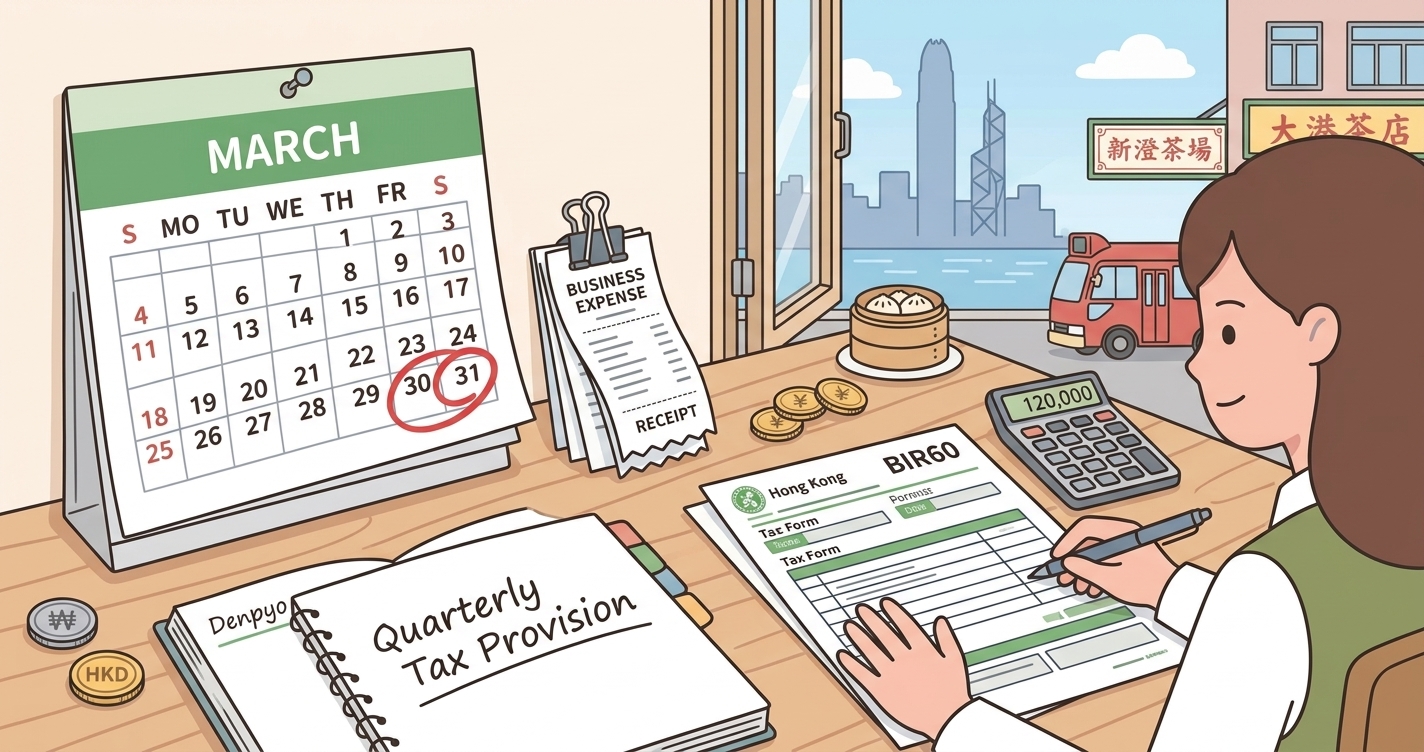
- March 31: Tax year closes. This is your last chance to make qualifying expenditures that reduce the current year's assessable profits.
Understanding this timeline is the foundation of good planning. Every business decision—from buying a new laptop to prepaying professional subscriptions—carries a different tax implication depending on whether it lands before or after March 31.
The Deductions Most Hong Kong Freelancers Miss
Under the Inland Revenue Ordinance, self-employed individuals can deduct expenses that are "wholly, exclusively, and necessarily" incurred in earning their assessable profits. The IRD's profits tax guidance lists the key categories, but in practice many freelancers claim only the obvious ones.
Professional Services and Subscriptions
Fees paid to accountants, solicitors, and tax advisors for business purposes are fully deductible. So are professional software subscriptions—design tools, project management platforms, cloud storage, and creative tools used for client work. Many freelancers pay these annually; timing your renewal before March 31 rather than in April gives you a deduction in the current year rather than the next.
Equipment and Capital Allowances
Hong Kong does not allow an immediate deduction for capital expenditure (equipment, computers, cameras, etc.) in most cases. Instead, you claim a depreciation allowance over time under Schedule 3 of the Inland Revenue Ordinance. However, for qualifying machinery and plant, you may be eligible for:
- Initial allowance: 60% of cost in the year of purchase
- Annual allowance: 10–30% of the reducing value each year
This makes the timing of equipment purchases strategically important. Buying a HK$15,000 laptop in March 2026 instead of April 2026 gives you the initial 60% allowance (HK$9,000) in your 2025/26 assessment rather than 2026/27.
MPF Contributions
If you're self-employed, you're required to make Mandatory Provident Fund (MPF) contributions—but they're also fully tax-deductible up to a maximum of HK$18,000 per year. Voluntary contributions above the mandatory amount are deductible up to a combined limit of HK$60,000 per year under tax-deductible voluntary contributions (TVC) schemes. If you haven't reached this ceiling, topping up your MPF before year-end is both a retirement investment and a tax reduction.
Home Office Expenses
If you work from home and have a dedicated workspace, you can claim a proportionate share of rent, rates, and utilities. The proportion is calculated based on the floor area used for business. Document this carefully—keep floor plan sketches, photos, and utility bills to support the claim.
Business Travel and Client Entertainment
Travel directly related to earning income (client meetings, site visits, industry conferences) is deductible. Keep detailed records including date, destination, purpose, and cost. Client entertainment (meals, events) is deductible when it directly relates to generating assessable profits—but the business purpose must be clearly documented.
A Quarterly Planning Framework
Q1: April–June (New Year, Fresh Start)
The start of the new tax year is the best time to set up your tracking systems. Open a dedicated business bank account if you haven't already—separating business and personal finances makes record-keeping dramatically simpler. Set up folders (physical or digital) for receipts by month. Register for eTAX if you haven't done so, so you can file online when the time comes.
Also use this period to submit your BIR60 for the prior year (issued in May), while the details are relatively fresh. File on time or request an extension via eTAX—late filing carries penalties.
Q2: July–September (Mid-Year Review)
By mid-year, you have roughly 6 months of data to work with. This is the time for a mid-year financial review: How much have you earned? What have you spent? Are you on track with your estimated tax liability? If this has been a strong income year, you may want to accelerate deductible expenditures into the current year rather than the next.
Also review your MPF contributions year-to-date. If you're falling short of your deductible maximum, there's still time to make additional voluntary contributions.
Q3: October–December (Assessment Season)
Many freelancers receive their tax assessment notice between November and January. Review it carefully—errors are more common than you'd think. Check that all the deductions you claimed are reflected and that the assessment matches your records. If you disagree, you have 1 month from the date of the assessment to object.
You'll also receive a provisional tax demand (an estimate of next year's liability). Consider whether to apply for holdover of provisional tax if your income is expected to be materially lower in the coming year.
Q4: January–March (The Planning Sprint)
This is your most important tax planning window. With the tax year ending March 31, any qualifying expenditure made before that date reduces your current-year assessable profits. Consider:
- Purchasing needed equipment, tools, or software that you would have bought in April anyway
- Prepaying professional subscriptions that renew in April–June
- Topping up MPF voluntary contributions to reach the HK$60,000 deductible limit
- Settling any outstanding business expenses before year-end
- Renewing professional memberships or certifications
Do not make artificial or unnecessary expenditures purely for tax reasons—purchases must be genuine business expenses. But if you were going to make a purchase soon anyway, doing it before March 31 versus after April 1 is smart planning, not tax avoidance.
Digital Receipt Management: The Foundation of Good Claims
Under Hong Kong law, you must keep business records for at least 7 years. In practice, this means maintaining organized records of all income and expense documentation. The IRD can request these at any time during a compliance check.
Paper receipts fade and get lost. A growing number of freelancers are switching to digital receipt capture tools—photographing receipts as soon as they're issued, then categorizing them by expense type. Tools like Denpyo use AI to automatically extract date, vendor, amount, and expense category from receipt photos, creating a searchable digital archive that makes year-end preparation much faster. The 7-year record-keeping requirement becomes manageable when you're capturing expenses in real time rather than reconstructing them months later.
Whatever system you use, the key is consistency: capture every business expense at the point of occurrence, not in batches at year-end. A missed HK$500 meal receipt might seem minor, but across dozens of business meals over a year, uncaptured expenses add up to real money.
Using the Free Tax Savings Estimator
Not sure how much your deductions are actually saving you? Use the free Denpyo Tax Savings Estimator to model different scenarios. Enter your estimated assessable profits and expense claims to see your effective tax rate and total liability—useful for Q2 mid-year reviews and Q4 planning sprints.
Summary: The Year-Round Tax Planning Habit
Year-round tax planning for Hong Kong freelancers isn't about complex schemes or aggressive avoidance. It's about three simple disciplines:
- Track every business expense in real time—don't rely on memory or paper piles at year-end.
- Review your position quarterly—especially at Q2 (mid-year check) and Q4 (planning sprint).
- Time significant expenditures strategically—align purchases with the March 31 tax year-end when it makes genuine business sense.
The IRD's Profits Tax guide for businesses and the eTAX portal are your primary resources for official guidance. Build these habits now and your next BIR60 season will be a formality rather than a fire drill.

Track expenses, maximize deductions
Denpyo scans your receipts and finds tax savings automatically.