
Residence Tax (Juminzei) Guide for Sole Proprietors 2026: Reading Your June Notice
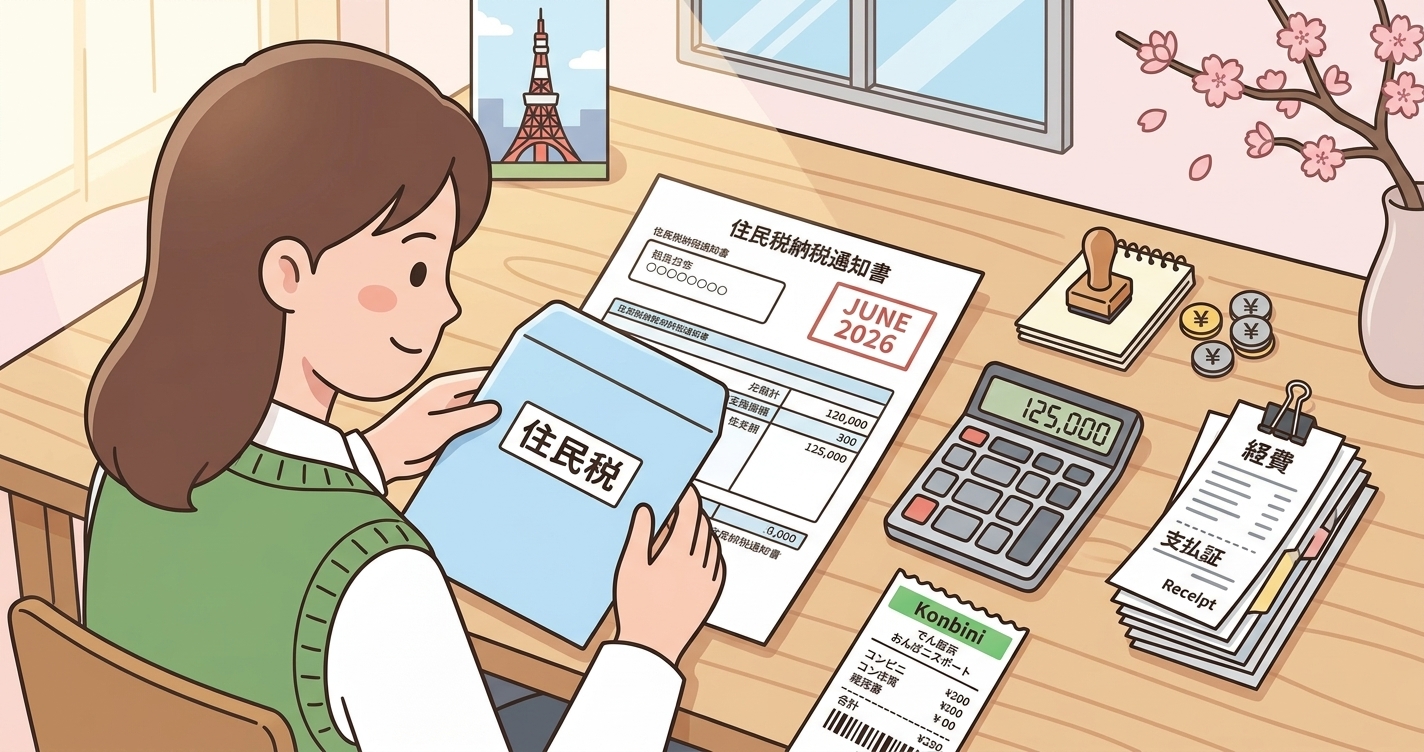
Every June, sole proprietors and freelancers in Japan receive a residence tax notice. This guide explains how juminzei is calculated for fiscal 2026, the four ordinary-collection payment dates, and why accurate expense records also lower your residence tax.
This article is general information current as of June 2026 and is not individual tax advice. For your exact amounts and payment methods, please confirm with your local municipality and the latest guidance from the Ministry of Internal Affairs and Communications (individual residence tax) and the National Tax Agency (NTA).
Every June, sole proprietors and freelancers across Japan find a residence tax notice (juminzei) in their mailbox. Just when you thought tax season ended with your March filing, a sizeable payment slip arrives. This guide explains how residence tax works for fiscal 2026, how it is calculated, when you must pay, and how keeping accurate expense records throughout the year quietly reduces this bill too.
What Is Residence Tax and How Does It Differ From Income Tax?
Residence tax is a local tax paid to the prefecture and municipality where you live. It is separate from national income tax. It is calculated on your income from January 1 to December 31 of the previous year and is levied from June of the following year. So the notice arriving in June 2026 covers your 2025 income.
The key difference: income tax applies to the current year, while residence tax is charged in arrears on the prior year. Even if you close your business or your income drops sharply, the bill is based on last year, so plan your cash flow carefully.
How Residence Tax Is Calculated (Fiscal 2026)
The Income-Based Portion
The income-based portion (shotokuwari) applies to your taxable income at a standard combined rate of 10 percent, typically split as 6 percent municipal and 4 percent prefectural. Taxable income is your business income minus deductions such as the basic deduction and social insurance premiums.
The Per-Capita Portion and Forest Environment Tax
The per-capita portion (kintowari) is a flat amount regardless of income, with a standard total of 4,000 yen (1,000 yen prefectural plus 3,000 yen municipal). On top of this, since fiscal 2024 a national Forest Environment Tax of 1,000 yen per year is added. Together, the per-capita portion and Forest Environment Tax come to roughly 5,000 yen per year in most municipalities.
Payment Schedule: Four Instalments Under Ordinary Collection
Unlike employees who have tax withheld from salary, sole proprietors pay by ordinary collection (futsu choshu). Using the payment slips enclosed with your notice, you pay in four instalments, typically due in June, August, October, and the following January. You may also prepay in a lump sum. More municipalities now accept bank transfer, smartphone payment apps, and convenience store payment.
Ordinary Collection Versus Special Collection
Ordinary collection means you pay yourself, while special collection means the tax is withheld from salary. If you run a side business as an employee, you can sometimes select self-payment (ordinary collection) for your side-income residence tax on your final return, which makes it less likely your employer is notified. If privacy matters to you, check that selection box when you file.
Accurate Expense Recording Is the Key to a Lower Bill
The income-based portion of residence tax is calculated from the same taxable income as income tax. That means claiming every legitimate expense on your final return, and correctly reducing your taxable income, lowers both income tax and residence tax. A single missed receipt affects both taxes.
Sorting a year of receipts and invoices by hand is a heavy chore. Tools like Denpyo let you photograph a receipt and have AI extract the date, amount, and expense category automatically, then organise it into your books. Recording a little each day prevents a last-minute scramble and missed entries before filing.
Worked Example: Taxable Income of 3 Million Yen
For a sole proprietor with taxable income of 3 million yen, the income-based portion is roughly 3 million times 10 percent, or 300,000 yen. Adding about 5,000 yen for the per-capita portion and Forest Environment Tax gives roughly 305,000 yen for the year (amounts vary by municipality and deductions). Paid across June, August, October, and January, that is about 76,000 yen per instalment. If you had claimed 100,000 yen more in expenses, your residence tax would be about 10,000 yen lower.
Use Denpyo to Record Expenses and Prepare for Next Year
Because residence tax is set by last year income, tax planning starts with this year records. Use the Denpyo tax savings estimator to gauge how much expense claims can save, and the income tax calculator to project your liability. Early preparation softens the shock of next June notice.
Summary
Residence tax is a local tax charged in arrears on last year income, made up of an income-based portion (standard 10 percent) and a per-capita portion plus Forest Environment Tax (about 5,000 yen per year). Sole proprietors generally pay by ordinary collection in four instalments (June, August, October, and the following January). Because accurate expense claims reduce residence tax too, digitise your daily records and prepare for next year.

Track expenses, maximize deductions
Denpyo scans your receipts and finds tax savings automatically.