
20 Deductible Business Expenses in Malaysia: 2026 Tax Guide
Discover which business expenses you can claim as tax deductions in Malaysia. This guide covers 20 major categories with worked examples and real RM amounts to maximize your 2026 tax filing.
Disclaimer: This article provides general information about Malaysian tax obligations. It is not professional tax, legal, or financial advice. For your specific situation, please consult a qualified tax advisor or certified public accountant. Disclosure: This article is published on the Denpyo blog. Denpyo provides receipt management and expense tracking services.
Understanding Deductible Business Expenses in Malaysia
One of the most powerful ways to reduce your income tax liability in Malaysia is to claim every legitimate business expense your LHDN tax file allows. Many self-employed individuals and SME owners leave thousands of ringgit on the table simply because they don't know what qualifies as a deduction.
Under Malaysia's Income Tax Act, the golden rule is straightforward: any expense that is wholly and exclusively incurred in the production of business income is deductible. Personal, domestic, or private expenses—no matter how small—are not allowed. The challenge is knowing where that line lies for the 20 major categories the LHDN accepts.
Core Deductible Expense Categories
1. Rent & Property Costs
If you rent a dedicated office, studio, or retail space, the full rental cost is deductible. For home-based businesses, you can claim a proportionate share of your home rental or mortgage interest (if renting) based on the percentage of your home used for business.
Example: You rent a RM2,000/month apartment and use one bedroom (20% of the space) exclusively for your freelance graphic design work. You can claim RM400/month (RM4,800/year) as a deductible rent expense.
2. Utilities (Electricity, Water, Internet)
Full utility costs for a dedicated business premises are deductible. For home-based work, claim only the portion attributable to your business space.
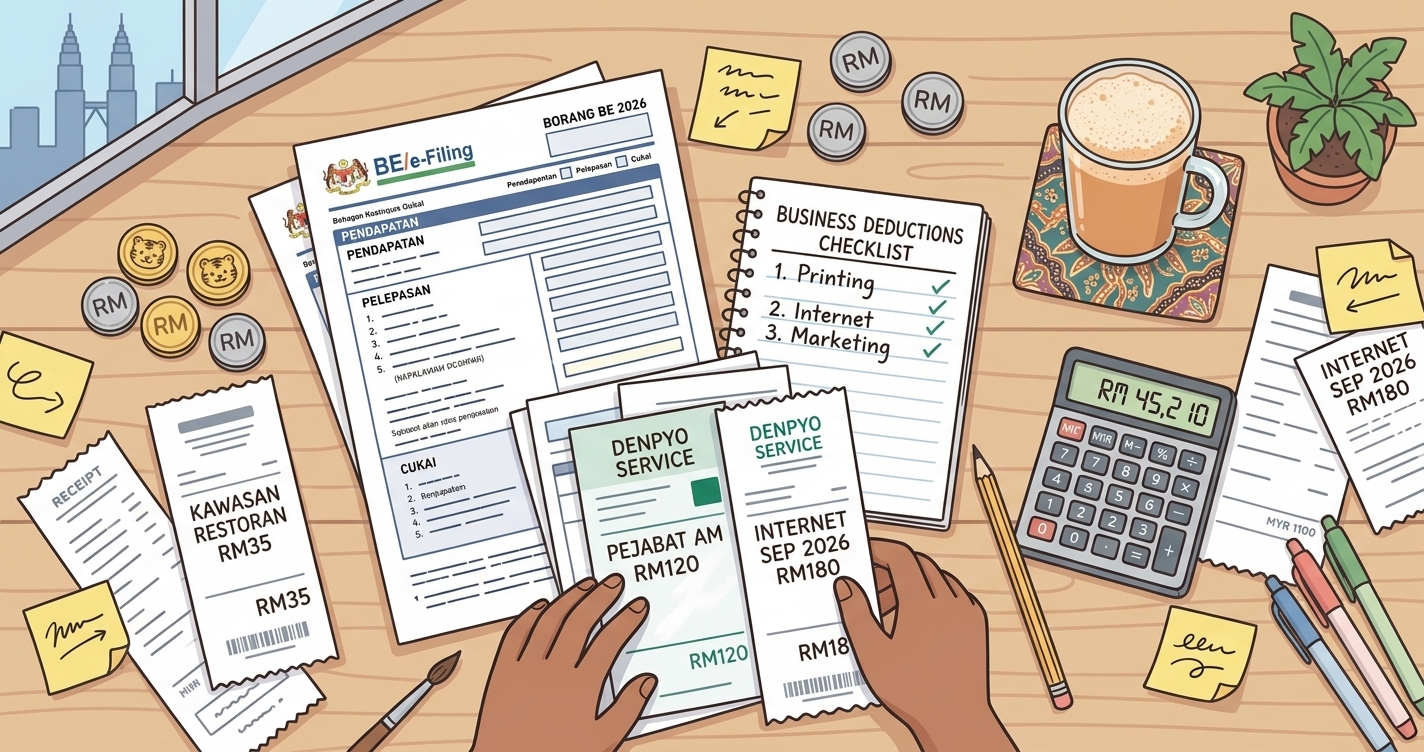
Example: Your monthly internet bill is RM120. If you use 50% of your internet connection for business (the rest is personal), you can deduct RM60/month (RM720/year).
3. Business Transport & Travel
Costs for vehicle maintenance, fuel, toll charges, and parking related to business travel are deductible. If you use a personal vehicle partly for business and partly for personal use, calculate the business proportion based on kilometers or time spent.
Example: You drive 30,000 km per year, of which 18,000 km (60%) is for business. At RM0.40/km operating cost, you can claim RM7,200 (18,000 × RM0.40) as a deductible transport expense.
4. Professional Fees & Services
Fees paid to accountants, lawyers, business consultants, marketing agencies, and other professional service providers are fully deductible when directly related to your business operations.
Example: You pay RM2,400/year to an accountant to maintain your books and prepare your tax filing. This is entirely deductible as a professional services expense.
5. Marketing & Advertising
All costs to promote your business are deductible: Google Ads, Facebook campaigns, social media content creation, website design, brochures, signage, and promotional events.
Example: You spend RM500/month on Instagram ads and RM200/month on website hosting. Total RM8,400/year is a deductible marketing expense.
6. Office Supplies & Stationery
Paper, pens, envelopes, labels, folders, and other consumable office items are deductible. This also includes printing and photocopying costs.
Example: You purchase stationery and business cards totaling RM1,800 during the year. All of it is deductible.
7. Software & Subscriptions
Subscription costs for business software (accounting, design, project management, CRM tools) are deductible. This includes cloud storage, email hosting, and productivity apps directly used in your business.
Example: Adobe Creative Suite (RM55/month), accounting software (RM30/month), and Slack (RM8/month) total RM1,116/year—all deductible.
8. Equipment & Machinery (Capital Allowances)
While the cost of purchasing fixed assets (computers, machinery, vehicles) is not directly deductible as an expense, you can claim capital allowances (tax depreciation) against them. The LHDN allows different rates depending on asset type.
Example: You purchase a laptop for RM4,000 for your business. You can claim an industrial building allowance (IBA) or plant allowance (PA) depending on the asset class. Computers typically qualify for accelerated depreciation (40% initial allowance, then 20% per year).
9. Insurance Premiums
Business liability insurance, professional indemnity insurance, property insurance for business assets, and vehicle insurance for business vehicles are all deductible.
Example: You pay RM1,200/year for professional indemnity insurance as a consultant. This is entirely deductible.
10. Telephone & Communications
Business phone lines, mobile plans (if used exclusively for business), and communication subscriptions are deductible. Personal portions of shared plans must be excluded.
Example: You maintain a dedicated business mobile line at RM80/month (RM960/year). This is fully deductible.
11. Repairs & Maintenance
Costs to keep your business assets in working order are deductible. This includes equipment repairs, building maintenance, and routine servicing.
Example: You spend RM300 to repair your office printer and RM500 on annual air-conditioner servicing. Total RM800 is deductible as repairs & maintenance.
12. Bank Charges & Fees
Business account fees, transfer charges, credit card processing fees, and check cashing fees related to your business are deductible.
Example: Your business bank account charges RM20/month in fees (RM240/year). This is deductible.
13. Postage & Shipping
Costs to mail business correspondence, ship products to customers, or courier important documents are deductible.
Example: You spend RM2,000/year on postage and shipping. This is entirely deductible.
14. Training & Professional Development
Costs for courses, certifications, webinars, and workshops that improve your business skills are deductible. However, basic education (school, college) is generally not deductible.
Example: You take a RM800 digital marketing certification course relevant to your freelance business. This is deductible as training expense.
15. Staff Costs & Employment Benefits
If you employ staff, salaries, wages, EPF contributions, SOCSO premiums, and reasonable employee benefits are deductible. This is one of the largest deductible categories for growing businesses.
Example: You employ one part-time assistant at RM2,000/month (RM24,000/year) plus EPF contributions (RM1,440/year). Total RM25,440 is deductible as staff costs.
16. Meals & Entertainment (50% Limit)
Here's the catch: while business meals and entertainment are deductible, only 50% of the expense is allowed by the LHDN. This prevents excessive personal spending from being hidden as business entertainment.
Example: You spend RM1,000 taking clients to dinner. Only RM500 (50%) is deductible.
17. Donations & Sponsorships
Donations to approved charitable institutions and business-related sponsorships may be deductible, subject to specific limits and conditions set by the LHDN. Generally limited to 10% of your aggregate income.
Example: If your business income is RM100,000, you can deduct up to RM10,000 in approved charitable donations.
18. Research & Development (R&D)
If your business conducts R&D (product development, market research, technical testing), costs are deductible. Some R&D expenses even qualify for double deduction under incentive schemes.
Example: You spend RM5,000 testing new product prototypes. This is deductible as R&D expense.
19. Licenses & Permits
Annual business licenses, trade permits, professional registration fees, and regulatory compliance costs are deductible.
Example: You renew your business license annually at RM300 and pay a professional association fee of RM500. Total RM800 is deductible.
20. Depreciation on Business Assets
While capital expenditure (the purchase price) isn't directly deductible, depreciation allowances allow you to recover the cost over time. The LHDN sets rates for different asset categories: plant & machinery (20-50%), industrial buildings (3-10%), vehicles (40-50% initial, then 20-40% annually).
Example: You purchase a van for RM50,000 for delivery services. You can claim an initial allowance (IA) of RM20,000 (40% of cost) in Year 1, then annual allowance (AA) of RM12,000 (24% of remaining cost) in subsequent years until fully depreciated.
Common Non-Deductible Expenses
The LHDN explicitly disallows certain expenses:
- Personal & Domestic Expenses: Groceries, utilities for personal use, home renovation
- Fines & Penalties: Traffic violations, late payment penalties (except legitimate business penalties)
- Income Tax & Social Contributions: Your own income tax, EPF, SOCSO contributions are not deductible (they're taxes on income, not business expenses)
- Loan Principal Repayment: Only interest is deductible, not principal repayment
- Gifts (over RM500 per recipient): Small gifts to customers may be deductible, but lavish gifts are not
- Entertaining Yourself: Personal entertainment, vacations, hobbies are not deductible even if you work on vacation
Documentation & MyInvois Requirements
As of 2026, Malaysia's MyInvois e-invoicing system is being phased in for businesses earning RM1M+. For all business expenses you claim, you must retain supporting documents for 7 years:
- Original invoices and receipts
- Bank statements and payment evidence
- Digital copies of e-invoices (MyInvois-compliant if applicable)
- Supporting documentation (contracts, quotes, proof of service)
The LHDN may request documentation during an audit, so maintaining organized, clear records is essential.
How Denpyo Helps
Denpyo automatically scans and categorizes your business receipts into the 20+ deductible expense categories accepted by the LHDN. Rather than manually tracking every meal, office supply, and professional service receipt, Denpyo's mobile app lets you photograph receipts as you spend, and the app's AI instantly categorizes them into the right deduction bucket. When tax filing season arrives in March-July, your expense records are already organized and documented—ready to support your Form B claims with the LHDN.
Summary
- Golden Rule: Only expenses wholly and exclusively incurred in producing business income are deductible
- 20 Major Categories: Rent, utilities, transport, professional fees, marketing, office supplies, software, equipment allowances, insurance, communications, repairs, bank charges, postage, training, staff, meals (50%), donations, R&D, licenses, and depreciation
- Document Everything: Keep original receipts and invoices for 7 years—the LHDN may audit your claims
- Personal vs. Business: If an expense is partly personal, claim only the business proportion
- Entertainment Cap: Remember the 50% limit on meals and entertainment expenses
- Capital Assets: Don't forget capital allowances—depreciation on vehicles, equipment, and machinery can yield substantial deductions
- Get Help: For complex claims (R&D, donations, depreciation), consult a qualified tax advisor or accounting firm
Use our expense-checker tool to verify which of your current spending patterns qualify as deductible business expenses.

Track expenses, maximize deductions
Denpyo scans your receipts and finds tax savings automatically.
More Articles
View All Articles
Side Income Tax in Hong Kong: Reporting Freelance Earnings Alongside Your Job (2026)
6 min read
Personal Assessment in Hong Kong 2026: Can It Lower Your Tax Bill?
5 min read