
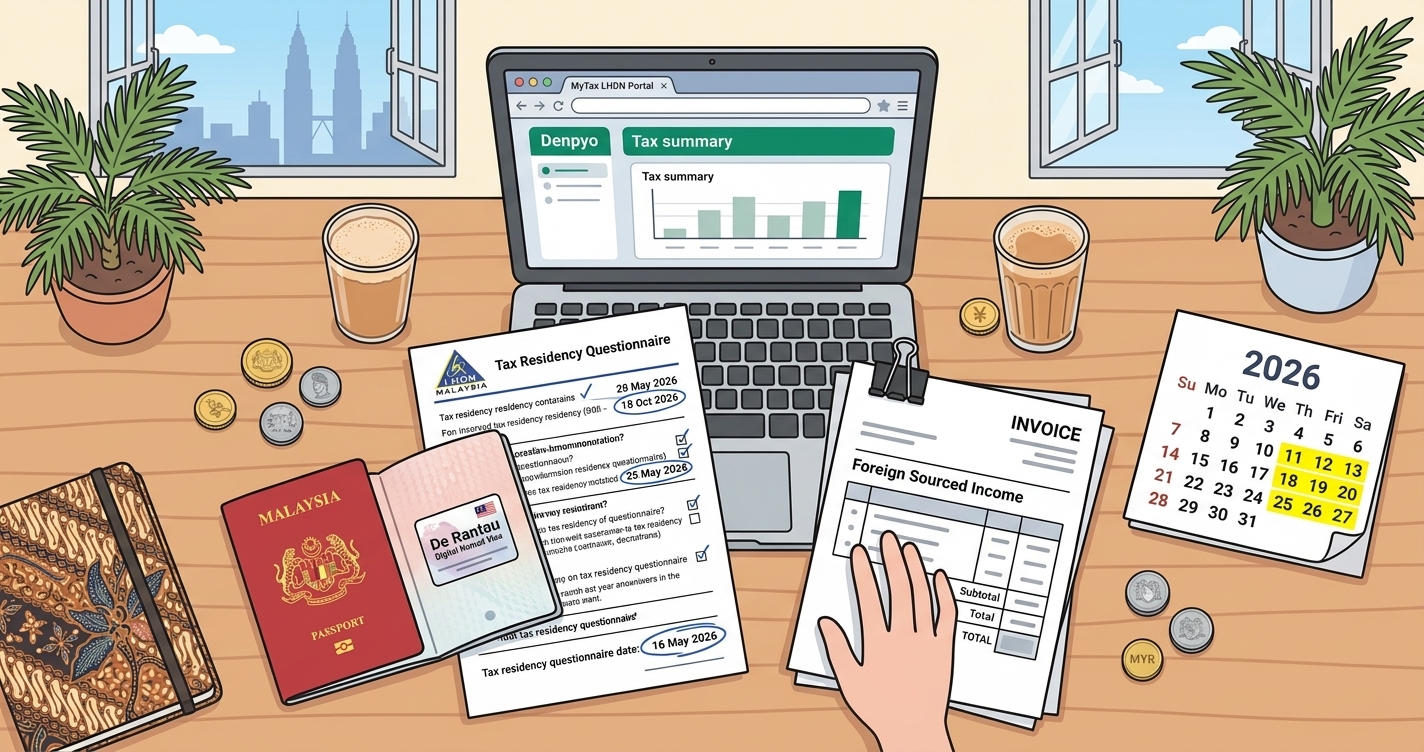
De Rantau Nomad Pass: Tax Obligations for Digital Nomads in Malaysia 2026
Malaysia's De Rantau programme offers digital nomads a 12-month renewable pass to live and work remotely from one of Asia's most affordable tech hubs. But what are your tax obligations? This guide covers everything from residency rules to foreign-sourced income exemptions.
Disclaimer: This article is for general informational purposes only and does not constitute professional tax or immigration advice. Malaysia's tax system is administered by the Inland Revenue Board of Malaysia (LHDN). Immigration matters fall under the Immigration Department of Malaysia (JIM). Always consult a qualified Malaysian tax professional and immigration advisor for your specific situation.
Malaysia's Play to Win the Global Digital Nomad Market
Launched in October 2022 under the Malaysia Digital Economy Corporation (MDEC), the De Rantau Nomad Pass is Malaysia's bid to attract location-independent professionals to its growing digital economy hub. Malaysia Digital (formerly MSC Malaysia) targets 12,000 digital nomad pass holders by 2025, offering a renewable 12-month stay for remote workers employed by or running businesses outside Malaysia.
The appeal is clear: Kuala Lumpur consistently ranks among Asia's most affordable capitals for expats, with fast fibre internet, a world-class co-working ecosystem, excellent English penetration, and a growing startup community in districts like Bangsar South and KL Sentral. Penang and Johor Bahru offer lower costs still, with easy access to Singapore.
But before you book your flight, understanding your Malaysian tax obligations—and equally important, what you don't owe—is essential for a smooth stay.
Who Qualifies for the De Rantau Pass?
According to the MDEC De Rantau programme page, applicants must meet one of the following criteria:
- Tech freelancers: Working on projects for clients based outside Malaysia, earning a minimum of USD 24,000/year (approximately RM113,000 at current rates)
- Employees of foreign companies: Employed by a company registered outside Malaysia, performing work remotely from Malaysia
- Business owners: Owning and operating a business registered outside Malaysia
The pass is initially valid for 12 months and can be renewed. Holders are permitted to bring a spouse and dependents. The application fee is RM1,000 for the primary applicant.
The Critical Tax Question: Are You a Tax Resident?
Whether you owe Malaysian income tax depends primarily on whether you become a Malaysian tax resident. Under Section 7 of the Malaysian Income Tax Act 1967, an individual is a tax resident if they are present in Malaysia for:
- 182 days or more in a calendar year, OR
- At least 90 days in the current year, and a combined 182 days across the current and previous 3 years (with some further conditions)
For a De Rantau pass holder who stays in Malaysia for a full 12-month period, they will almost certainly become a tax resident. This has significant implications—both positive and negative—that we'll explore below.
The Good News: Foreign-Sourced Income Exemption Extended to 2036
Here's the key provision that makes Malaysia highly attractive for digital nomads in 2026: foreign-sourced income (FSI) received by Malaysian tax residents is generally exempt from Malaysian income tax until December 31, 2036.
This exemption was originally announced in Budget 2022 and has since been extended. Under the current rules, income that is earned abroad (i.e., from foreign clients or foreign employers) and remitted to or received in Malaysia by an individual tax resident is not subject to Malaysian income tax—provided it has already been subjected to tax in the country of origin (or qualifies under a specific exclusion).
For a De Rantau holder working entirely for overseas clients, this means your freelance income or employment salary is effectively tax-free in Malaysia for the foreseeable future, regardless of whether you receive it into a Malaysian bank account.
However, there are important caveats:
- The exemption applies to individuals—not to companies. If you operate through a Malaysian-registered company, the rules differ.
- Income sourced from Malaysian clients or Malaysian business activities is not foreign-sourced and remains taxable in the normal way.
- The exemption is not guaranteed to be permanent—it's a legislative provision that could change with future budgets.
- If your home country also taxes your income on a worldwide basis, you may still owe taxes there.
What If You Also Earn Malaysian-Sourced Income?
Many digital nomads end up taking on a local Malaysian client or two, attending paid speaking engagements in KL, or earning some platform income from Malaysian customers. This income is Malaysia-sourced and is subject to Malaysian income tax regardless of your residency status—though the rates and filing requirements differ.
For Malaysian tax residents, Malaysian-sourced income is taxed at progressive rates from 0% to 30%:
- First RM5,000: 0%
- RM5,001–RM20,000: 1%
- RM20,001–RM35,000: 3%
- RM35,001–RM50,000: 8%
- RM50,001–RM70,000: 13%
- RM70,001–RM100,000: 21%
- RM100,001–RM400,000: 24%
- Above RM400,000: 25–30%
Resident individuals also benefit from a personal relief of RM9,000 and a range of additional reliefs for lifestyle expenses, CPF-equivalent contributions, and professional development.
Filing Requirements for De Rantau Pass Holders
If Your Only Income is Foreign-Sourced
If you have no Malaysian-sourced income and your foreign-sourced income is exempt, you may have minimal or zero Malaysian income tax liability. However, if you become a tax resident, you are still required to register with LHDN and file a tax return (Form B for self-employed, Form BE for employees) if your total income exceeds RM34,000 per year—even if no tax is payable after exemptions.
If You Have Mixed Income (Malaysian + Foreign)
File Form B (for those with business income) via the MyTax portal by July 15 of the following year. Declare your Malaysian-sourced income in full, and claim the foreign-sourced income exemption separately. Keep clear documentation showing which income was earned from foreign vs local clients, including contracts, invoices, and payment records.
Tax Number Registration
Register for a Malaysian income tax number (TIN) via the MyTax portal or at any LHDN office. This is required once you meet the income threshold for filing, regardless of whether you ultimately owe tax.
Record Keeping: What Digital Nomads in Malaysia Should Track
Even if your foreign-sourced income is exempt, maintaining clean records is essential:
- Client contracts and engagement letters: Documenting that clients are based outside Malaysia
- Invoices and payment records: Showing the foreign origin of income
- Bank statements: Tracking all income received, regardless of currency
- Receipts for business expenses: If you have any Malaysian-sourced income, business expenses reduce your taxable base
- Travel records: Dates of entry and exit from Malaysia (for residency determination)
Malaysian law requires business records to be kept for 7 years. Using a receipt management tool like Denpyo to photograph and categorize receipts in real time—with AI automatically extracting vendor, amount, date, and category—makes this painless whether you're in KL or hopping between co-working spaces across the country.
Practical Considerations for Tax Planning
Home Country Tax Obligations
The Malaysian FSI exemption only addresses your Malaysian tax liability. Many countries tax their residents (or citizens) on worldwide income regardless of where they live. US citizens and green card holders, for example, must continue filing US taxes. UK, Australian, and Canadian tax residents who spend time abroad may or may not lose tax residency at home—rules vary significantly. Consult a tax professional in your home country before relocating.
Double Tax Agreements
Malaysia has double tax agreements (DTAs) with over 70 countries. These treaties can affect how your income is taxed if you earn from both Malaysian and foreign sources. If your home country has a DTA with Malaysia, income may be taxed only once—check with a cross-border tax specialist.
GST/SST Considerations
Malaysia does not have a GST system (it was abolished in 2018 and replaced with a narrower Sales and Service Tax). As a digital nomad providing services to foreign clients, your services are generally outside the scope of SST. If you start providing services to Malaysian clients above the SST registration threshold, you may need to register and charge service tax.
Using the Free Tax Savings Estimator
If you do have Malaysian-sourced income alongside your exempt foreign income, the free Denpyo Income Tax Calculator can help you estimate your Malaysian tax liability on that portion. Enter your Malaysia-sourced income, applicable reliefs, and personal deductions to see your estimated tax bill—useful for quarterly financial planning so you're never caught short at filing time.
Summary: The De Rantau Tax Picture in 2026
For most digital nomads on a De Rantau pass working entirely for foreign clients, the Malaysian tax picture in 2026 is remarkably favorable:
- Foreign-sourced income is exempt from Malaysian income tax until 2036—you can receive foreign client payments into Malaysian accounts without triggering local tax.
- You may still need to file once you meet the income threshold—even if no tax is owed, registration and filing keep you compliant.
- Malaysian-sourced income is taxable—keep a clean separation between local and foreign income streams.
- Home country obligations still apply—Malaysia's exemption doesn't affect what your home country may claim.
The official resources to bookmark: LHDN's official tax portal, MyTax for filing, and MDEC's De Rantau programme page.

Track expenses, maximize deductions
Denpyo scans your receipts and finds tax savings automatically.
More Articles
View All Articles
Side Income Tax in Hong Kong: Reporting Freelance Earnings Alongside Your Job (2026)
6 min read
Personal Assessment in Hong Kong 2026: Can It Lower Your Tax Bill?
5 min read