
Malaysia Tax Filing Deadline 15 July 2026: What Happens If You File Form B Late
Missing LHDN's 15 July 2026 e-filing deadline is expensive. Here's the penalty structure under Sections 112, 103 and 113, a practical late-filing recovery plan, and how to avoid compounding surcharges in 2027.
Disclaimer: This article is general guidance for Malaysian freelancers and small business owners about the penalties for late tax filing in Assessment Year 2025 (the return due in 2026). It is not tax or legal advice. Rules are current as of April 2026 — always confirm with Lembaga Hasil Dalam Negeri (LHDN) or a licensed Malaysian tax agent before acting.
The deadline every freelancer in Malaysia needs on the fridge
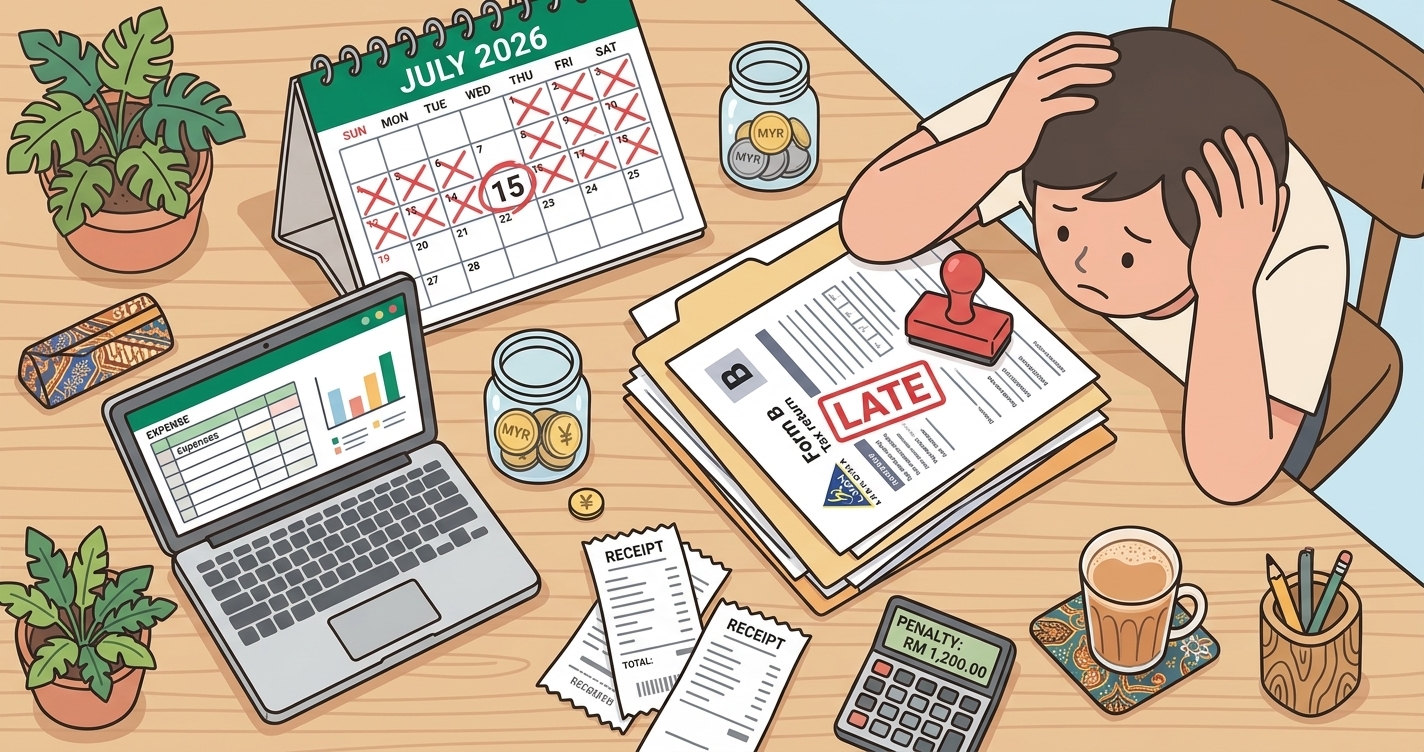
If you earn any self-employment, freelance, gig, e-commerce or partnership income in Malaysia, your Form B for Assessment Year 2025 is due by 15 July 2026 (e-filing) or 30 June 2026 (paper submission). Employees on Form BE have an earlier deadline of 15 May 2026 (e-filing) or 30 April 2026 (paper). Miss those windows and you step into a penalty regime with three compounding layers: Section 112 (failure to furnish a return), Section 103 (late payment surcharge), and Section 113 (incorrect return). Understanding all three is the difference between a manageable mistake and a year of back-and-forth with LHDN.
A realistic number: a self-employed graphic designer in Petaling Jaya earning RM120,000 adjusted profit who files her Form B six months late and pays her balance of RM6,400 three months after the due date will rack up penalties and surcharges of roughly RM960–RM1,600 on top of the tax itself. Same designer who also under-declares her trade income can add another 15%–45% under Section 113.
The three Malaysian penalty sections you must know
Section 112 — Failure to furnish a return
Section 112(1) of the Income Tax Act 1967 makes it an offence to fail to furnish a return on or before the due date without reasonable excuse. On conviction you face a fine of RM200 to RM20,000, imprisonment up to six months, or both. In practice LHDN rarely prosecutes first-time offenders, but it routinely issues a composite assessment under Section 112(3) which adds a penalty typically calculated as a percentage of the tax payable:
- First 60 days late: commonly assessed at 10% of tax payable
- After 60 days: additional percentages stacking up, sometimes reaching 45%
- Repeat offenders: LHDN has discretion to push the composite penalty to the full 300% of tax undercharged
The published scale and LHDN's discretion are covered in the Board's public rulings on penalties.
Section 103 — Late payment of tax
Even if you file your Form B on time, unpaid tax after the statutory payment date attracts a Section 103 surcharge:
- 10% on any balance still unpaid after the due date (30 June or 15 July depending on your form)
- Additional 5% if the balance remains unpaid 60 days after the first surcharge is raised
So a RM10,000 balance paid 90 days late costs you RM10,000 + RM1,000 + RM500 = RM11,500 before Section 112 is considered. These rules are explained in LHDN's payment section and in EY's 2024/25 Malaysia Tax Alerts.
Section 113 — Incorrect return or incorrect information
If LHDN's review or audit finds your return under-declared income, wrongly claimed deductions, or claimed capital allowances the business was not entitled to, Section 113 permits penalties of up to 100% of the tax undercharged. Many voluntary disclosures settle between 15%–45%, as published in LHDN's Operational Guidelines 1/2024.
Worked example — Aina, freelance copywriter
Aina runs a sole-proprietor copywriting practice. AY2025 chargeable income: RM76,000. Tax payable after reliefs: RM4,400. She forgot to e-file her Form B and only submits it on 15 October 2026 (three months late). She also pays the RM4,400 on the same day.
- Section 103 late payment: 10% × RM4,400 = RM440
- Section 112(3) composite penalty (approx 15% for 90 days late): 15% × RM4,400 = RM660
- Total penalties: RM1,100 — a 25% surcharge on top of the tax.
If Aina also forgot to declare RM12,000 from a one-off Klook content project and LHDN discovers it in a desk audit, Section 113 could add 30%–45% of the extra tax due on that RM12,000.
What to do if you know you will miss the deadline
- File first, pay later. Submit the return even if you cannot pay yet. You immediately cap your Section 112 exposure and only Section 103 surcharges accrue until the balance is paid.
- Apply for an installment plan. Log into MyTax and request a payment arrangement. LHDN generally approves 2–6 month installment plans for genuine cash-flow issues, and an active plan freezes further surcharges beyond the initial 10%.
- Request an extension by writing. You can write to your Cawangan LHDN branch with a reasonable excuse (medical, disaster, data loss) before the deadline. Extensions are discretionary but available.
- Voluntarily disclose errors. If you have already under-declared, a voluntary disclosure under the current Special Voluntary Disclosure framework usually caps the Section 113 penalty at 10%–15% instead of the default 45%.
How to file on time in 2026 — a four-week countdown
Week 1 (late June)
- Reconcile all bank statements for 1 Jan – 31 Dec 2025
- Pull platform payout reports (Grab, Shopee, Lazada, TikTok Shop, Upwork, Fiverr, Etsy)
- Download your MyInvois consolidated e-invoices for the year from the MyInvois portal
Week 2 (early July)
- Categorise expenses under LHDN-recognised heads: rental, staff, marketing, travel, utilities, depreciation
- Tally personal reliefs (life insurance, EPF, SSPN, zakat, medical, parents, lifestyle)
- Apply capital allowances for assets purchased in 2025
Week 3 (mid-July)
- Draft Form B inside MyTax ezHASiL
- Run our free income tax calculator to sanity-check your liability
- Cross-check i-Saraan Plus EPF matching and SESSS/PERKESO contributions under the 2025 Gig Workers Act
Week 4 (10–15 July)
- Submit Form B via e-Filing before 23:59 on 15 July 2026
- Pay via FPX, credit card or over-the-counter before the same deadline
- Save the acknowledgement PDF and e-receipt for seven years
Red flags LHDN looks for
- Large gaps between declared turnover and MyInvois e-invoice totals
- Home office claims exceeding 30% of rent without supporting apportionment
- Personal lifestyle expenses labelled as business (salon, gym, groceries, alcohol)
- Capital allowances on assets used solely for personal use
- Missing SST registration where turnover exceeds RM500,000 for taxable services
Record keeping — the seven-year rule
Under Section 82 of the Income Tax Act 1967 you must keep business records for seven years from the end of the assessment year. That includes invoices issued, receipts paid, bank statements, cash books, contracts, and supporting workings for every deduction. Digital copies are fully accepted provided they are legible and accessible on demand.
How Denpyo helps Malaysian freelancers file on time
Most late filings happen not because the taxpayer intended to be late, but because assembling the numbers takes too long. Tools like Denpyo capture every receipt, invoice and bill as you go, extract the vendor, date, amount and tax category automatically, and keep the digital originals for the full seven-year LHDN retention. When July arrives you export a clean P&L, a capital allowance schedule and a reliefs checklist that plug straight into Form B. Pair it with our free expense deductibility checker to confirm which items meet the LHDN test before you claim them.
Key takeaways
- Form B deadline: 15 July 2026 (e-filing). Form BE: 15 May 2026.
- Section 112 penalises late filing from 10% to 45% (up to 300% for repeat offenders).
- Section 103 adds 10% on unpaid tax, plus another 5% if still outstanding 60 days later.
- Section 113 penalises incorrect returns up to 100% of the undercharged tax.
- File first, pay later if cash-strapped — it caps your exposure.
- Keep records for seven years and reconcile monthly, not yearly.

Track expenses, maximize deductions
Denpyo scans your receipts and finds tax savings automatically.
More Articles
View All Articles
Side Income Tax in Hong Kong: Reporting Freelance Earnings Alongside Your Job (2026)
6 min read
Personal Assessment in Hong Kong 2026: Can It Lower Your Tax Bill?
5 min read