
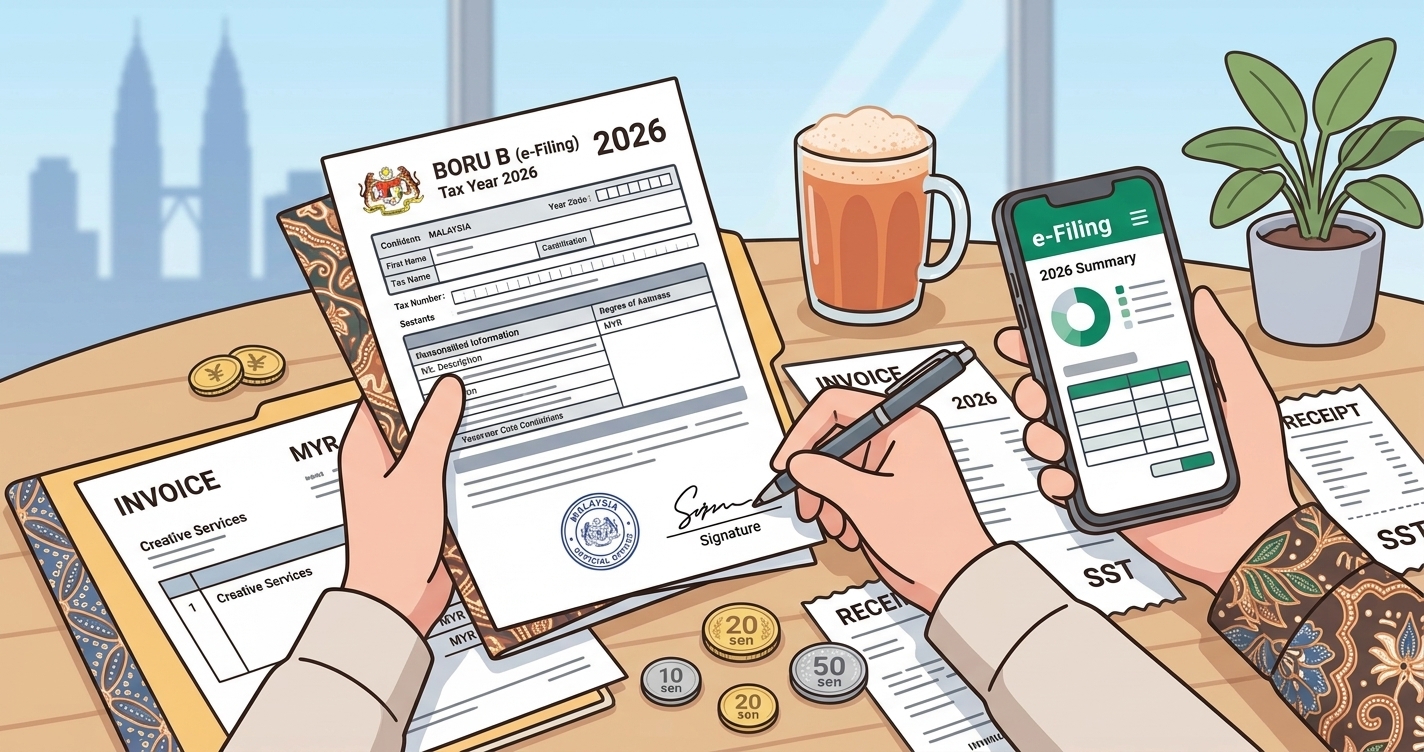
Malaysia Form B Tax Filing Guide for Freelancers and SMEs 2026
Master Malaysia's Form B filing with our comprehensive guide for freelancers and SMEs. Real examples, SST tips, MyInvois Phase 3 prep, and Denpyo tools to simplify tax season.
Disclaimer: This article provides general information about Malaysian tax obligations. It is not professional tax, legal, or financial advice. For your specific situation, please consult a qualified tax advisor or chartered accountant. Disclosure: This article is published on the Denpyo blog. Denpyo provides receipt management and expense tracking services.
Malaysia's Tax System: The Big Picture
Malaysia's tax year runs January 1 to December 31, and if you're self-employed—whether you're a content creator, consultant, freelancer, or running a small business—Form B is your filing form. But here's the thing: with 1 in 4 Malaysian workers now in the gig economy (thanks to the Inland Revenue Board (LHDN) and recent Gig Workers Act 2025, the rules have gotten clearer and stricter.
Income tax rates in Malaysia are progressive, ranging from 0% on the first RM35,000 (for residents) up to 30% on income above RM400,000. Most self-employed people fall into the 10–20% bracket. The good news? You can deduct legitimate business expenses, which can dramatically reduce your taxable income.
Who Files Form B? (Hint: It's Broader Than You Think)
You need to file Form B if you're:
- Self-employed — freelancers, consultants, digital creators, photographers, designers
- Running a partnership or sole proprietorship — small restaurants, F&B consultancies, trading businesses
- Earning professional income — doctors, lawyers, accountants
- Operating without a corporate structure — if you've incorporated as a Sdn Bhd, you file corporation tax instead
Important: Even if your income is below the taxable threshold, filing is often mandatory if you're registered with LHDN. And if you earn above RM35,000 (RM40,000 if aged 60+), you're definitely filing.
Two Real Scenarios
Scenario 1: Priya, Digital Content Creator (Solo)
Priya runs a YouTube channel and Instagram sponsored content business. Annual gross revenue: RM96,000.
| Item | Amount (RM) |
| Gross Revenue | 96,000 |
| Internet & Phone | 2,400 |
| Home Office Utilities (40%) | 1,200 |
| Equipment depreciation | 1,500 |
| Camera & Lighting | 2,000 |
| Software Subscriptions | 1,200 |
| Total Deductions | 8,300 |
| Taxable Income | 87,700 |
| Estimated Tax (~10%) | 8,770 |
Without proper expense tracking, Priya might claim only RM2,000 in deductions—costing her RM630 extra in tax.
Scenario 2: Chen & Co., F&B Consulting (5-Person Partnership)
Annual revenue: RM1.2M, operating from Bangsar.
| Item | Amount (RM) |
| Gross Revenue | 1,200,000 |
| Staff Salaries & CPF/SOCSO | 420,000 |
| Office Rent | 72,000 |
| Vehicle & Travel | 45,000 |
| Client Entertainment (50%) | 18,000 |
| Software & Professional Fees | 24,000 |
| Utilities & Supplies | 15,600 |
| Total Deductions | 594,600 |
| Taxable Income | 605,400 |
| Estimated Tax (~18%) | ~108,972 |
Deductible Expenses: What LHDN Allows
The LHDN allows deductions for expenses incurred wholly and exclusively for producing income.
Always Deductible
- Rent & Utilities — office space, internet, electricity (business use only)
- Salaries & Wages — staff pay, SOCSO (PERKESO), EPF contributions
- Professional Services — accounting, legal, consultancy fees
- Depreciation — equipment, vehicles, furniture
- Insurance — business liability, professional indemnity
- Travel & Transport — mileage, fuel, accommodation for business
- Software & Subscriptions — accounting tools, design software
Partially Deductible
- Meals & Entertainment — 50% for client entertaining; 100% for team meals
- Home Office — utilities, rent proportioned by business use
- Vehicle Expenses — business % only for mixed-use vehicles
Use Denpyo's Expense Deductibility Checker to instantly verify whether a purchase qualifies.
SST (Sales & Service Tax)
SST applies to specific goods and services. If you supply taxable services (consulting, design, catering), you're likely SST-liable at 6%. Mandatory registration at RM500,000+ annual turnover.
Filing Form B via ezHASiL
File through MyTax Portal. Deadline: June 30 each year. Late filing incurs penalties up to RM300 + 10% of unpaid tax.
EPF & SESSS
Self-employed can voluntarily contribute to SESSS via PERKESO (~11% of monthly income, government subsidizes ~30%). Contributions are tax-deductible. Employers must contribute EPF (12%), SOCSO (1.25%), and HRDF (0.5% if payroll exceeds RM250K).
MyInvois E-Invoicing: Phase 3 Coming July 2026
MyInvois Phase 3 (July 2026): all SST-registered businesses must submit invoices in real-time. Failure to comply: RM1,000–RM10,000 penalties. Prepare now: audit your invoicing, choose MyInvois-compatible software, test the LHDN sandbox.
Record Keeping: 7-Year Rule
LHDN requires 7 years of records: invoices, receipts, bank statements, payroll, depreciation schedules. Denpyo's receipt OCR captures all key data from photos—amount, vendor, date, category—for a searchable 7-year archive.
How Denpyo Helps You Stay Compliant
Denpyo simplifies Malaysian tax prep: Expense Deductibility Checker, receipt digitization with AI categorization, Income Tax Calculator, Tax Savings Estimator, SST tracking, and organized export for Form B filing.
Key Takeaways
- File Form B if self-employed and earning above RM35,000/year. Deadline: June 30.
- Deductions are your friend—home office, equipment, travel, software, insurance. Use Denpyo's Expense Checker.
- SST registration mandatory at RM500K+. Switch to MyInvois by July 2026.
- EPF/SESSS contributions reduce taxable income.
- Keep 7 years of records. Digital receipts via Denpyo beat shoeboxes of paper.
- Use MyTax Portal and MyInvois early—LHDN compliance is non-negotiable.
Start documenting expenses with Denpyo's tools. Clean, categorized records turn filing season from dread into done.
For complex tax planning, firms like EY Malaysia tax advisory and KPMG Malaysia tax services offer expert guidance. Find a qualified chartered accountant through the Malaysian Institute of Accountants (MIA).

Track expenses, maximize deductions
Denpyo scans your receipts and finds tax savings automatically.
More Articles
View All Articles
Side Income Tax in Hong Kong: Reporting Freelance Earnings Alongside Your Job (2026)
6 min read
Personal Assessment in Hong Kong 2026: Can It Lower Your Tax Bill?
5 min read