
Home Office Deductions Malaysia 2026: How to Calculate Proportionate Rent, Utilities, and Internet
Working from home as a Malaysian freelancer or SME owner? Here is exactly how LHDN expects you to calculate the home office portion of rent, electricity, broadband, and more — with worked examples.
Disclaimer: This article summarises publicly available guidance from Lembaga Hasil Dalam Negeri (LHDN) at the time of writing. It is general information, not personal tax advice. Consult a Malaysian tax agent or LHDN directly for advice specific to your situation.
Why home office deductions matter in Malaysia 2026
Since the pandemic, working from home has become the default for a significant share of Malaysia's 1.5–2 million freelancers and small business owners — designers, developers, translators, online sellers, and consultants running their entire operation from a bedroom, balcony, or renovated spare room. What many don't realise is that a proportionate share of your rent, electricity, water, and internet bills is legitimately deductible against your trade income under Section 33(1) of the Income Tax Act 1967, as long as the space and costs are genuinely used in the production of income.
LHDN's position is consistent with most modern tax authorities: you cannot deduct the full cost of your home, but you can deduct the reasonable business portion. Get that portion right and you'll often save several hundred to several thousand ringgit of tax per year. Get it wrong — claim too much or claim without records — and you risk a field audit, additional assessment, and penalties under Section 113 of up to 100% of tax undercharged.
This guide walks through exactly how to calculate the home office deduction for the 2026 Year of Assessment (covering 2025 income), with worked examples for three common scenarios: a renter, a homeowner, and a hybrid side-hustler. It also covers what to keep on file, common mistakes, and how Denpyo helps you collect the substantiation you need without spreadsheet drudgery.
The three-step framework LHDN expects
Home office deductions in Malaysia rest on three questions every freelancer and SME must answer:
- What portion of your home is used for business? Typically calculated on a floor area basis — square feet of the work area ÷ total floor area. You can also use room count as an approximation, but floor area is the safer method in a field audit.
- What portion of time is it used for business? If the same room is your family living room in the evening, you must discount accordingly. A dedicated office used 5 days × 8 hours = 40 hours/week is different from a dining table doubling as a desk 20 hours/week.
- What records do you have? LHDN can request seven years of documentation under Section 82 of the Income Tax Act. Without bills, floor plans, and a calculation trail, even legitimate deductions can be denied.
Once you have answers to those three questions, applying them is straightforward. Let's walk through it.
Calculating the business-use percentage
The standard formula is:
Business-use % = (Business floor area ÷ Total floor area) × (Business hours ÷ Total hours used)
The second multiplier (business hours ÷ total hours) only applies if the space is shared with personal use. For a fully dedicated office that is never used for anything else, you can skip it and use just the floor-area percentage.
Example 1: Dedicated home office, renter
Aisha is a freelance graphic designer renting a 900 sq ft apartment in Petaling Jaya for RM2,400/month. She converted the second bedroom (120 sq ft) into a dedicated office used exclusively for client work.
- Business floor area: 120 sq ft
- Total floor area: 900 sq ft
- Business-use %: 120 / 900 = 13.33%
Her annual deductible rent: RM2,400 × 12 × 13.33% = RM3,840
Because the office is a dedicated workspace, she doesn't need to apply a time discount.
Example 2: Shared space, homeowner
Ravi runs an e-commerce business from a 1,500 sq ft terrace house in Shah Alam. He uses one corner of the 300 sq ft living room for his laptop, printer, and packing station — the rest of the living room remains family space. He works 6 hours/day Monday–Saturday (36 hours/week) from this corner; the whole living room is used ~100 hours/week in total.
- Business floor area (workstation corner): 60 sq ft
- Total floor area: 1,500 sq ft
- Workspace floor %: 60 / 1,500 = 4%
- Time discount: 36 / 100 = 36%
- Business-use %: 4% × 36% = 1.44% (for the living room overhead portion)
Because Ravi owns the home, he cannot deduct rent. But he can deduct 1.44% of his utilities (electricity, water, broadband, quit rent/assessment), plus 100% of the incremental cost directly attributable to business (e.g., a dedicated packing table, business-only broadband upgrade).
Example 3: Hybrid side-hustler
Farah is employed full-time as an accountant and runs a part-time bookkeeping side-business. She works on her side business from a 150 sq ft spare room in her 1,200 sq ft condo 3 evenings per week (3 × 3 hours = 9 hours/week) and sometimes on weekends. She estimates total business use at 12 hours/week; the room is otherwise used as a guest room ~5 hours/week.
- Business floor area: 150 sq ft
- Total floor area: 1,200 sq ft
- Floor %: 12.5%
- Time discount: 12 / (12 + 5) = 70.6%
- Business-use %: 12.5% × 70.6% = 8.8%
Farah applies 8.8% to her rent, electricity, water, and broadband for the portion of the year she was side-hustling. Because her side income is reported on Form B (or Form BE if below the threshold), this reduces her statutory income from the side business.
What you can deduct (and what you can't)
Deductible
- Rent — proportionate share if you are a tenant
- Electricity (TNB) — proportionate share
- Water (SYABAS/air utility) — proportionate share
- Broadband and mobile data — proportionate share or 100% for a dedicated business line
- Internet installation — proportionate share
- Maintenance and minor repairs of the business portion
- Cleaning services — proportionate share
- Quit rent and assessment — proportionate share for homeowners
Not deductible
- Mortgage principal repayments — capital, not revenue
- Mortgage interest — not deductible against Malaysian business income for a personally owned home
- Full cost of home renovations — may qualify for capital allowance if the improvement is directly for business
- Furniture and equipment used personally — only business-use equipment qualifies (via capital allowance)
- Utilities during periods of no business activity — e.g., holidays when you did no billable work
What to keep on file for 7 years
Under Section 82 of the Income Tax Act, Malaysian taxpayers must retain business records for 7 years from the end of the relevant YA. For home office claims, this means:
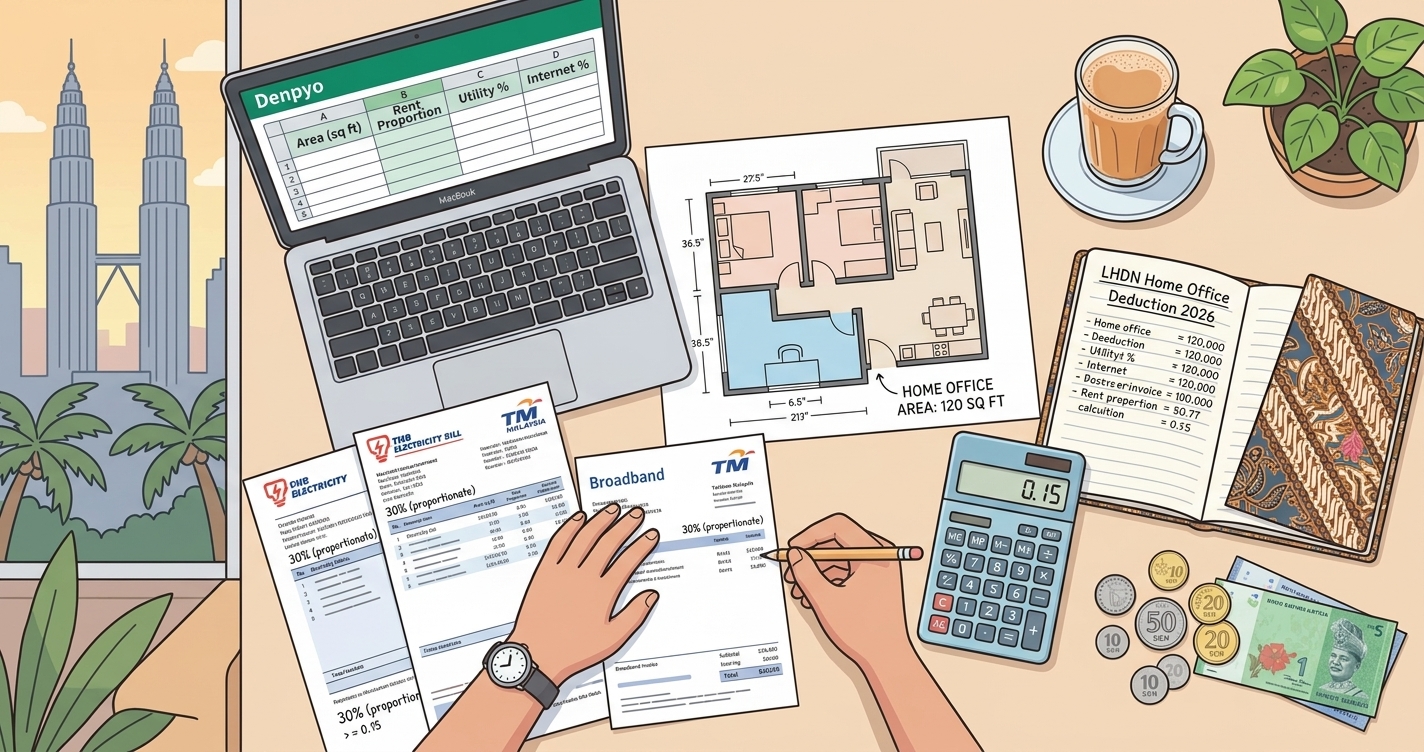
- A simple floor plan showing total area and business area with measurements
- Monthly utility bills (TNB, SYABAS, broadband) — digital copies are acceptable
- Your tenancy agreement (if renting) showing monthly rent
- Quit rent / assessment bills (if owner)
- A simple calculation sheet showing how you derived your business-use %
- Evidence of dedicated business use — photos of the workspace, business lines, equipment
LHDN rarely asks for this in Year 1, but if you are selected for a field audit (typically triggered by deductions that look high relative to declared revenue), they will want to see the trail going back years. The earlier you build the habit, the easier it becomes.
Claiming it on Form B
Home office costs flow into your Form B as business expenses under Part F (self-employment income statement). You don't declare them as a separate relief — they reduce your gross business income to arrive at adjusted income, and ultimately statutory income. On the MyTax portal (ezHASiL):
- Log in with your MyKad number and password
- Select Form B (for business income) or Form BE (if business income is below threshold and combined with employment)
- Under the business income section, enter gross income
- Enter allowable expenses — rent, utilities, internet, with the home office portion included
- The system calculates adjusted income, then statutory income
- Apply personal reliefs (including the default RM9,000 personal relief)
Our free Malaysia income tax calculator can help you estimate how the home office deduction affects your final tax before filing.
Common mistakes to avoid
- Claiming 100% of internet because "the whole house uses it for my business." If family members stream Netflix on the same connection, the personal portion is not deductible. 50–80% for a full-time remote freelancer is a defensible range.
- Including mortgage payments. Mortgage principal is never deductible. Mortgage interest is also not deductible against Malaysian business income for a personally owned property (different rules apply if the property is held by a company).
- Using the same business-use % year after year without revisiting. If you move, renovate, or change working habits, update the calculation.
- Not tracking utility bills month by month. LHDN wants to see real receipts, not estimates. Save every TNB and Astro/UniFi/Maxis bill.
- Claiming during months you were abroad or not earning. The deduction only applies during the period your home was actually used for business activity.
- Overclaiming on square footage. A 150 sq ft "home office" in a 600 sq ft studio is not a 25% deduction — LHDN will scrutinise implausibly high ratios.
Worked example: total annual savings
Let's put it all together. Yen Ling is a full-time freelance translator renting a 1,000 sq ft apartment in KL for RM2,800/month. She has a dedicated 100 sq ft home office (10% of floor area). Her annual costs:
- Rent: RM2,800 × 12 = RM33,600
- TNB: RM200 × 12 = RM2,400
- Water: RM50 × 12 = RM600
- Unifi: RM139 × 12 = RM1,668
- Cleaning service: RM160 × 12 = RM1,920
Total relevant home costs: RM40,188. At 10% business use: RM4,019 deductible. If her marginal tax rate is 19% (taxable income RM50,001–RM70,000 band), that's roughly RM764 in tax savings — more if her margin is higher. Over 5 years, that is almost RM4,000 back in her pocket simply from claiming what the law already allows.
How Denpyo helps Malaysian freelancers
The biggest barrier to claiming home office deductions correctly isn't the math — it's the documentation. You need a clean, accessible log of every utility bill, every tenancy receipt, every internet invoice across the year. Denpyo lets you snap a photo of each bill as it arrives; AI extracts vendor, date, amount, and category instantly. At tax time, you export a tidy summary that maps directly onto the allowable expenses section of Form B. No shoebox, no 2 a.m. scrambling through an email folder in July. Our free expense deductibility checker also helps you decide whether an ambiguous expense (e.g., a standing desk, a second monitor) qualifies.
Summary
Home office deductions in Malaysia are legitimate, legal, and often under-claimed. Calculate a defensible business-use percentage using floor area (and time if shared), apply it to rent, utilities, and broadband, keep clean records for 7 years, and enter the total on Form B. Start by estimating your current situation with our tax savings estimator, and consider how a simple receipt-scanning habit could save you several thousand ringgit of tax every single year. The MyInvois and e-invoicing push from LHDN has made 2026 the year Malaysian freelancers need to get digital about records anyway — claiming your home office properly is a natural extension.

Track expenses, maximize deductions
Denpyo scans your receipts and finds tax savings automatically.
More Articles
View All Articles
Side Income Tax in Hong Kong: Reporting Freelance Earnings Alongside Your Job (2026)
6 min read
Personal Assessment in Hong Kong 2026: Can It Lower Your Tax Bill?
5 min read