
Home Office Deductions in Singapore: Calculate Your Allowable Portion
Working from home as a freelancer in Singapore? Learn how to calculate and claim home office expenses — including rent, utilities, and internet — against your taxable income with IRAS.
Disclaimer: This article is for general informational purposes only and does not constitute professional tax or legal advice. Tax laws are subject to change. Please consult a qualified tax advisor or the Inland Revenue Authority of Singapore (IRAS) for guidance specific to your situation.
If you are a freelancer or self-employed professional in Singapore who works from home — whether full-time or part-time — you may be able to deduct a portion of your household expenses against your business income. This is one of the most commonly overlooked deductions among Singapore's 228,000+ self-employed workers, and getting it right can meaningfully reduce your tax bill.
In this guide, we will walk through exactly which home office expenses IRAS allows, how to calculate the deductible portion, what records you need to keep, and common mistakes to avoid.
Who Qualifies for Home Office Deductions
To claim home office expenses in Singapore, you must meet two basic conditions:
- You are self-employed or a freelancer reporting business income under Section 10(1)(a) of the Income Tax Act. Salaried employees working from home generally cannot claim these deductions — this is specifically for those filing business income.
- You use part of your home regularly and exclusively for business purposes. IRAS expects the space to be identifiable as a work area. A dedicated room is ideal, but a consistently used desk area in a shared room can also qualify, provided you can demonstrate regular business use.
According to IRAS guidance on self-employed tax obligations, allowable business expenses are those that are wholly and exclusively incurred in the production of income. Home office costs fall under this umbrella when they are proportionately allocated to business use.
What Expenses Can You Claim
The following household costs can be partially deducted when you work from home:
Rent or mortgage interest
If you rent your home, the portion of rent attributable to your workspace is deductible. If you own your home, you may deduct the mortgage interest (not the principal repayment) attributable to the workspace — though this is less common for HDB flat owners due to the CPF-funded mortgage structure.
Utilities
Electricity, water, and gas bills can be partially claimed. Electricity is typically the largest component, especially if you use air conditioning during work hours. The deductible amount is based on the proportion of your home used for business.
Internet and phone
Your broadband internet bill is partially deductible based on business usage. If you use a separate business phone line, the full cost is deductible. If you use a personal mobile phone for business, you can claim the estimated business-use percentage.
Repairs and maintenance
Maintenance costs that relate to the workspace — such as repainting the office area or repairing the air conditioning unit that serves your workspace — can be partially claimed. General household maintenance (e.g., roof repairs) is allocated proportionately.
Property tax
For property owners, the portion of property tax attributable to the workspace area can be deducted.
Insurance
Home insurance premiums can be partially claimed based on the workspace proportion.
What you cannot claim
The following are not deductible as home office expenses:
- Furniture and equipment for personal use (even if occasionally used for work)
- Renovation costs that are capital in nature (these may qualify for capital allowance instead)
- The full mortgage payment (only interest, not principal)
- Costs related to areas used purely for personal purposes
How to Calculate the Deductible Portion
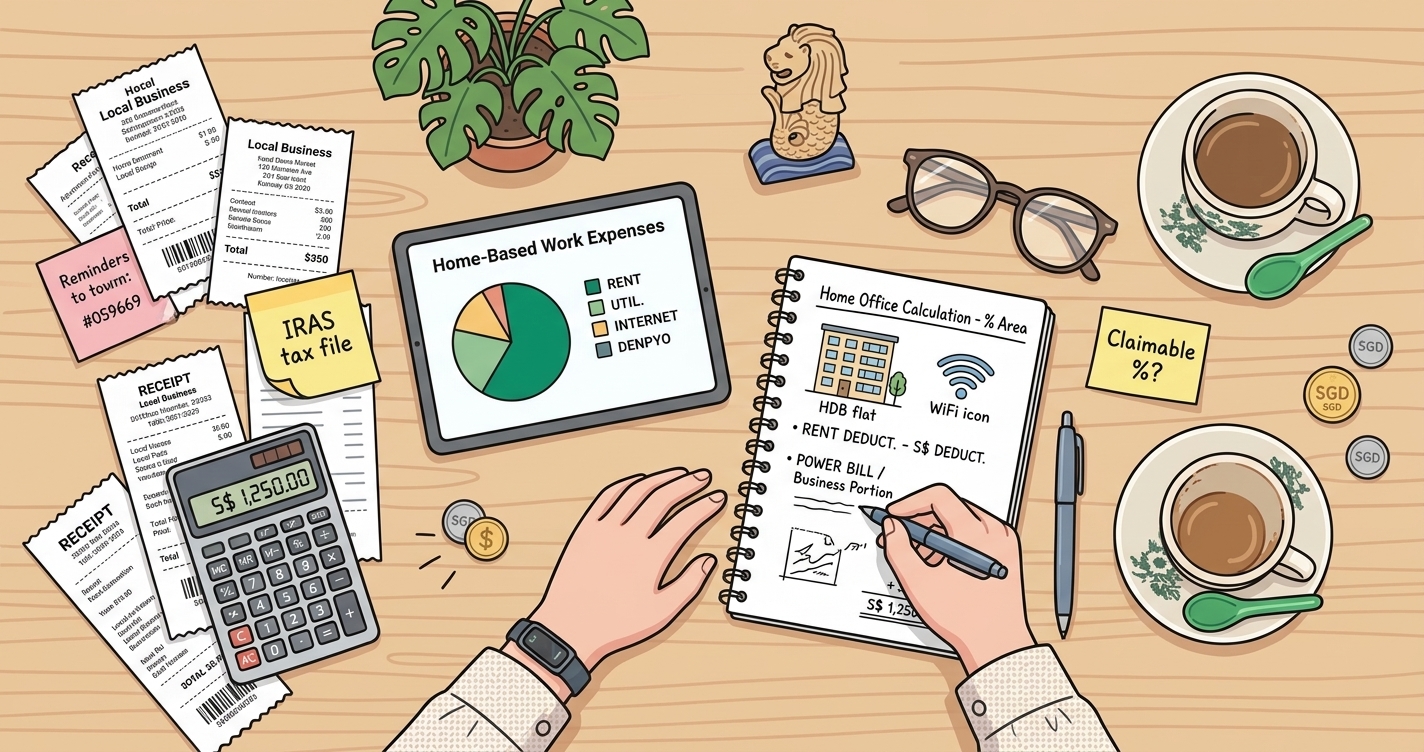
IRAS does not prescribe a single formula, but the most widely accepted method is the floor area basis. Here is how it works:
Step 1: Measure your workspace
Determine the floor area of the space you use for business. If you have a dedicated home office room of 10 square metres in an 80-square-metre apartment, your workspace ratio is 10/80 = 12.5%.
Step 2: Apply the ratio to eligible expenses
Multiply each deductible household expense by your workspace ratio. For example:
- Monthly rent: S$2,500 x 12.5% = S$312.50/month
- Monthly electricity: S$150 x 12.5% = S$18.75/month
- Monthly internet: S$50 x 50% (estimated business use) = S$25/month
Note that internet is often calculated separately from the floor area ratio because business usage may differ from the spatial proportion. A 50/50 split is commonly accepted when the connection is used for both personal and business purposes.
Step 3: Annualize and report
Total your monthly deductions over 12 months and report the annual figure as a business expense in your tax return. Using the example above:
(S$312.50 + S$18.75 + S$25) x 12 = S$4,275/year in home office deductions.
Alternative: time-based apportionment
If your workspace doubles as a personal space (e.g., a dining table used as a desk during the day), you may further adjust by a time factor. For instance, if you use the space for business 8 hours out of 16 waking hours, apply an additional 50% factor to the floor area ratio. IRAS has not published a rigid rule on this, but the principle is that the apportionment must be reasonable and defensible.
Worked Example: Freelance Graphic Designer
Let us walk through a realistic scenario. Sarah is a freelance graphic designer living in a 3-room HDB flat in Toa Payoh. Her flat is approximately 65 square metres, and she uses a 9-square-metre bedroom exclusively as her studio.
Her annual household expenses are:
- Rent: S$2,200/month = S$26,400/year
- Electricity: S$120/month = S$1,440/year
- Water: S$30/month = S$360/year
- Internet: S$49/month = S$588/year
- Property insurance: S$200/year
Workspace ratio: 9/65 = 13.8%
Deductible amounts:
- Rent: S$26,400 x 13.8% = S$3,643
- Electricity: S$1,440 x 13.8% = S$199
- Water: S$360 x 13.8% = S$50
- Internet: S$588 x 50% (business use) = S$294
- Insurance: S$200 x 13.8% = S$28
Total annual home office deduction: S$4,214
If Sarah is in the 7% marginal tax bracket (chargeable income S$40,001–S$80,000), this deduction saves her approximately S$295 in tax. At higher income levels, the savings increase proportionately. You can estimate your own savings using the Denpyo tax savings estimator.
Record Keeping Requirements
IRAS requires self-employed persons to maintain business records for 5 years from the relevant Year of Assessment. For home office deductions specifically, you should keep:
- Floor plan or measurement records showing your workspace dimensions relative to total floor area
- Utility bills (electricity, water, gas) for each month you claim
- Rental agreements or mortgage statements showing the amount paid
- Internet and phone bills with notes on estimated business-use percentage
- Photos of your workspace (optional but helpful during an audit)
The IRAS guide on record keeping for self-employed persons specifies that records must be sufficient to determine your income and allowable expenses. Digital records are acceptable — IRAS does not require paper originals as long as the digital copy is legible and complete.
Tools like Denpyo can help streamline this process. Photograph each utility bill or rental receipt as it arrives, and the AI will extract the key details — amount, date, vendor — and categorize it automatically. After five years of accumulating monthly bills, having them all digitized and searchable beats digging through filing cabinets.
Common Mistakes to Avoid
Claiming 100% of a shared space
If your workspace is a corner of the living room, you cannot claim the entire living room. Be realistic about the floor area you actually use for business. IRAS auditors look at the proportionality of claims relative to the total space.
Forgetting to adjust for part-year use
If you only started freelancing in July, you can only claim home office expenses for July through December — not the full year. Prorate accordingly.
Double-dipping with employer reimbursements
If you receive a work-from-home allowance from a client or employer (common in hybrid arrangements), you cannot also deduct the same expenses. The expense must be genuinely borne by you.
Claiming capital expenses as revenue deductions
Buying a desk or computer is a capital expenditure, not a home office running cost. These items may qualify for Section 19/19A capital allowances instead, which are depreciated over their useful life (typically 1–3 years for IT equipment under the accelerated write-off scheme).
No documentation
The most common audit trigger is claiming home office deductions without any supporting documentation. Always keep your bills, lease agreements, and workspace measurements on file.
How Home Office Deductions Fit Into Your Tax Return
When filing your annual tax return via the myTax Portal, self-employed persons report business income and expenses in the 4-line or 2-line statement (depending on revenue thresholds). Home office expenses are included as part of your total allowable business expenses.
If your annual revenue is below S$500,000, you use the simplified 2-line statement — just total revenue and total expenses. Home office costs are bundled into the total expenses figure. If your revenue exceeds S$500,000, the 4-line statement requires a breakdown, but home office costs are still reported within the operating expenses category.
Either way, you do not need to file a separate home office claim form. The deduction is simply part of your total business expense calculation.
Maximizing Your Home Office Deduction
Here are practical tips to ensure you get the full benefit:
- Dedicate a specific space. A room with a door is stronger than a desk in the corner. If possible, designate one room as your office.
- Document your setup. Take photos at the start of each tax year showing your workspace. Note the measurements and keep them on file.
- Track expenses monthly. Do not try to reconstruct a year of utility bills in March. Capture each bill as it arrives.
- Separate business internet if feasible. A dedicated business broadband plan allows you to deduct 100% of its cost, removing the need for a business-use estimate.
- Review annually. If you move, renovate, or change your workspace, update your floor area calculation and documentation.
- Combine with other deductions. Home office expenses work alongside other business deductions — transport, supplies, professional development, insurance. Use the Denpyo income tax calculator to see how combined deductions affect your total tax liability.
Summary
Home office deductions are a legitimate and often underused way for Singapore freelancers to reduce their tax bill. The key is proportionate allocation: measure your workspace, apply the ratio to eligible household costs, and keep thorough records for five years. IRAS does not make this complicated — the floor area method is straightforward, and digital records are fully accepted.
For a freelancer earning S$80,000 a year, a well-documented home office deduction of S$4,000–S$6,000 can save several hundred dollars in tax annually. Over a career, that adds up. The effort required is minimal: measure once, photograph bills monthly, and report the total each April. If you are already tracking business receipts with a digital tool, adding household bills to the routine takes almost no extra time.

Track expenses, maximize deductions
Denpyo scans your receipts and finds tax savings automatically.
More Articles
View All Articles
Side Income Tax in Hong Kong: Reporting Freelance Earnings Alongside Your Job (2026)
6 min read
Personal Assessment in Hong Kong 2026: Can It Lower Your Tax Bill?
5 min read