
Vietnam Business Expense Deductions: What Freelancers and SMEs Can Claim in 2026
Vietnamese freelancers and small businesses can significantly reduce their Personal Income Tax bill by claiming allowable business expenses. This guide covers exactly what qualifies, how to document it, and how to claim it on your annual PIT settlement.
Disclaimer: This article provides general tax information for Vietnam and does not constitute individual tax advice. Tax rules change frequently. Always verify with the General Department of Taxation (GDT) or a licensed Vietnamese tax accountant before filing. Rates and thresholds cited are based on regulations in effect as of 2026.
Why Expense Deductions Matter for Vietnamese Freelancers
Vietnam taxes individual business income under the Personal Income Tax (PIT) law, with progressive rates ranging from 5% to 35% on net taxable income. Whether you are a freelancer (cá nhân kinh doanh), a sole proprietor, or a small business owner, the expenses you can deduct directly reduce your taxable profit — and with them, your tax liability.
Despite this opportunity, many Vietnamese freelancers either over-pay because they don't claim legitimate expenses, or face penalties because they claim expenses without proper documentation. This guide tells you what qualifies, what doesn't, and exactly how to record it.
The Two Business Income Tax Methods in Vietnam
Before diving into deductions, it's important to understand how your business income is taxed, because the deduction rules differ significantly between the two methods.
Method 1: Lump-Sum Tax (Thuế Khoán)
Under this method — the default for many small traders — the tax authority applies a flat deemed rate to your revenue. You cannot deduct individual expenses under this method; the deemed rate already accounts for an average cost structure. The PIT rates for lump-sum businesses are set by Circular 40/2021/TT-BTC:
- Distribution and supply activities: 0.5%
- Services and construction: 2%
- Production, transport, construction with materials: 1.5%
- Other activities: 1%
Method 2: Declared Income (Khai Thuế Theo Doanh Thu Thực Tế)
Under this method — available to individuals whose revenue exceeds ₫100 million per year, and optional for others — you keep full accounts, report actual revenue, deduct allowable expenses, and pay PIT on the resulting net profit. This is where expense deductions become powerful. Most freelancers earning above ₫100 million annually should be on this method and actively tracking expenses.
What Counts as an Allowable Business Expense?
Under Circular 40/2021/TT-BTC and the Enterprise Law (Luật Doanh nghiệp), a business expense is deductible when it meets three criteria:
- Directly related to income-generating activities
- Actually incurred (not estimated or prepaid far in advance)
- Properly documented with valid invoices (hóa đơn hợp lệ) or receipts
20 Expense Categories Freelancers Can Deduct
Equipment and Technology
- Laptop, desktop computer, tablet: Used for work. Keep the purchase invoice (hóa đơn VAT). Large purchases over ₫30 million may need to be depreciated over 3–5 years rather than expensed in full immediately.
- Smartphone: Business-use portion deductible. If also used personally, only the business proportion can be claimed (e.g., 70% if used predominantly for work).
- Cameras, audio equipment, studio gear: Fully deductible for content creators, photographers, and videographers.
- Software subscriptions: Design tools, project management platforms, cloud storage — fully deductible in the year incurred.
Workspace and Rent
- Office rent: Fully deductible with lease agreement and payment receipts. Co-working space memberships also qualify.
- Home office proportion: If you work from home, a portion of rent, electricity, and internet can be claimed. Calculate the ratio of your work area to total home area (e.g., if your home office is 20% of your apartment floor area, claim 20% of rent and utilities).
- Utilities (electricity, water, internet): Business-use portion is deductible. Keep bills and note the business-use calculation.
Professional and Business Services
- Accounting and tax preparation fees: Fully deductible.
- Legal fees: Contract reviews, business formation costs — deductible.
- Professional association memberships: Industry groups, professional bodies — deductible.
- Training and professional development: Courses, workshops, books, online learning platforms directly related to your business — deductible.
Marketing and Client Acquisition
- Advertising costs: Facebook Ads, Google Ads, Zalo promotions, LinkedIn campaigns — fully deductible.
- Website costs: Domain registration, hosting, web development — deductible.
- Business cards, promotional materials: Printing, design — deductible.
- Client entertainment (representation expenses): Partially deductible — limited to no more than 15% of total other deductible expenses. Keep receipts and note the business purpose and client name.
Travel and Transport
- Business travel: Flights, trains, buses for client visits or business trips — fully deductible with tickets and a business purpose note.
- Motorbike/car expenses: Fuel for business trips, repair and maintenance costs. Keep receipts and a log of business trips. Personal travel is not deductible.
- Accommodation: Hotel stays for business travel — deductible with invoice.
Insurance and Financial Costs
- Business insurance: Professional liability, equipment insurance — deductible.
- Bank fees: Business account fees, payment gateway fees (e.g., for receiving international payments via Payoneer or Wise) — deductible.
What Is NOT Deductible
- Personal expenses (groceries, personal entertainment, personal clothing)
- Fines and penalties from tax authorities or government bodies
- Capital expenditure that should be depreciated (claimed in a single year when it should be spread)
- Expenses without a valid VAT invoice (hóa đơn VAT) or legal receipt where one is required
- Client entertainment exceeding the 15% cap
Documentation: What Vietnam Requires
Vietnam's tax authority takes documentation very seriously. For each expense you plan to deduct, you should have:
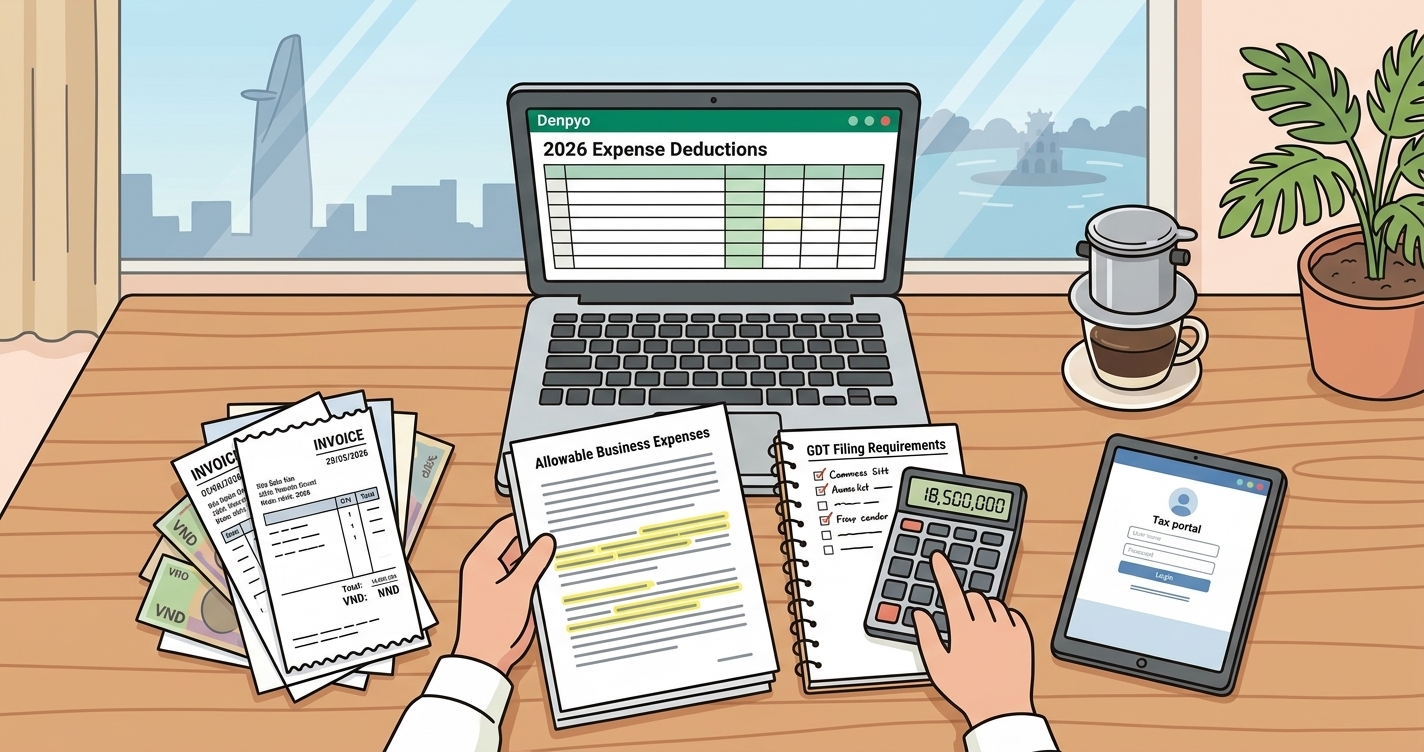
- VAT invoice (hóa đơn GTGT / hóa đơn điện tử): Required for purchases from registered businesses. Since July 2022, e-invoices (hóa đơn điện tử) have been mandatory for most suppliers. Check that invoices are on the GDT's e-invoice verification portal.
- Payment evidence: Bank transfer records are preferred over cash payments. For cash payments above ₫20 million, a bank transfer is mandatory for the expense to be deductible.
- Business purpose note: A brief description of why the expense was incurred and how it relates to your business income.
Tools like Denpyo can help you photograph and digitally store your Vietnamese receipts and invoices, automatically organizing them by category so your year-end tax settlement is straightforward.
Annual PIT Settlement: Claiming Your Deductions
If you use the declared income method, you must file an annual PIT settlement (quyết toán thuế TNCN) with your local tax authority by 31 March of the following year (or 31 May if filing through the eTax portal with an extension). You will report:
- Total revenue earned
- Total allowable expenses (with supporting documents ready for audit)
- Net taxable income
- Personal deductions (₫11 million personal relief + ₫4.4 million per dependent)
- PIT payable at progressive rates (5%–35%)
Quarterly provisional PIT declarations (tờ khai thuế tạm tính) are also required for those with actual revenue above ₫100 million per year.
Use Denpyo to Stay Organized Year-Round
The most common reason Vietnamese freelancers miss deductions is failing to capture receipts in the moment. Use Denpyo's expense checker tool to quickly verify whether a cost qualifies, and scan receipts immediately after each purchase so nothing slips through the cracks at year-end settlement time.
Summary
Vietnamese freelancers and SMEs using the declared income method can significantly reduce their PIT bill by systematically tracking and claiming business expenses. The key rules: expenses must be directly related to income generation, actually incurred, and documented with proper invoices. Keep digital records of all business invoices throughout the year — it takes minutes per transaction but can save millions of dong come settlement time.
For official guidance, refer to Vietnam's General Department of Taxation and Circular 40/2021/TT-BTC.

Track expenses, maximize deductions
Denpyo scans your receipts and finds tax savings automatically.