
Depreciation Allowances in Hong Kong: Claiming Laptops, Cameras & Equipment (2026 Guide)
Freelancers and SME owners in Hong Kong can recover the cost of capital purchases — laptops, cameras, desks, vehicles — through depreciation allowances. Here is how Initial and Annual Allowances work, which rates apply in 2025/26, and what you must keep on file to claim.
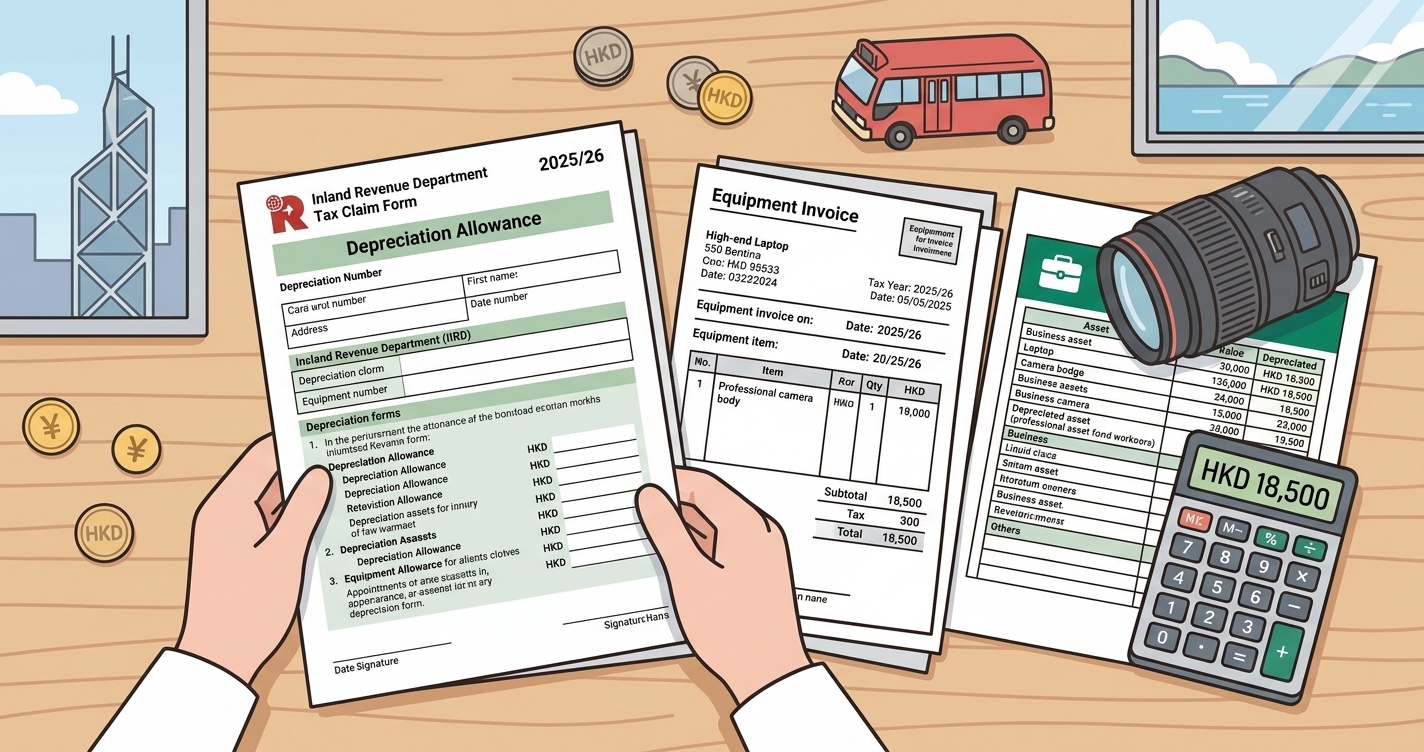
Disclaimer: This article is general information for freelancers and small-business owners in Hong Kong. It is not professional tax advice. Depreciation rules are set by the Inland Revenue Ordinance (Cap. 112) and published by the Inland Revenue Department (IRD). For anything material, consult a Hong Kong CPA or the IRD directly.
Why depreciation allowances matter to freelancers and SMEs
If you buy a laptop, camera, desk, or delivery bike for your Hong Kong freelance business, you cannot simply deduct the full price as an expense. Capital expenditure — anything with a useful life beyond one tax year — must instead be recovered through depreciation allowances. This is the mechanism the Inland Revenue Department uses to let sole proprietors and SMEs spread equipment costs across several years of assessment, while still producing meaningful tax relief in the year of purchase.
Depreciation allowances often represent the largest non-operating deduction on a freelancer's profits tax return. A HK$25,000 MacBook Pro, a HK$60,000 camera kit, or a HK$120,000 delivery vehicle all generate allowances that reduce assessable profits — sometimes substantially in year one. Understanding which allowance applies, at what rate, and what evidence the IRD expects is one of the highest-leverage compliance skills any Hong Kong self-employed person can develop.
How Hong Kong's depreciation system works
The IRD grants two main categories of allowance on plant and machinery, and a separate category on industrial or commercial buildings. For almost every freelancer and SME owner, the plant-and-machinery rules are the ones that matter.
Initial Allowance (IA)
The Initial Allowance is a one-off deduction of 60% of qualifying capital expenditure, claimed in the year of assessment in which you incur the cost. It applies broadly to machinery, equipment, furniture, computers, and vehicles used for producing assessable profits.
Annual Allowance (AA)
After the IA is taken, the remaining 40% of the cost enters a pool at a prescribed annual rate. Each year, you claim an Annual Allowance equal to the pool's reducing balance multiplied by the applicable rate. The IRD publishes three rates — 10%, 20%, and 30% — and assigns each asset class to a rate.
Typical AA rates for freelance and SME assets
- 30% pool: Computers, laptops, tablets, smartphones, printers, cameras, lighting, drones, motor vehicles, data-processing equipment.
- 20% pool: Office furniture, desks, chairs, general machinery, commercial kitchen equipment, air-conditioning units.
- 10% pool: Plant assets with a long useful life (safes, heavy-duty workshop machinery).
For a typical freelancer — designer, photographer, consultant, videographer, software engineer — almost every capital purchase falls into the 20% or 30% pool. You can confirm the applicable rate in the IRD's Departmental Interpretation and Practice Note No. 7 on plant and machinery allowances.
A worked example: claiming a HK$30,000 laptop
Suppose you buy a MacBook Pro for HK$30,000 on 10 July 2025, entirely for client work. The laptop belongs to the 30% pool.
Year of Assessment 2025/26
- Initial Allowance: HK$30,000 × 60% = HK$18,000
- Annual Allowance: (HK$30,000 − HK$18,000) × 30% = HK$3,600
- Total deduction in year 1: HK$21,600
- Closing pool value carried forward: HK$8,400
Year of Assessment 2026/27
- Annual Allowance: HK$8,400 × 30% = HK$2,520
- Closing pool value: HK$5,880
Each year thereafter you continue applying 30% to the reducing balance until the pool is effectively written down. At the top marginal rate of 15% on profits above HK$2 million, that HK$21,600 year-one deduction is worth roughly HK$3,240 in real tax saved. For two-tiered profits-tax payers at the 7.5% band, it is about HK$1,620 saved in the first year alone.
Mixed private and business use
If an asset serves both private and business purposes — a very common situation for freelancers working from home — you must apportion the allowance. The IRD expects a reasonable, documented basis for the split.
Example: A photographer buys a HK$40,000 camera and estimates 80% business use based on an annual log of shoots versus personal photography. Only 80% of the IA and AA can be claimed. The remaining 20% is disallowed. Keep the usage log — not just the receipt.
Disposals and balancing adjustments
When you sell, scrap, or stop using an asset, the IRD calculates a balancing allowance (if the disposal proceeds are lower than the pool balance allocated to that asset) or a balancing charge (if proceeds exceed the unrelieved balance, recapturing excess allowances as income).
In practice, most freelancers sell old laptops or cameras on Carousell or Facebook Marketplace for well below the pool balance, producing a modest balancing allowance. The key compliance point is to record the disposal date and proceeds so the balancing adjustment is accurate in the next BIR60 return.
What documentation must you keep?
The IRD can request substantiation for any allowance on audit — typically within six years of filing. At a minimum, retain:
- Original supplier invoice showing the date, item description, and price paid in HK$
- Proof of payment (bank transfer, FPS, credit-card statement, or Stripe/PayPal record)
- A short note linking the asset to your business activity (e.g., "Main client-edit laptop — replaces 2021 MacBook Air")
- Usage apportionment log if the asset has mixed private use
- Disposal record (sale receipt, scrapping note, or insurance write-off confirmation) when the asset leaves the pool
Hong Kong has a seven-year record retention requirement under section 51C of the Inland Revenue Ordinance. Receipts from faded thermal paper, emailed PDFs, and Stripe auto-receipts all qualify as long as they are clearly readable and linked to the specific asset.
Digitising receipts for depreciation claims
Thermal receipts from Fortress, Broadway, or Apple retail fade within 12–24 months — well short of the seven-year retention window. Tools like Denpyo can auto-extract the vendor, date, and amount from a photo of a receipt and store a searchable digital record, keeping your depreciation pool reconciled to source documents for the full retention period. Combined with an annual spreadsheet listing each pool (30%, 20%, 10%) and its opening/closing balance, this gives you the minimum evidence the IRD expects during a profits-tax audit.
Special cases freelancers and SMEs should know
Electric vehicles
EVs bought for business use qualify for the full 60% IA plus the 30% AA, with no distinction from petrol vehicles at the profits-tax level. The HK government's EV first registration tax concession is a separate regime and does not affect depreciation.
Software and websites
Off-the-shelf software (Adobe Creative Cloud, Figma Enterprise, Microsoft 365) is usually treated as a deductible revenue expense rather than a capital asset, because it is paid annually and has no enduring benefit. Bespoke website development or a custom CRM build that has an enduring useful life may, however, be capitalised and claimed through allowances — talk to a CPA for large software projects.
Shared assets across family members
If your spouse also uses the laptop for their own freelance work, only the portion used in your business qualifies. Split the cost by agreed business-use percentages and claim on each sole proprietorship separately.
How depreciation interacts with the 100% tax rebate
For year of assessment 2025/26, the HKSAR government extended a 100% profits-tax reduction capped at HK$3,000 (see our 2025/26 tax rebate guide). The rebate is applied after all allowances — including depreciation — are computed, so higher depreciation claims still reduce your pre-rebate profits, and the rebate then caps the final bill.
Practical checklist before filing your BIR60
- List every capital purchase over HK$2,000 during the year of assessment.
- Assign each item to the 30%, 20%, or 10% pool.
- Calculate the 60% IA on current-year additions.
- Add the remaining 40% to the pool and compute the AA on the total reducing balance.
- Apportion for any private-use assets and keep the usage log.
- Record disposals and compute balancing allowances or charges.
- File the totals on BIR60 Part 5 (Sole Proprietorship) alongside your other deductions.
To estimate the real tax impact of a specific purchase, try our tax savings estimator, or check whether an expense qualifies as capital or revenue using the expense deductibility checker.
Common mistakes to avoid
- Claiming the full price as a revenue expense. Capital items must go through the allowance pools — a common error on self-prepared BIR60s. Reputable guidance from firms such as Deloitte Hong Kong and PwC Hong Kong repeatedly flags this.
- Forgetting the apportionment log. A mixed-use asset without usage evidence is an easy target for an IRD adjustment.
- Mixing tax years. The IA applies in the year of purchase, not the year payment is settled. A laptop bought 28 March 2026 still falls in the 2025/26 year of assessment.
- Losing the original invoice. Without a source document, the entire allowance can be disallowed on audit.
Summary
Hong Kong's depreciation system rewards freelancers and SMEs who track capital spending carefully: a 60% Initial Allowance followed by ongoing 30%, 20%, or 10% Annual Allowances can turn a single large purchase into five or six years of profits-tax relief. Pool your assets correctly, apportion mixed-use items, and keep every invoice for the full seven-year retention window. Done well, depreciation is often the single largest lever a sole proprietor has on their effective tax rate — and it compounds every year you continue to invest in your business.

Track expenses, maximize deductions
Denpyo scans your receipts and finds tax savings automatically.