
Hong Kong 2025/26 Tax Rebate: How Freelancers and SMEs Benefit from the 100% Reduction
The Financial Secretary's Budget included a one-off profits tax reduction for 2024/25. Here's what Hong Kong freelancers and small businesses need to know about claiming the rebate on their upcoming 2025/26 BIR60 or profits tax return.
Disclaimer: This article is general information only and not tax advice. Rebate amounts and caps are set each year in the Financial Secretary's Budget and must be enacted by the Legislative Council. Always verify the current year's figures on the Inland Revenue Department website or consult a registered accountant for your situation.
Why the tax rebate matters for Hong Kong freelancers and SMEs
Every year, the Financial Secretary announces a package of tax concessions in the Hong Kong Budget. For freelancers and small-medium enterprises (SMEs), the most talked-about measure is usually the one-off reduction in profits tax and salaries tax — commonly called the "tax rebate" even though it works as a direct deduction against your final assessed tax rather than a cash refund.
If you're a sole proprietor, partner, or company director running a small operation in Hong Kong, the rebate can meaningfully cut your final tax bill for the year. In recent Budgets, the cap has ranged from HK$1,500 to HK$6,000 per case, with the actual amount calculated as 100% of the tax otherwise payable, subject to the announced ceiling.
How the rebate actually works
The mechanism is simpler than it sounds. Once the IRD finalises your assessable profits for the year and calculates the tax due, it applies the rebate automatically before issuing your Notice of Assessment. You do not need to file a separate claim form.
- Step 1 — IRD calculates your profits tax. For unincorporated businesses (sole proprietors, partnerships), the two-tier rate is 7.5% on the first HK$2 million of assessable profits and 15% above. For companies, the rates are 8.25% and 16.5%.
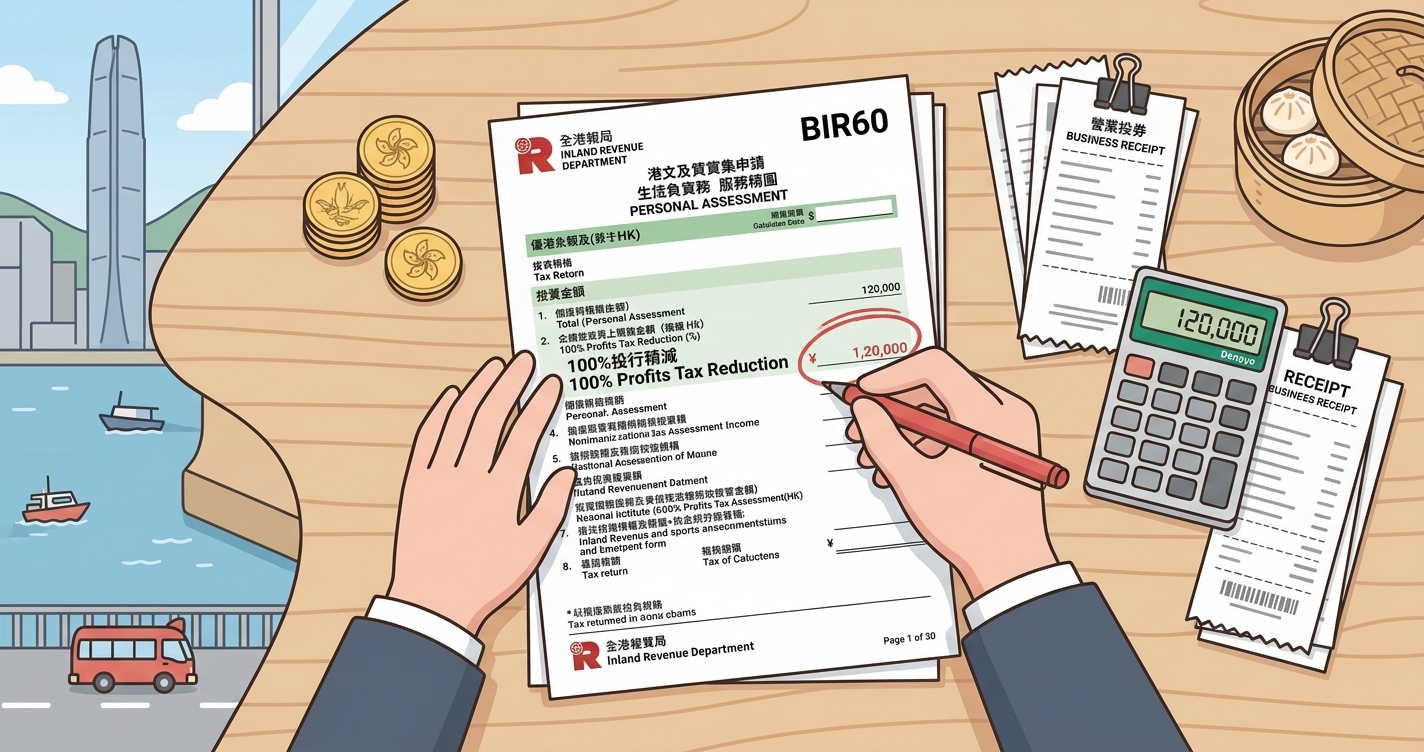
- Step 2 — IRD applies the 100% reduction. If your profits tax payable comes to HK$2,800 and the announced cap is HK$3,000, you receive a full reduction and your final tax bill is HK$0. If your tax payable is HK$12,000 and the cap is HK$3,000, you pay HK$9,000.
- Step 3 — Rebate is reflected on your Notice of Assessment. Look for the line "Tax Reduction" in your 2025/26 assessment. This is where you'll see the rebate applied.
Important: The rebate ceiling announced in a given Budget year applies to the year of assessment referenced — e.g., the rebate announced in February 2025 applied to 2024/25, not 2025/26. Confirm which year of assessment your rebate covers before filing.
Who qualifies for the profits tax reduction?
The profits tax rebate is available to anyone assessed to profits tax in Hong Kong, including:
- Sole proprietors running freelance businesses (design, consulting, content, coaching, translation, etc.)
- Partnerships — each partner's share of partnership profits is eligible separately up to the cap
- Limited companies filing Form BIR51
- Freelancers who are taxed under profits tax rather than salaries tax (the IRD makes this distinction based on whether you're carrying on a "trade, profession or business")
You don't need to be a Hong Kong permanent resident. Non-residents who carry on business in Hong Kong and have Hong Kong-sourced profits are equally eligible. What matters is that you're assessable to profits tax for the relevant year.
Case studies: What the rebate looks like in practice
Case 1: Solo freelance designer
Mei-Ling is a freelance UI designer invoicing HK$480,000 in gross income for the year, with HK$110,000 in deductible business expenses (laptop, software subscriptions, home office share, co-working membership).
- Assessable profits: HK$370,000
- Profits tax at 7.5%: HK$27,750
- Rebate (100%, capped at HK$3,000): -HK$3,000
- Final tax payable: HK$24,750
Mei-Ling saves HK$3,000 — roughly the cost of two months of her co-working desk.
Case 2: Consulting partnership (two partners)
Wilson and Priya run a small consulting partnership. Assessable profits are HK$1,200,000, split 50/50.
- Each partner's share: HK$600,000
- Each partner's profits tax at 7.5%: HK$45,000
- Rebate per partner (capped at HK$3,000): -HK$3,000 each
- Combined household saving: HK$6,000
Case 3: E-commerce SME (limited company)
Bright Path Ltd. is a two-person online retailer with HK$850,000 in assessable profits.
- Profits tax at 8.25% (first HK$2M): HK$70,125
- Rebate (capped at HK$3,000): -HK$3,000
- Final tax payable: HK$67,125
What you still need to do — filing your BIR60 or BIR51
Although the rebate is applied automatically, you still need to file your return accurately to get there. Key reminders for the 2025/26 filing cycle:
- BIR60 issued in May 2026 for individuals (sole proprietors, partners). The standard filing deadline is one month from issue date, with extensions typically granted to early August for e-filers.
- BIR51 issued in April 2026 for corporations. Standard deadline is one month; block extensions run into November for 31 December year-ends.
- File through the eTAX portal — it's faster, auto-calculates provisional tax, and gives you automatic extensions compared to paper filing.
Maximising the value of your rebate
The rebate itself is small, but combining it with aggressive (and legal) expense capture can compound your savings. Small Hong Kong freelancers routinely underclaim on:
- Proportionate home office costs (a share of rent, electricity, internet, and cleaning if you work from home regularly)
- Equipment and software depreciation allowances — the IRD's depreciation allowance rules let you claim initial and annual allowances on capital items
- Mobile and internet bills pro-rated between personal and business use
- Training courses, professional subscriptions, and industry event fees
The catch: every deduction requires documentary evidence retained for 7 years under the Inland Revenue Ordinance. Paper receipts fade, and chasing down an invoice from 2024 in 2031 is no one's idea of a good time. Tools like Denpyo can auto-extract amounts, dates, and categories from receipt photos, saving the JSON record to the cloud where your future self — or your accountant — can retrieve it in seconds. It's the kind of unglamorous infrastructure that makes sure you actually benefit from rebates like this one.
Want a quick check on whether your business purchase is deductible? Try our free Expense Deductibility Checker, or estimate your likely profits tax with the Income Tax Calculator.
Common mistakes when expecting a rebate
- Assuming it's a cash refund. It isn't. The rebate reduces tax payable. If you already paid provisional tax for 2025/26, any overpayment is refunded or credited to the next year — but only after your final assessment.
- Not filing because "the rebate covers my tax anyway." You must still file the return, or you'll face a penalty under section 80(2) of the Inland Revenue Ordinance.
- Double-counting salaries tax rebates. If you have both employment and freelance income, you get separate reductions — one for salaries tax and one for profits tax — each capped independently.
- Forgetting provisional tax. The rebate applies to final tax, not to provisional tax for the following year. Budget for provisional tax separately.
Summary: Claim what you're owed, file on time
The Hong Kong profits tax rebate is a small but reliable perk for freelancers and SMEs — it applies automatically, requires no extra paperwork, and stacks on top of whatever deductions you already claim. The real work happens before filing: tracking every allowable expense, keeping receipts for 7 years, and making sure your BIR60 or BIR51 is accurate.
If you only take three things from this guide: (1) confirm the current year's rebate cap on the IRD website before filing, (2) file even if you expect zero tax after the rebate, and (3) invest in a system — paper folder, spreadsheet, or app like Denpyo — that captures every receipt the day you get it. The rebate will arrive on its own. The deductions won't.

Track expenses, maximize deductions
Denpyo scans your receipts and finds tax savings automatically.