
Hong Kong Personal Allowances 2025/26: How Freelancers Cut Their Tax Bill
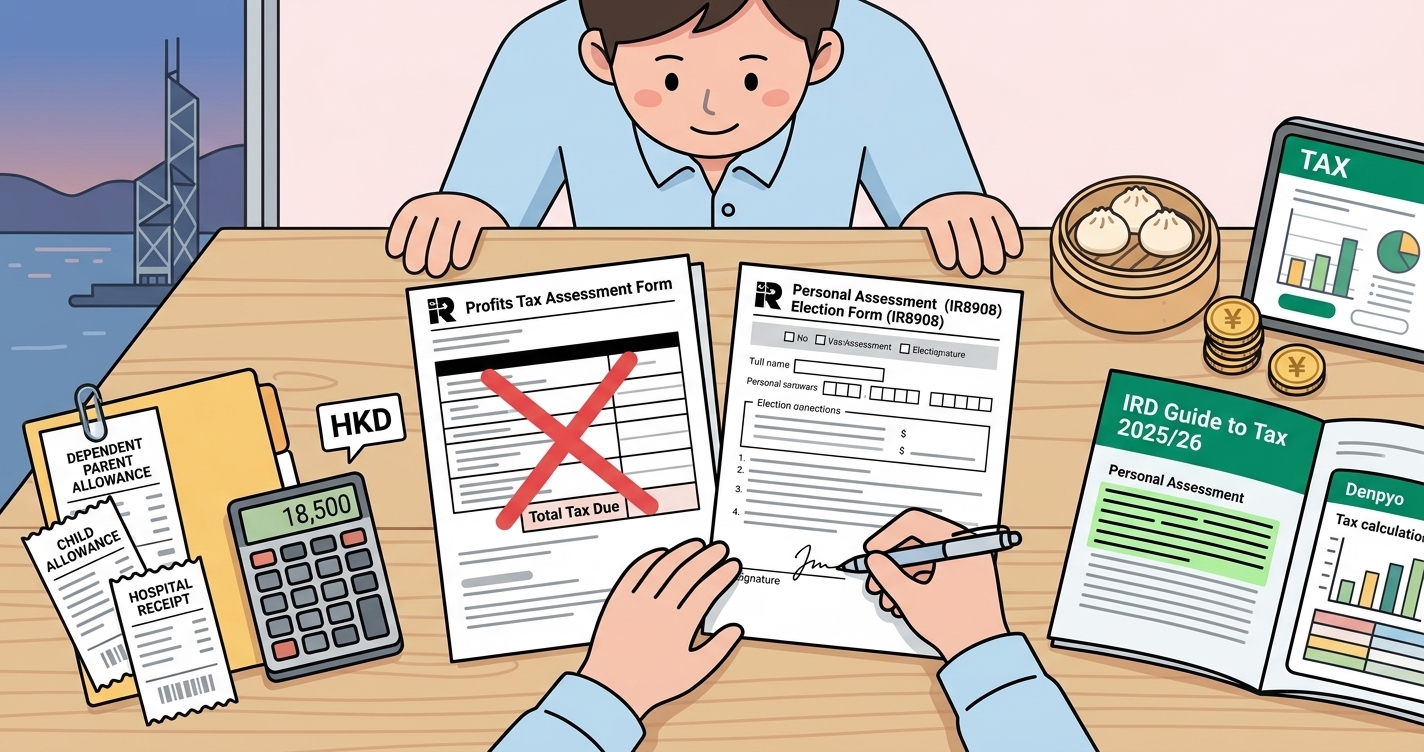
Profits tax has no personal allowances, but electing Personal Assessment lets sole proprietors claim the basic, married, child and dependent-parent allowances. Here is how each allowance works and how to decide if Personal Assessment saves you money.
Disclaimer: This article provides general information as of June 2026 and is not tax advice. Allowance amounts and rules are set by the Hong Kong Inland Revenue Department (IRD) and can change at each Budget. Confirm current figures and your eligibility with the IRD (ird.gov.hk) or a qualified tax adviser.
If you run a freelance business or a sole proprietorship in Hong Kong, you have probably noticed something: your Profits Tax bill is calculated straight on your assessable profits, with no personal allowances to soften it. Yet a salaried friend earning the same amount pays far less, because employees get a generous basic allowance and progressive rates. The good news is that you can often access those same allowances — through an election called Personal Assessment. This guide explains the main allowances and when claiming them pays off.
Why allowances usually skip sole proprietors
Hong Kong taxes different types of income separately: Salaries Tax for employment, Profits Tax for business, and Property Tax for rental income. Personal allowances (the basic allowance, married person's allowance and so on) apply automatically under Salaries Tax. Under Profits Tax, your tax is simply assessable profits multiplied by the profits-tax rate (7.5% on the first HK$2 million, 15% above), with no personal allowances deducted.
For many small operators, that means paying more than they need to. Personal Assessment fixes this by letting eligible individuals combine their income from all sources, deduct personal allowances, and then apply the same progressive Salaries Tax rates. If your income is modest, this can produce a lower bill than flat Profits Tax.
The main personal allowances (2025/26)
The figures below are for the year of assessment 2025/26 and are carried into 2026/27 unless the Budget changes them. Always confirm the latest amounts on the IRD allowances page.
- Basic allowance: HK$132,000. Granted to every taxpayer who is not claiming the married person's allowance.
- Married person's allowance: HK$264,000. Claimed where a couple elects to be jointly assessed and one spouse has little or no income.
- Child allowance: HK$130,000 for each of the 1st to 9th child, with an additional HK$130,000 in the year the child is born.
- Dependent parent / grandparent allowance: HK$50,000 for each dependant aged 60 or above (HK$25,000 if aged 55–59), with an additional same-amount allowance if the dependant lives with you throughout the year.
- Single parent allowance: HK$132,000.
- Disabled dependant allowance: HK$75,000 for each eligible dependant.
These allowances are deducted from your total income before the progressive rates apply, which is why they matter so much for keeping your effective tax rate low.
How Personal Assessment uses your allowances
When you elect Personal Assessment on your tax return (form BIR60), the IRD does the following:
- Adds together your assessable profits, any salary, and 80% of net rental income.
- Deducts approved charitable donations and allowable business interest.
- Deducts your personal allowances (basic, married, child, dependent parent, and so on).
- Applies the progressive Salaries Tax rates (2% / 6% / 10% / 14% / 17%) to the remainder, capped by the standard rate.
The IRD will, in practice, assess you the way that produces the lower tax, but you should still tick the Personal Assessment box to be safe. You can read the official rules on the IRD Personal Assessment page and check allowance amounts in the IRD Allowances, Deductions and Tax Rate Table.
Worked example
Suppose Mei is a single freelance illustrator with assessable profits of HK$300,000 and no other income.
Under Profits Tax: HK$300,000 × 7.5% (two-tiered first band) = HK$22,500, with no allowance.
Under Personal Assessment: HK$300,000 − HK$132,000 basic allowance = HK$168,000 net chargeable income. Applying progressive rates (2% on the first HK$50,000, 6% on the next HK$50,000, 10% on the next HK$50,000, 14% on the remaining HK$18,000) gives roughly HK$11,520. Mei saves about HK$11,000 simply by electing Personal Assessment.
For higher earners, flat Profits Tax can be cheaper, so it is worth comparing both. Estimate your position with our income tax calculator before you file.
Records are what make allowances stick
Allowances reduce your tax, but only on top of an accurate profit figure — and your profit is only as low as the expenses you can prove. Every receipt you fail to keep inflates your assessable profits and quietly raises your tax. The IRD requires businesses to keep records for seven years, so a reliable system matters.
This is where Denpyo helps. Photograph a receipt or invoice and its AI extracts the date, amount and category automatically, building a clean expense record you can hand to your accountant at filing time. It even shows an estimated tax impact as you scan, so you can see how each expense lowers your profits. Try the tax savings estimator or the expense checker to see how much your costs reduce your bill.
Summary
Profits Tax gives sole proprietors no personal allowances, but electing Personal Assessment lets you claim the basic (HK$132,000), married, child and dependent-parent allowances and pay progressive rates instead. For modest incomes this often beats flat Profits Tax; for higher incomes it may not, so compare both. Whichever route you take, keep every receipt for seven years — accurate expense records are what let your allowances do their job.
Track expenses, maximize deductions
Denpyo scans your receipts and finds tax savings automatically.
More Articles
View All Articles
Malaysia Lifestyle Tax Relief 2026: Claim RM2,500 (and RM1,000 for Sports)
5 min read
Capital Allowances in Malaysia: Claiming Your Laptop, Camera & Equipment (2026)
5 min read