
No Receipt? How to Still Claim the Expense with a Cash Voucher (Japan, 2026)
Train fares, condolence money, split bills, vending machines—plenty of business expenses come without a receipt. With the right record, you can still deduct them. Here is how to write a Japanese cash voucher (shukkin denpyo), what backup evidence to keep, and how to stay compliant with the 2026 Electronic Books Preservation Act.
Disclaimer: This article is general information as of June 2026 and is not tax advice. For your specific situation, consult your local tax office or the National Tax Agency (nta.go.jp) or a licensed tax accountant.
"There's no receipt for a train ticket." "I gave condolence money at a client's funeral—of course there was no receipt." "We split the lunch bill, so I couldn't get a receipt for my share." Every freelancer and small business owner in Japan runs into this. The good news: an expense without a receipt can still be deducted, as long as it relates to your business and you keep a proper record. What matters is not the slip of paper, but being able to show the expense really happened.
This guide explains how to handle expenses you can't get a receipt for, how to write the document that does the heavy lifting—the cash voucher (shukkin denpyo)—and how to comply with Japan's Electronic Books Preservation Act as it stands in 2026.
A receipt is not an absolute requirement
Many people assume a receipt is mandatory to claim an expense. It isn't. What the law asks for is that the spending is business-related and that the amount, date, payee and purpose are recorded in your books. Receipts are simply the most common form of supporting evidence. So if you keep an alternative record, a receipt-less expense is perfectly deductible—while a receipt with no bookkeeping behind it does little good.
Common situations with no receipt
- Public transport fares: Train and bus tickets, or tapping an IC card, usually produce no receipt.
- Ceremonial gifts (keicho-hi): Condolence or celebration money for clients—by nature, no receipt is issued.
- Split restaurant bills: When a meeting meal is divided, you don't get a receipt for your portion.
- Vending machines, coin parking, coin lockers: Often no slip at all.
- Peer-to-peer and flea-market purchases: Private sellers may not issue receipts.
- Lost or forgotten receipts: The evidence simply went missing.
The star of the show: the cash voucher
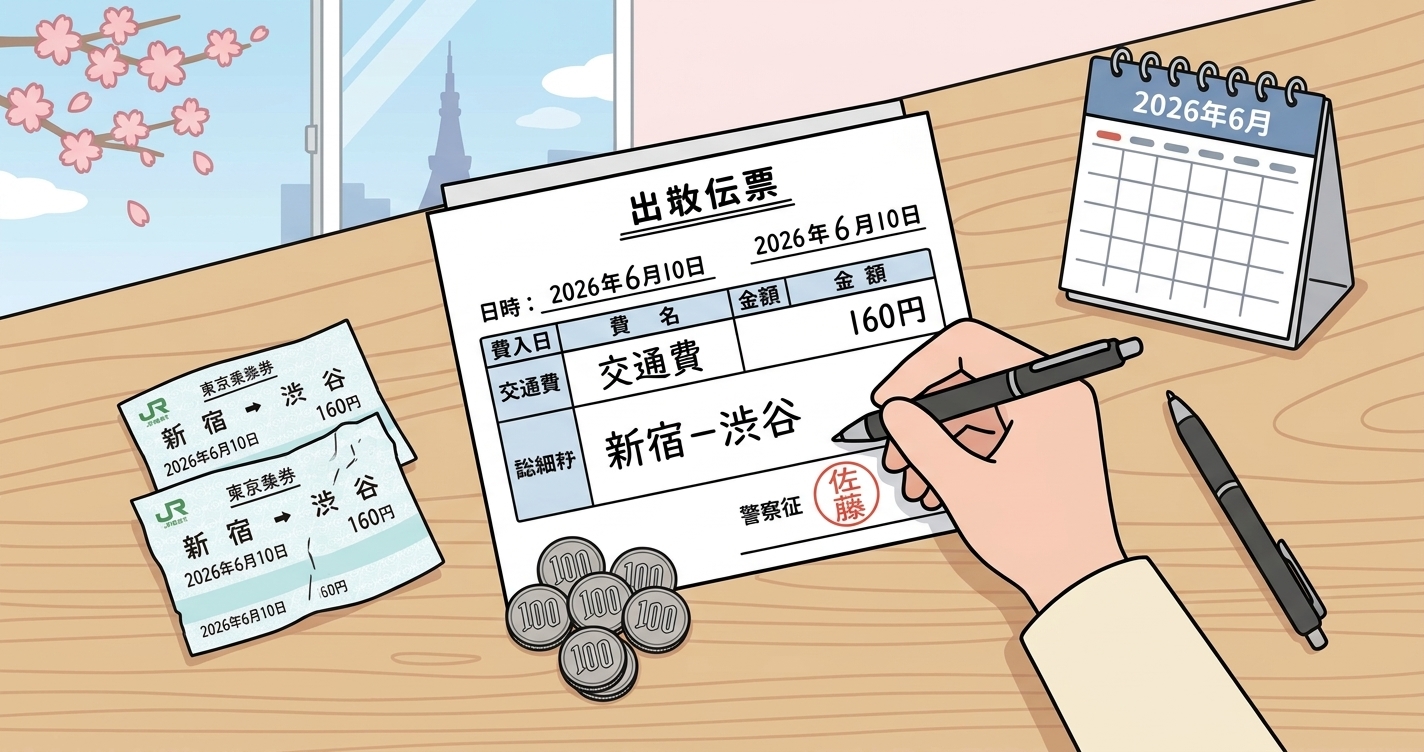
This is where the cash voucher (shukkin denpyo) comes in. It is an internal slip you fill out yourself to record a cash payment, available at stationery shops, 100-yen stores, or inside accounting software. It can stand in for a receipt—but because it is self-reported, it must be written accurately and based on facts.
Five fields to complete
- Date of payment.
- Payee—who or where you paid (e.g., JR East, ABC Co., the Tanaka family funeral).
- Account category—travel, entertainment, supplies, and so on.
- Amount actually paid.
- Description—the purpose, stated specifically: "Shinjuku to Shinagawa, round trip for A Co. meeting."
Example: 2026/6/24 — JR East — Travel — JPY 680 — "Shinjuku→Shinagawa, round trip, meeting with A Co."
Evidence that strengthens a voucher
Vouchers are convenient, but relying on a stack of them invites doubt during a tax audit. Wherever you can, pair the voucher with backup evidence:
- Transport: IC card usage history, a screenshot of the route-search app, a travel expense report.
- Ceremonial gifts: the funeral thank-you card, invitation, or announcement showing whose event it was.
- Split bills: the restaurant receipt for the total, annotated "split 4 ways, my share JPY X," or a record of money sent to the organiser.
- General: credit-card statements, bank passbook withdrawals, and email or chat history with the other party.
When you lose a receipt
If you lose a receipt, first ask the issuer to reissue it. If that's not possible, prove the payment with a card statement, bank record or order-confirmation email, and back it up with a cash voucher. The higher the amount, the more you should prioritise securing solid evidence.
Meeting the 2026 Electronic Books Preservation Act
Since January 2024, data from electronic transactions must be stored electronically—and this applies to sole proprietors and freelancers too. Key points:
- Receipts and invoices received by email or online (PDFs, etc.) cannot simply be printed and filed on paper; the electronic data itself must be retained.
- Paper receipts may still be kept on paper, or—if requirements are met—digitised via scanner storage using a phone or scanner.
- Storage must ensure integrity (a timestamp, or a system that logs edits and deletions) and searchability (you can search by date, amount and counterparty).
Your own cash vouchers are best stored the same way: scan paper ones, keep digital ones as data. See the NTA's Electronic Bookkeeping portal for the full requirements.
Collect evidence and see your savings with Denpyo
Receipts, card statements and cash vouchers are different formats, and managing them separately is a chore. With Denpyo, you just photograph a receipt, invoice, card statement or cash voucher and the AI reads the date, amount, payee, account category and consumption-tax breakdown, storing everything in a form that matches the e-bookkeeping search requirements (date, amount, counterparty). It also shows your estimated tax savings as you go, so you can watch each expense shrink your tax bill. Start with the expense checker to confirm whether a cost is deductible, then try the tax savings estimator.
Summary
A missing receipt does not mean a lost deduction. If the cost is business-related and you record it with a cash voucher plus backup evidence, you can claim it with confidence. Write the voucher accurately—date, payee, category, amount, description—and attach IC histories, funeral cards or card statements wherever you can. And in 2026, anything received electronically must be stored electronically and searchably. The habit of recording every expense as it happens is your best protection and your biggest source of tax savings.

Track expenses, maximize deductions
Denpyo scans your receipts and finds tax savings automatically.
More Articles
View All Articles
Capital Allowances in Malaysia: Claiming Your Laptop, Camera & Equipment (2026)
5 min read
CP500 Tax Instalments for Malaysian Freelancers 2026: Pay, Revise, Avoid Penalties
4 min read