
Singapore Tax Rebates, Reliefs & Allowances 2026: The Freelancer & SME Guide
IRAS offers over 20 personal reliefs plus a Year of Assessment 2026 tax rebate. Here is how Singapore freelancers and SME owners can stack reliefs and allowances to legally cut their income tax bill — with worked examples, caps, and eligibility rules.
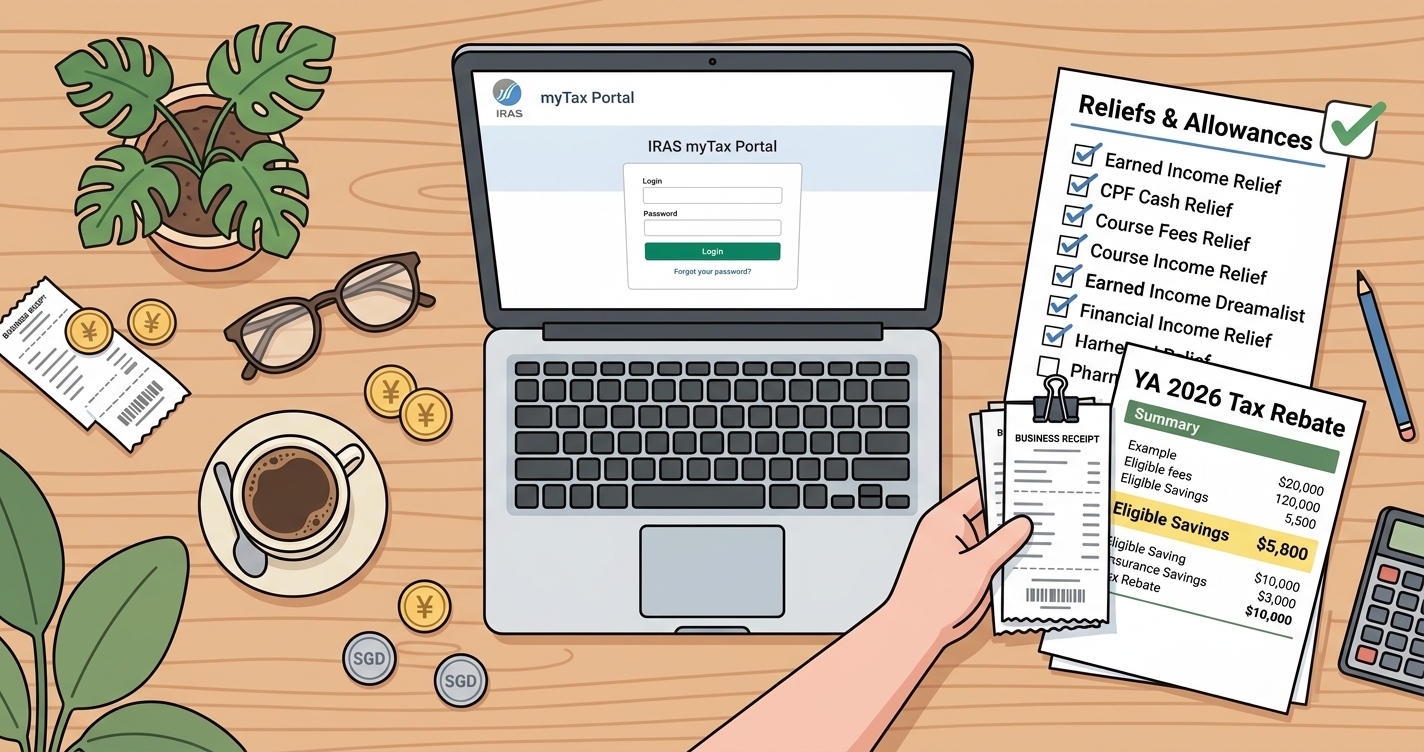
Disclaimer: This article is general information for Singapore freelancers and SME owners. It is not professional tax advice. Every relief is governed by specific conditions published by the Inland Revenue Authority of Singapore (IRAS). For anything material, speak with a tax agent or check the official pages linked below.
Why reliefs and rebates matter more than most freelancers realise
Singapore's headline income-tax rates look modest — 0% on the first S$20,000 and 24% at the top — but that is only half the story. What actually determines your bill is your chargeable income, which is assessable income minus every relief and deduction you qualify for, multiplied by the progressive brackets, and then reduced by any rebate granted in the Budget.
For self-employed persons and SME owners, stacking reliefs intentionally is the single biggest legal lever on your tax bill. A freelancer earning S$90,000 in net trade income who claims only the Earned Income Relief pays hundreds more than one who layers on CPF relief, MediSave top-ups, SRS contributions, and parent or child reliefs. This guide walks through the main reliefs for Year of Assessment (YA) 2026 — for income earned in calendar year 2025 — and shows how to combine them correctly.
The three-layer model: relief vs deduction vs rebate
Singapore's tax system distinguishes three mechanisms, and mixing them up is a common source of over- and under-claiming.
1. Business deductions
Expenses wholly and exclusively incurred to produce your trade income (subscriptions, laptop depreciation, home-office utility share). These come off gross revenue before reliefs. See our 15 deductions guide.
2. Personal reliefs
Statutory allowances against assessable income (Earned Income Relief, CPF, spouse, child, parent, course fees, etc.). These are capped in aggregate at S$80,000 per YA.
3. Tax rebates
Direct reductions of the tax bill itself, announced in the annual Budget. For YA 2026, the government extended a Personal Income Tax Rebate of 60% capped at S$200, applied after all reliefs and the progressive brackets. See the IRAS rebates page for the current Budget position.
Think of it as: revenue → (minus deductions) = assessable income → (minus reliefs, capped at S$80k) = chargeable income → tax at progressive rates → (minus rebates) = your final bill.
Earned Income Relief (automatic — every freelancer gets it)
This is the default relief for anyone with trade, business, or employment income. IRAS grants it automatically; you do not have to claim. Amounts depend on age at 31 December:
- Below 55: S$1,000
- 55 to 59: S$6,000
- 60 and above: S$8,000
Persons with disabilities receive enhanced Earned Income Relief of S$4,000, S$10,000, or S$12,000 respectively. Nothing to file — IRAS mirrors your NRIC date of birth against your tax filing.
CPF and retirement reliefs: the freelancer's biggest single lever
Self-employed persons in Singapore contribute to MediSave through CPF on their net trade income, and the contribution is fully relief-eligible.
Compulsory MediSave contribution relief
If you earn more than S$6,000 of net trade income in the year, you must contribute to MediSave at rates ranging from 4% (under age 35) to 10.5% (age 65 and above), capped at the Basic Healthcare Sum. The full contribution is fully deductible as Compulsory MediSave Contribution Relief — there is no separate cap beyond the S$80,000 personal-relief ceiling.
Voluntary Contribution to MediSave (VC-MA)
You may top up your own MediSave account with after-tax cash up to the Basic Healthcare Sum, and that voluntary top-up is also relief-eligible subject to the Annual CPF Contribution Cap. Freelancers commonly use this to accelerate retirement savings while trimming their tax bill.
Supplementary Retirement Scheme (SRS)
SRS remains the most flexible retirement-savings vehicle. The 2025 contribution cap is S$15,300 for Singapore citizens and PRs, and S$35,700 for foreigners. Every dollar contributed reduces chargeable income dollar-for-dollar (within the S$80k relief cap). Withdrawals after the statutory retirement age are taxed at 50% of the amount withdrawn. Official rules on the IRAS SRS page.
CPF Cash Top-Up Relief
Cash top-ups to your own Retirement Account / Special Account, or to those of family members (parents, spouse, siblings, grandparents) qualify for up to S$8,000 relief for yourself and a separate S$8,000 for family members. Useful for SMEs whose owners want to help parents' MediSave while lowering the owner's own chargeable income.
Family-related reliefs
Qualifying Child Relief (QCR) and Handicapped Child Relief (HCR)
- QCR: S$4,000 per child
- HCR: S$7,500 per child (enhanced when the child has a disability)
Can be shared between working parents — typically claimed by the spouse with higher chargeable income for the biggest benefit.
Working Mother's Child Relief (WMCR) — structural change from YA 2025
WMCR is now a fixed dollar amount (S$8,000 for first, S$10,000 for second, S$12,000 for third and each subsequent child) rather than a percentage of income. Available only if the mother is a Singapore citizen and the child is also a Singapore citizen. Details on the IRAS WMCR page.
Parent / Handicapped Parent Relief
- Parent not living with you: S$5,500
- Parent living with you: S$9,000
- Handicapped parent not living with you: S$10,000
- Handicapped parent living with you: S$14,000
Conditions: parent must be aged 55+ with annual income ≤ S$4,000 (waived if parent is handicapped) and you must have spent at least S$2,000 supporting them in the year.
Spouse / Handicapped Spouse Relief
- Spouse relief: S$2,000 (if spouse's annual income ≤ S$4,000)
- Handicapped Spouse Relief: S$5,500
Grandparent Caregiver Relief (GCR)
S$3,000 for working mothers whose parent or grandparent cares for a Singaporean child under 12. Useful for freelancers with school-age kids and a helper-grandparent at home.
Skills, insurance, and special reliefs
Course Fees Relief
Up to S$5,500 per YA for courses leading to approved qualifications or directly related to your current trade/profession. Weekend courses, certificates, and some online programmes qualify — keep the invoice and the syllabus.
Life Insurance Relief
Only claimable if your total CPF contribution is less than S$5,000. If eligible, relief is the lower of (i) S$5,000 minus total CPF contribution, (ii) 7% of the insured value of the life insurance policy, or (iii) premiums paid.
NSman Self / Wife / Parent Relief
Automatically granted to eligible NSmen and their family members. Amounts vary by active-duty status: NSman Self ranges from S$1,500 to S$5,000; NSman Wife S$750; NSman Parent S$750 per parent.
Foreign Domestic Worker Levy Relief
Available to married women or divorced/widowed women with school-going children: twice the FDW levy paid in the calendar year.
The S$80,000 personal income tax relief cap
Since YA 2018, total personal reliefs are capped at S$80,000 per YA. Business deductions, MediSave on net trade income, and rebates sit outside this cap. In practice, most freelancers do not hit the cap unless they combine aggressive SRS contributions with multiple family reliefs. Plan top-ups before 31 December to optimise against the cap.
A worked example: freelance designer, YA 2026
Priya, age 42, Singapore citizen, married with two children. Her calendar-year-2025 figures:
- Trade income (freelance UX design): S$140,000
- Allowable business expenses: S$25,000
- Net trade income: S$115,000
- Compulsory MediSave contribution at ~8% of NTI: S$9,200
- Voluntary SRS contribution: S$15,300
- Course Fees Relief (UX certification): S$3,000
- Spouse's income: S$3,500 → qualifies for Spouse Relief S$2,000
- Both children: 2 × QCR = S$8,000
- WMCR (child 1 S$8,000 + child 2 S$10,000): S$18,000
- Earned Income Relief (under 55): S$1,000
Total reliefs before cap: 9,200 + 15,300 + 3,000 + 2,000 + 8,000 + 18,000 + 1,000 = S$56,500 (under the S$80,000 cap, all deductible).
Chargeable income = 115,000 − 56,500 = S$58,500.
Tax on S$58,500 at YA 2026 progressive rates ≈ S$1,745.
YA 2026 Personal Tax Rebate of 60% capped at S$200 = S$200 refund.
Final tax payable ≈ S$1,545.
Without the SRS, Course Fees, WMCR, QCR, and Spouse reliefs, Priya would have paid roughly S$6,000 on the same income — a S$4,455 saving purely from relief stacking.
Timing: the pre-31-December checklist
Every relief that depends on a transaction (SRS contribution, MediSave VC, CPF top-up, course fees, FDW levy) must be paid and settled by 31 December to count for the relevant YA. The IRAS portal only recognises contributions that clear before year-end. Build a 15 December reminder if you intend to maximise reliefs.
Using Denpyo to keep the paper trail
Most reliefs are pre-filled by IRAS from CPF and SRS operators, but reliefs like Course Fees, FDW levy, and parent-support spending rely on your own receipts. Denpyo can auto-extract the date, vendor, and amount from a photo of a tuition invoice, levy statement, or care-giver receipt and keep it in a searchable digital archive — useful when IRAS queries a claim. Read our related record-keeping guide for the five-year retention rules.
Useful Denpyo tools
- Income tax calculator — simulate chargeable income and tax at YA 2026 rates.
- Tax savings estimator — model how adding an SRS contribution or child relief changes your bill.
- Expense deductibility checker — verify whether a spend is a business deduction (pre-relief) or not.
Common mistakes
- Double-claiming medical premiums. Life Insurance Relief only kicks in when CPF contributions are below S$5,000 — a rare scenario for most employed residents but common for pure freelancers. Deloitte Singapore and PwC Singapore have flagged this repeatedly.
- Missing the S$80,000 cap. Big SRS + WMCR + Parent Relief stacks can exceed the cap; the excess is wasted.
- Late SRS or MediSave VC. Contributions cleared on 1 January count for the next YA, not the current one.
- Claiming Parent Relief when the parent earned too much. The S$4,000 parent-income threshold is strict.
Summary
Singapore's personal-tax regime rewards freelancers and SME owners who plan deliberately. Earned Income Relief is automatic, but SRS contributions, CPF top-ups, WMCR, QCR, parent relief, and Course Fees Relief are only claimed if you act — and almost always need to be funded before 31 December. Track every receipt that supports a relief, watch the S$80,000 cap, and layer the YA 2026 rebate on top once your chargeable income is settled. Done well, three or four smart moves before year-end can cut a freelancer's tax bill by thousands while also building retirement and healthcare savings.
Track expenses, maximize deductions
Denpyo scans your receipts and finds tax savings automatically.
More Articles
View All Articles
Capital Allowances in Malaysia: Claiming Your Laptop, Camera & Equipment (2026)
5 min read
CP500 Tax Instalments for Malaysian Freelancers 2026: Pay, Revise, Avoid Penalties
4 min read