
5-Year Record Keeping in Singapore: Digital vs Paper — What IRAS Accepts (2026)
IRAS requires self-employed Singaporeans and SMEs to keep business records for at least 5 years. This 2026 guide breaks down what counts as a 'proper record', how the agency treats digital scans and PDFs, and a practical workflow that survives an IRAS audit.
Disclaimer: This article is for general information only and does not constitute tax or legal advice. Please refer to the Inland Revenue Authority of Singapore (IRAS) at iras.gov.sg or consult a qualified tax professional for advice on your specific circumstances.
Every self-employed person, sole proprietor, partnership, and company in Singapore is required to keep proper accounting records and business documents for at least 5 years. The rule is set out in section 67 of the Income Tax Act and section 46 of the GST Act. It applies whether you earn S$2,000 a month from freelance design work or S$2 million a year from a Pte Ltd consulting business.
5 years sounds shorter than Hong Kong's 7-year rule, but Singapore makes up for it with stricter expectations around format: IRAS publishes detailed guidance on what a 'proper' record looks like, what 'simplified' record-keeping covers, and how electronic systems (including imaged receipts) must be set up.
This 2026 guide explains exactly what to keep, when the 5-year clock starts, what IRAS accepts in digital form, and how to build a workflow that does not collapse during a desk audit or random Self-Employed Persons (SEP) review.
The Legal Basis for 5-Year Record Keeping
Two statutes drive the requirement. Section 67 of the Income Tax Act requires every taxpayer carrying on a business to keep sufficient records to enable income and allowable deductions to be readily ascertained. Section 46 of the GST Act applies the same principle to GST-registered businesses. IRAS has consolidated its expectations into two e-Tax Guides:
- Keeping Proper Records and Accounts (IRAS individual income tax)
- Record Keeping Guide for GST-Registered Businesses
Both make clear that the 5-year clock starts from the end of the relevant Year of Assessment (YA), not from the date of the transaction. So a receipt for a March 2026 client lunch sits inside YA 2027 and must be kept until at least 31 December 2032. This subtle difference from Hong Kong matters when you set retention rules in your accounting system.
Big Four firms such as PwC Singapore and KPMG Singapore publish annual record-keeping checklists that mirror the IRAS guidance — useful cross-references when you are setting up internal controls.
What 'Proper Records' Actually Means
IRAS distinguishes between full record-keeping (required for most businesses) and simplified record-keeping (available to some small sole proprietors meeting strict criteria). The default for most freelancers and SMEs is full record-keeping.
Income Records
- Tax invoices issued (with GST registration number if you are GST-registered)
- Receipts and credit notes
- Bank statements showing client deposits
- Records of platform earnings (Stripe, PayPal, Wise, Upwork, Fiverr)
- Cash sales register entries
- Foreign currency conversions and the IRAS-acceptable rate used (you may use the supplier's rate, the bank's rate, or an average rate consistently)
Expense Records
- Tax invoices and itemised receipts from suppliers
- Rent agreements and rental receipts
- Utility bills (with home-office allocation worksheet)
- EZ-Link / SimplyGo statements, taxi receipts, ride-hailing receipts (Grab, Gojek)
- Software and subscription invoices (most arrive as PDFs)
- Equipment purchases with capital allowance computations
- Subcontractor invoices, with their NRIC or UEN
Accounting Records
- A general ledger or accounting software file (Xero, QuickBooks, Zoho Books, Wave)
- Bank reconciliation statements
- Stock count records if you sell physical goods
- Fixed asset register with depreciation/capital allowance schedules
- Working papers behind your tax computation, including any add-backs
Important: A credit-card slip alone is not a sufficient record. IRAS expects an itemised tax invoice or receipt that shows the supplier name, date, and a description of the goods or services purchased.
Digital vs Paper: What IRAS Officially Accepts
Singapore is one of the most digital-friendly tax jurisdictions in Asia. IRAS explicitly accepts electronic records — including imaged copies of original paper documents — provided the system meets a clear set of conditions.
IRAS Conditions for Electronic Record Keeping
IRAS expects electronic record-keeping systems to satisfy all of the following:
- Internal controls over data input, processing, and output to ensure completeness and accuracy
- Audit trail showing who created, modified or deleted each record and when
- Legibility: records can be reproduced in a clear, readable form
- Retrieval: any specific record can be produced within a reasonable time when requested
- Backups kept securely and tested for restorability
- Source document images (where used in place of originals) must be true and complete reproductions, including both sides of any document with content on both sides
If your system meets these conditions, you can destroy the original paper documents after imaging — IRAS does not require you to keep both. This is a major advantage over jurisdictions where paper originals are still mandatory.
Why Thermal Receipts Are a Problem
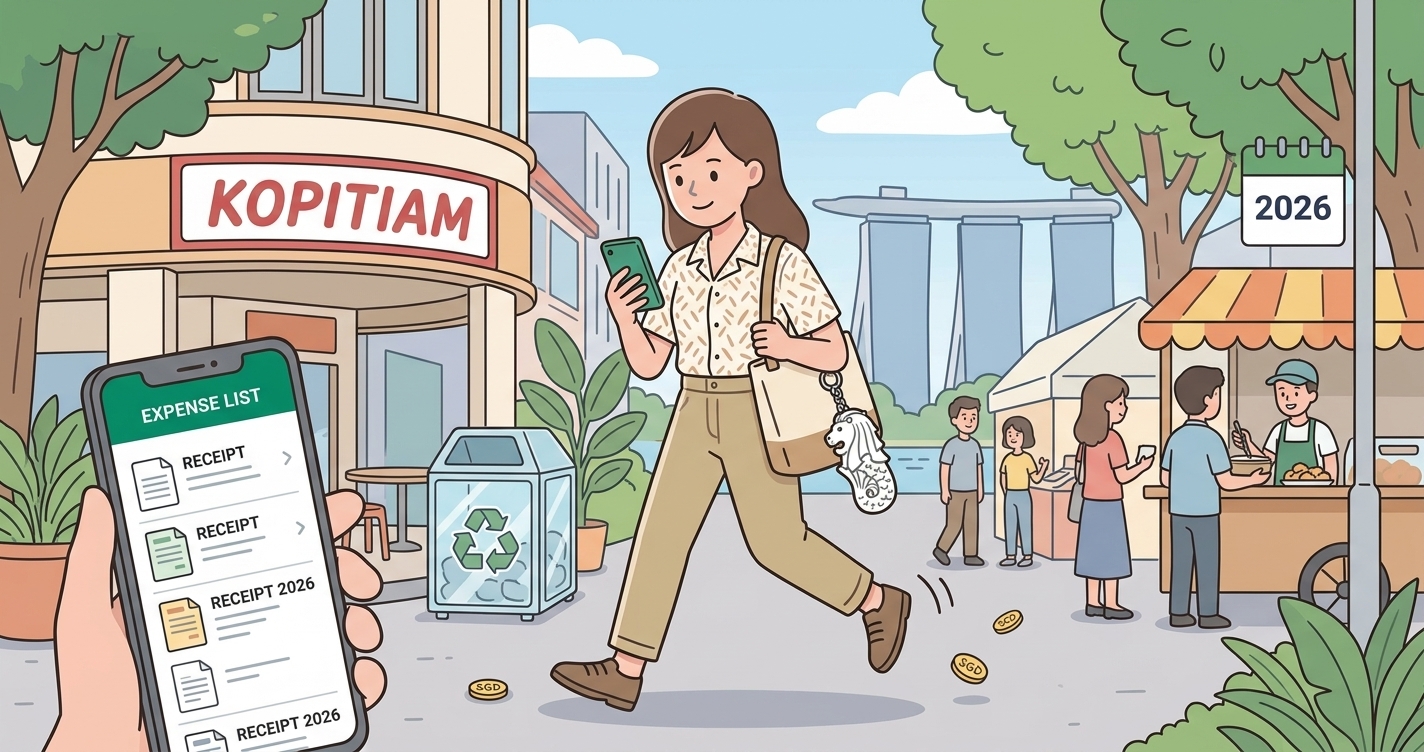
Singapore's hawker centres, kopitiams, and many retailers still issue thermal-printed receipts. Thermal paper fades — usually within 6 to 18 months — and a faded receipt is no longer a 'legible' record under IRAS criteria. The fix is straightforward: photograph or scan thermal receipts the same day they are issued, and treat the image as the record of truth.
A 5-Year Workflow That Actually Holds Up
Most Singapore freelancers we speak to either over-engineer record-keeping (a five-tab Excel file no one updates) or under-engineer it (a phone full of receipt photos and an inbox of Stripe emails). Here is a four-step workflow that scales from a side hustle to a Pte Ltd.
Step 1: Capture at the Point of Transaction
Photograph paper receipts the moment you get them. Forward PDF invoices into a single bookkeeping inbox. The aim is zero loose paper and zero unsorted email by the end of each week. Tools like Denpyo can auto-extract the supplier name, date, total, GST amount and a suggested category from a receipt photo, so you are not retyping anything later.
Step 2: Record Business Purpose, Not Just the Amount
IRAS allows deductions for expenses 'wholly and exclusively' incurred in producing income. The amount is only half the story — the why is what makes a deduction defensible. 'S$76 dinner — Q2 strategy review with client X' is far stronger than 'S$76 dinner'.
Step 3: Reconcile Against Your Bank Feeds Monthly
Match every line on your business bank statement and credit card statement to a corresponding invoice or receipt at least once a month. The single biggest cause of weak records at audit is year-end batching — by January, the freelancer has forgotten what half the November transactions were for.
Step 4: Back Up to Two Independent Locations
Keep your records in your accounting platform plus a second location — an external drive, a Google Drive folder, or an enterprise backup service. A 5-year retention window is too long to bet on a single device. Many SMEs export an encrypted ZIP each quarter to OneDrive or Backblaze.
Practical Examples
Example 1: The Hawker Lunch Receipt
Mei Ling, a freelance UX designer, has a S$32 working lunch with a prospective client at Lau Pa Sat in March 2026. The hawker prints a thermal receipt that will fade within a year. She photographs it the same afternoon and adds the client's name and meeting purpose to the Denpyo entry. By 2031 the original is unreadable, but the captured image, vendor data, and EXIF timestamp remain a perfectly proper record under IRAS criteria.
Example 2: The Multi-Currency Stripe Payout
Arjun runs a Pte Ltd selling templates to international customers via Stripe. Each monthly payout combines USD, EUR, and SGD sales. He keeps the Stripe payout report (which itemises each charge and the SGD-equivalent at settlement), the matching bank deposit, and the foreign exchange rate used — three documents that together let any auditor reconstruct his GST output tax in minutes.
Example 3: Mixing Personal and Business on a Personal Card
Hafiz, a sole-proprietor wedding photographer, occasionally pays for camera gear on his personal credit card. To keep records clean, he highlights the business line on each monthly statement, attaches the corresponding tax invoice from the supplier, and journals a reimbursement from his business bank account. The audit trail is unbroken even though the original purchase was off a personal card.
How Denpyo Helps Singapore Freelancers Stay IRAS-Ready
The hard part of 5-year record keeping is not the storage — Google Drive can hold a lifetime of receipts for a few dollars a month — but the capture and structure. A folder of 4,000 unsorted PNG files is no easier to audit than a shoebox of paper. Denpyo is built for the capture and structure layer. You snap a photo of any receipt, invoice, or transfer voucher (振替伝票 for our Japanese-speaking SG-based users), and the AI extracts the vendor, date, total, GST component, and suggested category. Multiple categories such as travel, client entertainment, software subscriptions, and office supplies are recognised out of the box, and you can add custom categories that mirror the chart of accounts in Xero or QuickBooks.
For Singapore-based users specifically, Denpyo helps with three compliance pain points: keeping faded thermal receipts legible across the full 5-year window (the photo, not the paper, is what you keep), separating GST-inclusive and GST-exclusive amounts so your input tax claim is defensible, and exporting a clean, dated record set for your accountant or for an IRAS audit. To see how much your captured deductions are worth in tax terms, run them through the Denpyo Tax Savings Estimator, or check whether a particular receipt is likely deductible with the Expense Deductibility Checker.
Common Record-Keeping Mistakes IRAS Sees
- Throwing receipts away after submitting Form B/B1 or Form C-S. The 5-year clock runs from the end of the YA, not from the filing date. Keep the records.
- Relying on bank statements alone. A bank line is a payment trail, not proof of what was bought.
- No business-purpose annotation. An undocumented S$200 dinner is much easier for IRAS to disallow than a labelled client meeting.
- Mixing personal and business spending on the same account, with no reimbursement journal. This is a top reason for additional assessments at SEP review.
- Storing only on a single device. A stolen laptop should not erase a year of records.
- For GST-registered businesses: keeping only summary reports without the underlying tax invoices. Input tax claims fail without the invoice itself.
Penalties for Inadequate Records
Failure to keep proper records is an offence under section 94 of the Income Tax Act. The penalty can include a fine of up to S$1,000 per offence and, in serious cases, additional tax assessments based on IRAS's best judgement of your income (rarely a flattering figure). For GST-registered businesses, section 46 of the GST Act adds a parallel penalty regime, including potential disallowance of input tax claims that lack the supporting invoice.
The bigger cost is rarely the fine. It is the time and accountant fees consumed reconstructing four-year-old transactions, the disallowed deductions that become permanent because the supporting receipt was thrown away, and the prolonged audit timeline that locks up months of attention.
Key Takeaways
- IRAS requires 5 years of business records, measured from the end of the Year of Assessment
- The Income Tax Act and GST Act both back the requirement; both apply to most freelancers and SMEs
- Electronic records — including imaged copies of paper receipts — are accepted, provided IRAS's conditions on controls, audit trail, legibility and retrievability are met
- You may destroy paper originals after imaging, if your system meets the conditions
- Thermal receipts fade — capture them on the day, treat the image as the record of truth
- Monthly bank reconciliation is the highest-leverage habit for surviving an IRAS audit
Resources

Track expenses, maximize deductions
Denpyo scans your receipts and finds tax savings automatically.