Philippines 8% Flat Tax vs Graduated Rate: Which Is Better for Freelancers in 2026?
Sign up free to read the full articleFilipino freelancers and self-employed professionals can choose between the 8% flat income tax rate and the graduated income tax table. The right choice depends on your annual gross receipts and allowable expenses. This guide walks you through both options with real calculations.
Disclaimer: This article provides general tax information for the Philippines and does not constitute individual tax advice. Tax rules are subject to change. Always verify current rates, thresholds, and filing requirements with the Bureau of Internal Revenue (BIR) or a licensed Certified Public Accountant (CPA) before filing. Figures are based on TRAIN Law and subsequent BIR issuances in effect as of 2026.
The Two Tax Rate Options for Filipino Freelancers
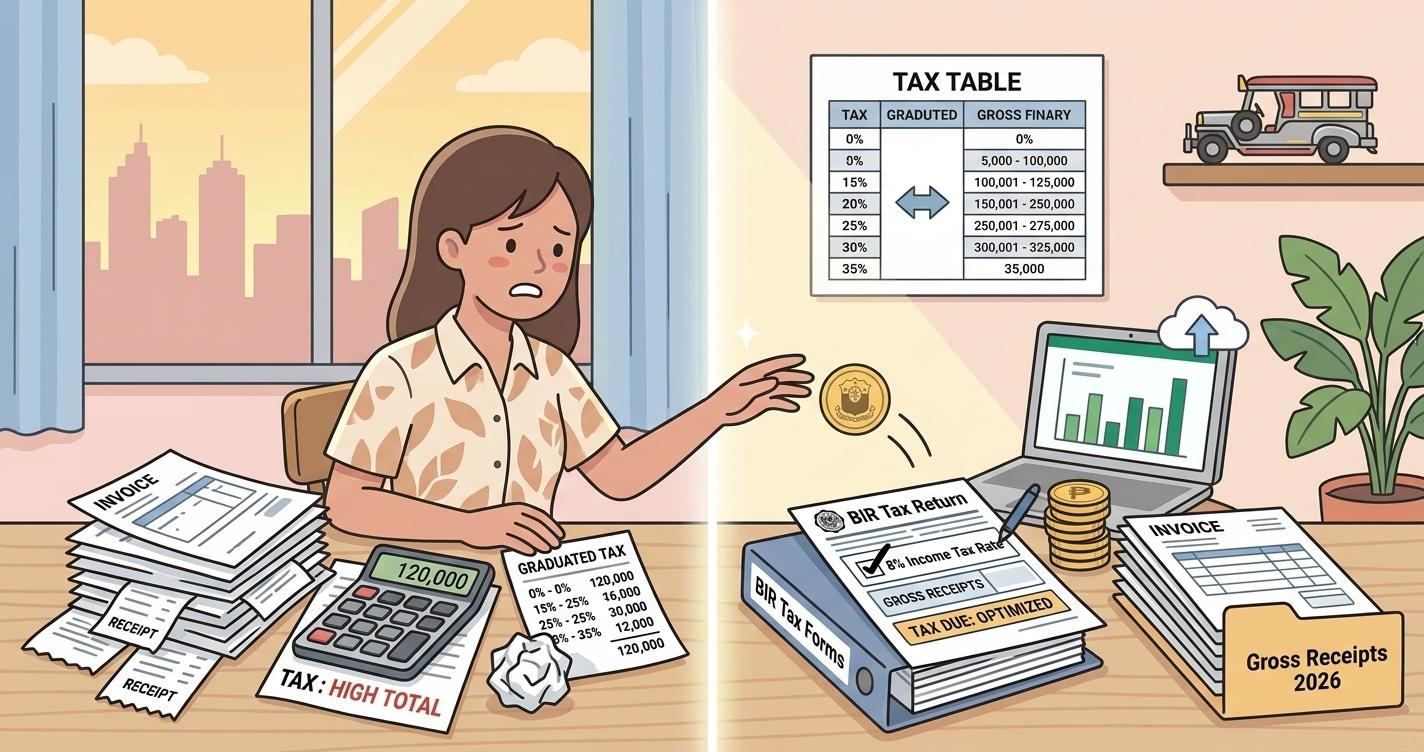
Under the Tax Reform for Acceleration and Inclusion (TRAIN) Law, self-employed individuals and professionals in the Philippines have two options for computing their annual income tax:
- 8% Flat Tax Rate — applied on gross receipts plus other non-operating income, in lieu of the graduated rates and the percentage tax
- Graduated Income Tax Rates — the standard progressive rates with deductions for allowable expenses
Choosing the wrong option can mean paying thousands of pesos more in tax than necessary. This guide helps you understand which is better for your specific situation.
Option 1: The 8% Flat Tax Rate
What It Is
The 8% rate is computed on your gross receipts and other income (not net income), with no deductions for business expenses. The first PHP 250,000 is exempt (for non-mixed income earners), so in practice you pay 8% only on amounts above PHP 250,000.
Who Can Avail
The 8% option is available if:
- You are a self-employed individual or professional
- Your annual gross receipts and other income do NOT exceed PHP 3,000,000 (the VAT threshold)
- You are not a VAT-registered taxpayer
- You are not a Mixed Income Earner (i.e., you do not also receive a salary from an employer) — or if you are a mixed income earner, the 8% applies only to the self-employment income component above PHP 250,000, and the salary portion is taxed separately under the graduated table
How to Compute (Simple Example)
Gross receipts for the year: PHP 1,200,000
- Less exemption: PHP 250,000
- Taxable amount: PHP 950,000
- 8% tax = PHP 76,000
No expenses to track, no depreciation schedules, no books of accounts required — just your total receipts.
Advantages of the 8% Rate
- Simplicity: no need to track or document individual business expenses
- Replaces percentage tax (3%): you do not pay the 3% Percentage Tax (BIR Form 2551Q) separately
- Lower record-keeping burden: no need to maintain complete books of accounts (though keeping basic records is still good practice)
- Predictable: you always know exactly what your tax will be based on gross income
Disadvantages of the 8% Rate
- If your actual expenses are high, you may pay more tax than under the graduated method
- You forfeit the ability to deduct legitimate business costs
- Not available once you exceed PHP 3 million in gross receipts
Option 2: Graduated Income Tax Rates
Under the TRAIN Law (as further amended), the progressive tax rates…
Read the rest of this article
Create a free Denpyo account to unlock the remaining sections and return to where you left off.
Already have an account? Log in
Eligible first-time subscribers get 7 days free. A payment card is required. Your plan renews automatically at the price shown at checkout unless you cancel before the trial ends.