
Thailand Freelancer Tax Deductions: Business Expenses and Allowances You Can Claim in 2026
Thailand's Personal Income Tax system offers freelancers two types of deductions: expense deductions against business income, and personal allowances that reduce your overall tax bill. This guide covers both, plus the practical steps to claim them via the Revenue Department's eFiling portal.
Disclaimer: This article provides general tax information for Thailand and does not constitute individual tax advice. Tax rules are subject to change. Always verify current rules with the Thai Revenue Department (RD) or a licensed Thai tax advisor before filing. Rates and thresholds reflect regulations in effect as of the 2025 tax year (filed in 2026).
How Thailand Taxes Freelance Income
In Thailand, freelancers and self-employed individuals pay Personal Income Tax (PIT / ภาษีเงินได้บุคคลธรรมดา) on net assessable income. Assessable income means your gross income minus two types of deductions:
- Expense deductions — costs of earning your business income
- Personal allowances — standard reliefs based on your personal situation
After deducting both, you apply progressive tax rates ranging from 0% (income up to THB 150,000) to 35% (income above THB 5 million).
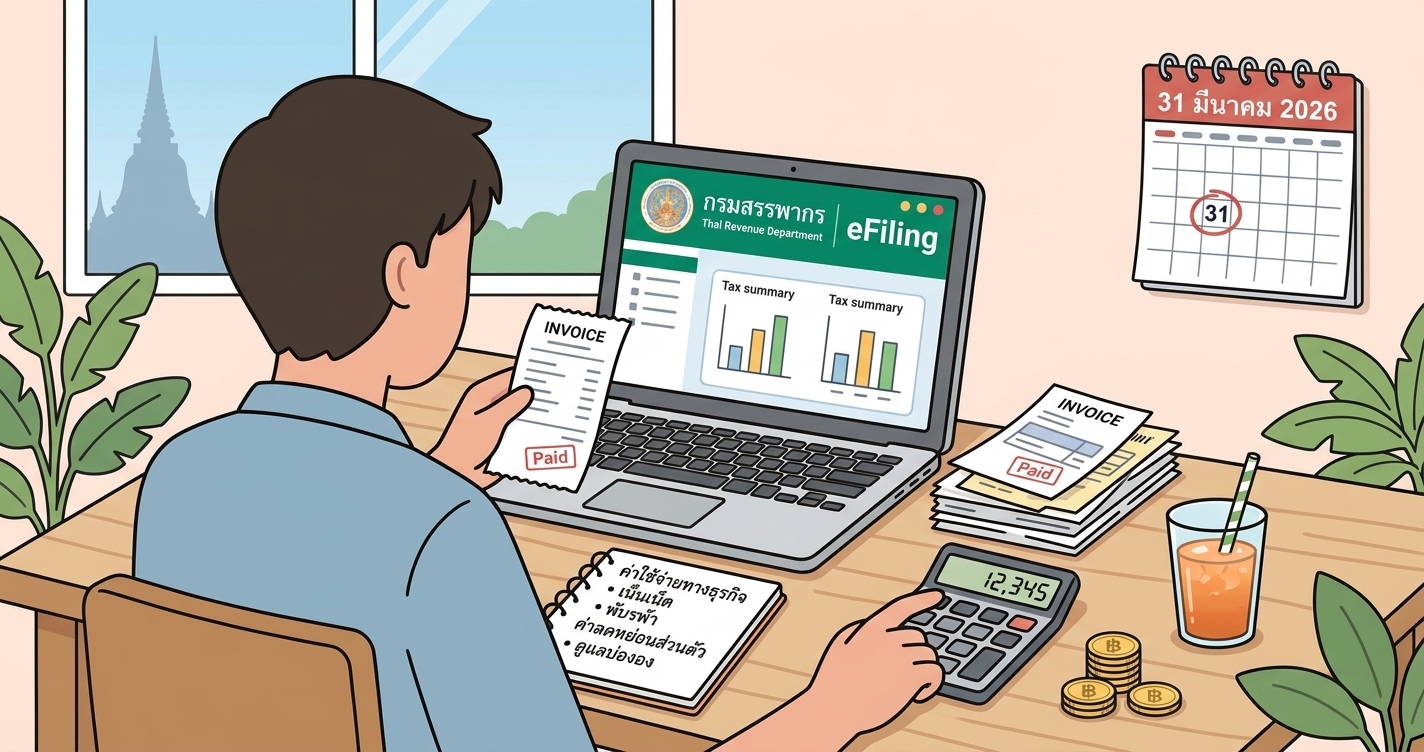
Thailand's PIT is filed annually via the Revenue Department eFiling portal, with a filing deadline of 31 March (paper) or 8 April (online) for the prior year's income.
Part 1: Business Expense Deductions
Thailand allows two methods for deducting business expenses, depending on your income category (assessable income type):
Standard Rate Deduction (วิธีหักแบบเหมา)
Most freelance income in Thailand falls under Section 40(2) (fees for services) or Section 40(6)–(8) (professional practice, business income). Each category has a fixed standard deduction rate that the Revenue Department allows without requiring you to prove individual expenses:
- Section 40(2) — Freelance service fees (design, consulting, writing, programming, etc.): 50% deduction, capped at THB 100,000
- Section 40(6) — Royalties: 50% deduction, capped at THB 100,000
- Section 40(7) — Agricultural income: 60% or 85% depending on crop type
- Section 40(8) — General business income (trading, manufacturing, other services): 60% deduction, no cap
For most freelancers whose income is coded as 40(8), the 60% standard deduction with no cap is extremely generous. If your actual costs are lower than 60% of revenue, using the standard rate deduction is simpler and often advantageous.
Actual Expense Deduction (วิธีหักตามจริง)
If your actual business costs exceed the standard rate, you may instead elect to deduct actual expenses. This requires keeping full accounting records and receipts. You must choose one method consistently for each income type in a given year.
Expenses that qualify under actual deduction include:
- Equipment purchases: Laptops, cameras, audio equipment, phones used for business. Items over THB 1 million should be depreciated; smaller items can generally be expensed in full.
- Software and digital tools: Subscriptions to design software, project management tools, cloud storage, accounting software — all deductible in the year incurred.
- Office rent and co-working space: Fully deductible with lease agreement and receipts.
- Home office proportion: If you work from home, you may claim a proportional share of rent, utilities, and internet based on the work-area-to-total-floor-area ratio.
- Internet and phone bills: Business proportion. Keep bills and calculate the work-use percentage.
- Professional services: Accounting fees, legal fees, business consulting — fully deductible.
- Marketing and advertising: Social media advertising, website costs, printing business cards and brochures — deductible.
- Business travel: Transport, accommodation for client meetings or business trips. Keep receipts and a business-purpose log.
- Training and professional development: Courses, certifications, books, online learning directly relevant to your work — deductible.
- Insurance premiums: Professional liability, business asset insurance — deductible.
Part 2: Personal Allowances (ค่าลดหย่อน)
On top of expense deductions, Thailand offers a range of personal allowances that further reduce your taxable income. These are available to all taxpayers regardless of income type.
Standard Personal Allowances
- Personal allowance: THB 60,000 (all taxpayers)
- Spouse allowance: THB 60,000 (if your spouse has no income)
- Child allowance: THB 30,000 per child (up to 3 children); THB 60,000 for the 2nd child onwards if born from 2018
- Parental care: THB 30,000 per parent over 60 years old (if their income is below THB 30,000/year)
Insurance and Savings Allowances
- Life insurance premiums: Up to THB 100,000 per year (policies of 10+ years)
- Health insurance premiums: Up to THB 25,000 per year
- Provident fund / RMF / SSF contributions: Retirement Mutual Fund (RMF) and Super Savings Fund (SSF) each allow deductions of up to 30% of income, capped together at THB 500,000 per year
- Social Security contributions: Freelancers who voluntarily contribute to Thailand's Social Security system can deduct those contributions
Other Allowances
- Mortgage interest: Up to THB 100,000 per year for a personal residence loan
- Charitable donations: Deductible at 2x the donated amount (for education-related donations) or 1x for general donations, capped at 10% of assessable income
Withholding Tax: Getting Credit for What Was Already Deducted
Many Thai clients are required to withhold 3% PIT at source when paying freelancers. If your clients have been withholding tax from your payments, this counts as a prepayment of your annual PIT liability. Make sure you collect your withholding tax certificates (หนังสือรับรองการหัก ณ ที่จ่าย / form PND.53) from each client — these are credited against your final annual tax bill when you file.
How to File: eFiling Portal Step-by-Step
- Go to efiling.rd.go.th and log in or register with your national ID
- Select the income year and choose Form PND.90 (general taxpayer) or PND.91 (employment income only)
- Enter your income by section (40(2), 40(8), etc.) and choose the deduction method
- Enter all personal allowances
- Upload withholding tax certificates from clients
- Review the calculated tax, pay if owed or submit bank details for a refund
- Submit before 8 April for the prior year's income
Track Your Business Expenses with Denpyo
Use Denpyo's tax savings estimator to see an estimate of how much deductible spending is reducing your expected tax bill.
Summary
Thailand's PIT system gives freelancers and self-employed individuals two powerful levers: business expense deductions (standard rate or actual) and personal allowances. For the 40(8) income category, the 60% standard deduction with no cap is a major advantage. For official guidance, refer to the Thai Revenue Department and the eFiling portal.

Track expenses, maximize deductions
Denpyo scans your receipts and finds tax savings automatically.