
Malaysia Income Tax Rates 2026: Progressive Brackets Explained for Freelancers
Complete guide to Malaysia's 2026 income tax rates (YA 2025) for freelancers and SMEs. Includes full bracket table, worked examples, key reliefs, and tips to reduce your tax bill.
Disclaimer: This article is for informational purposes only and does not constitute legal or tax advice. Tax rates and relief amounts may change with annual budgets. Please consult the Lembaga Hasil Dalam Negeri (LHDN) or a qualified tax professional for advice specific to your situation.
Understanding Malaysia's Progressive Tax System
If you are a freelancer or small business owner in Malaysia, understanding your income tax rates is the first step to keeping more of what you earn. Malaysia uses a progressive tax system, which means different portions of your income are taxed at different rates — from 0% on your first RM5,000 to 30% on income above RM2 million. The good news? Most freelancers fall well within the lower brackets, and with the right deductions and reliefs, your effective tax rate can be significantly lower than the headline numbers.
This guide breaks down the complete 2026 tax brackets (Year of Assessment 2025), walks through worked examples at different income levels, and highlights the reliefs and deductions most relevant to self-employed Malaysians. Whether you are a graphic designer earning RM60,000 or an e-commerce seller pulling in RM300,000, you will know exactly how much tax to expect.
Complete Tax Bracket Table: YA 2025 (Filed in 2026)
The following rates apply to resident individuals for the Year of Assessment 2025, as published by LHDN:
| Chargeable Income (RM) | Tax Rate | Tax on Band (RM) | Cumulative Tax (RM) |
|---|---|---|---|
| 0 – 5,000 | 0% | 0 | 0 |
| 5,001 – 20,000 | 1% | 150 | 150 |
| 20,001 – 35,000 | 3% | 450 | 600 |
| 35,001 – 50,000 | 6% | 900 | 1,500 |
| 50,001 – 70,000 | 11% | 2,200 | 3,700 |
| 70,001 – 100,000 | 19% | 5,700 | 9,400 |
| 100,001 – 250,000 | 24% | 36,000 | 45,400 |
| 250,001 – 400,000 | 24.5% | 36,750 | 82,150 |
| 400,001 – 600,000 | 25% | 50,000 | 132,150 |
| 600,001 – 1,000,000 | 26% | 104,000 | 236,150 |
| 1,000,001 – 2,000,000 | 28% | 280,000 | 516,150 |
| Above 2,000,000 | 30% | — | — |
Important: These rates apply only to Malaysian tax residents (individuals who spend 182 days or more in Malaysia during the year). Non-residents pay a flat rate of 30% with no personal reliefs or rebates.
How Progressive Tax Actually Works
A common misconception is that if you earn RM100,000, you pay 19% on the entire amount. That is not how progressive taxation works. Only the income within each bracket is taxed at that bracket's rate. Think of your income as filling up a series of buckets — each bucket has its own rate.
For example, even if your chargeable income is RM100,000, your first RM5,000 is still tax-free. The next RM15,000 is taxed at just 1%, and so on. Your effective tax rate (total tax divided by total income) will always be lower than the marginal rate of your highest bracket.
Worked Examples for Freelancers
Example 1: Freelance Designer Earning RM60,000
After applying the RM9,000 personal relief, your chargeable income is RM51,000. Here is the breakdown:
- First RM5,000 at 0% = RM0
- Next RM15,000 (RM5,001–RM20,000) at 1% = RM150
- Next RM15,000 (RM20,001–RM35,000) at 3% = RM450
- Next RM15,000 (RM35,001–RM50,000) at 6% = RM900
- Remaining RM1,000 (RM50,001–RM51,000) at 11% = RM110
Total tax: RM1,610 — an effective rate of just 2.7% on your gross income. If your chargeable income is RM35,000 or below, you also qualify for a RM400 tax rebate, which directly reduces your tax bill.
Example 2: IT Consultant Earning RM120,000
After personal relief (RM9,000), EPF voluntary contribution via i-Saraan (RM4,000), and lifestyle relief (RM2,500), your chargeable income is approximately RM104,500:
- First RM100,000 = RM9,400 (cumulative from table)
- Remaining RM4,500 (RM100,001–RM104,500) at 24% = RM1,080
Total tax: RM10,480 — an effective rate of 8.7%. Without deductions, tax on RM111,000 chargeable income would be RM12,040 — those deductions saved you over RM1,500.
Example 3: E-commerce Seller Earning RM300,000
After personal relief (RM9,000), business expenses, EPF, and other reliefs totalling RM30,000 in deductions, your chargeable income is approximately RM270,000:
- First RM250,000 = RM45,400 (cumulative from table)
- Remaining RM20,000 (RM250,001–RM270,000) at 24.5% = RM4,900
Total tax: RM50,300 — an effective rate of 16.8%. This illustrates why tracking every deductible expense matters at higher income levels. Tools like Denpyo's free tax savings estimator can help you see exactly how much each deduction is worth.
Key Tax Reliefs for Freelancers (YA 2025)
Tax reliefs reduce your chargeable income before the progressive rates are applied. The full list of reliefs is published by LHDN, but here are the most relevant ones for freelancers and small business owners:
Automatic Reliefs
- Individual (self): RM9,000 — every taxpayer gets this automatically
- Spouse relief: RM4,000 (if spouse has no income or elects joint assessment)
- Child relief: RM2,000 per child (RM8,000 for children in higher education)
Contribution-Based Reliefs
- EPF / i-Saraan voluntary contributions: Up to RM4,000. The i-Saraan programme provides a government matching contribution of 20% (capped at RM500/year) for self-employed contributors — essentially free money while reducing your tax bill. Crowe Malaysia has a detailed breakdown of EPF relief rules.
- Life insurance premiums: Up to RM3,000
- Education and medical insurance: Up to RM4,000 (increased from RM3,000 for YA 2025)
- SOCSO / SESSS contributions: Up to RM350
- Private retirement scheme (PRS): Up to RM3,000
Lifestyle and Medical Reliefs
- Lifestyle relief: Up to RM2,500 for books, computers, smartphones, internet subscriptions, gym memberships, and sports equipment
- Medical expenses (self/spouse/child): Up to RM10,000 — now includes dental treatment (sub-limit RM1,000 for YA 2025)
- Complete medical check-up: Up to RM1,000 (part of the RM10,000 medical limit)
RM400 Tax Rebate
If your chargeable income (after all reliefs) is RM35,000 or below, you receive a RM400 rebate that directly reduces your final tax payable. Your spouse also qualifies for a separate RM400 rebate if jointly assessed. This means many lower-income freelancers effectively pay zero or near-zero tax.
Freelancer-Specific Tips to Reduce Your Tax
1. Track Every Business Expense
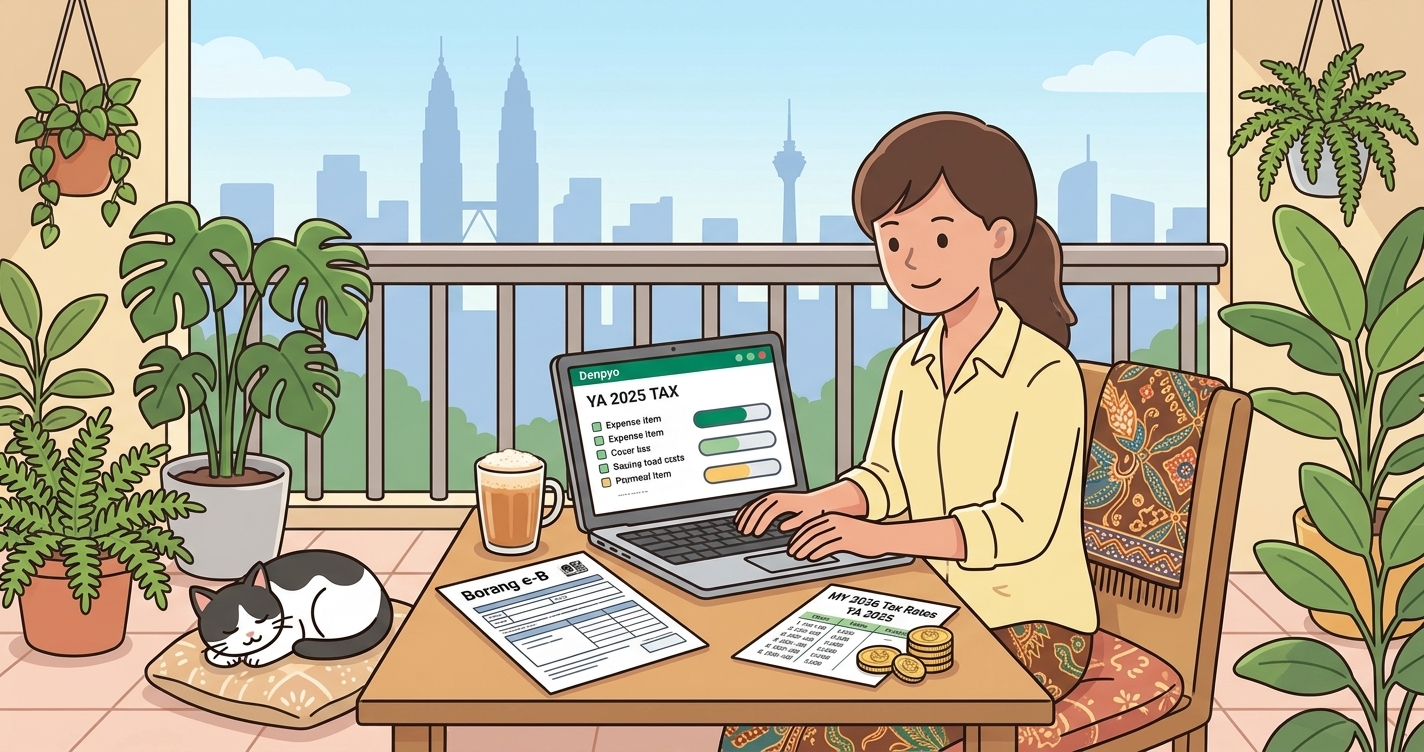
As a freelancer filing Form B, you can deduct business expenses incurred wholly and exclusively in producing your income. Common deductions include home office rent (proportionate share), equipment, software subscriptions, professional courses, travel, and marketing costs. Every ringgit of deductible expense reduces your chargeable income. Denpyo can help you auto-extract these details from receipt photos, making it easy to categorise and track deductible costs throughout the year. Check which expenses are deductible using our free tool.
2. Contribute to i-Saraan (EPF Voluntary)
Self-employed individuals are not required to contribute to EPF, but voluntary contributions via i-Saraan Plus are one of the smartest tax moves available. You get a tax deduction of up to RM4,000, plus a 20% government matching contribution (up to RM500/year). That is both a tax saving and retirement savings in one.
3. Maximise Lifestyle Relief
If you buy a laptop, smartphone, or internet subscription for work, these count toward your RM2,500 lifestyle relief. Keep the receipts — even gym memberships and sports equipment qualify.
4. Get Education or Medical Insurance
The relief for education and medical insurance premiums has been increased to RM4,000 for YA 2025. If you do not already have medical insurance, this is a strong incentive to get covered — you protect yourself and reduce your tax at the same time.
5. File on Time
The deadline for Form B e-filing is 15 July 2026 for YA 2025. Late filing incurs penalties of 10-20% of the tax payable, plus potential prosecution. For more on deadlines, see our Malaysia tax deadlines calendar.
Resident vs. Non-Resident: Why 182 Days Matters
Your tax rates depend entirely on your residency status. To qualify as a Malaysian tax resident, you must be physically present in Malaysia for at least 182 days in a calendar year. Residents enjoy progressive rates (0-30%) and access to all reliefs and rebates. Non-residents pay a flat 30% with no deductions — a massive difference. If you are a digital nomad or split time between countries, careful planning around the 182-day rule can save you tens of thousands of ringgit. PwC Malaysia's tax guide provides further detail on residency determination.
How Denpyo Can Help
Understanding your tax bracket is important, but the real savings come from maximising your deductions. Denpyo is designed for freelancers and small businesses across Asia — photograph your receipts and our AI automatically extracts the vendor, amount, date, and expense category. You will see your estimated tax savings in real time, and all your records are stored digitally for the full 7-year retention period required by LHDN. Try our free income tax calculator to see where you fall in the brackets.
Summary
Malaysia's progressive tax system is designed to be fair — lower earners pay proportionally less, and generous reliefs ensure that most freelancers keep the majority of their income. The key numbers to remember: your first RM5,000 is tax-free, the RM9,000 personal relief is automatic, and the RM400 rebate effectively zeroes out tax for those earning under RM35,000 after deductions. For higher earners, strategic use of EPF voluntary contributions, lifestyle relief, and thorough expense tracking can meaningfully reduce your effective rate. File Form B by 15 July 2026, keep records for 7 years, and make every deduction count.

Track expenses, maximize deductions
Denpyo scans your receipts and finds tax savings automatically.
More Articles
View All Articles
IRAS Audits & Record Requests: A Freelancer's Readiness Guide (Singapore, 2026)
5 min read
2-Line vs 4-Line Statement: Reporting Business Income to IRAS 2026
4 min read