
Platform Workers CPF 2026: New Mandatory Contributions Explained
How Singapore's Platform Workers Act changed CPF for Grab, Foodpanda, and Deliveroo workers in 2025 — and the 2026 rates, opt-in rules, and filing steps.
Disclaimer: This article summarises Singapore's Platform Workers Act and CPF contribution rules as of early 2026 and is for general information only. It is not financial, legal, or tax advice. CPF rates, ceilings, and opt-in windows are reviewed periodically — always verify the current figures with the CPF Board and IRAS before acting. Consult a qualified adviser for personalised guidance.
What changed on 1 January 2025
Singapore's Platform Workers Act 2024 came into force on 1 January 2025, fundamentally reshaping how CPF works for Grab drivers, Foodpanda riders, Deliveroo couriers, and the tens of thousands of other gig workers who earn through ride-hail or delivery platforms. For the first time, platform operators are legally required to contribute to workers' CPF accounts, mirroring the employer contributions that salaried Singaporeans have received for decades.
If you earn through ride-hail or delivery platforms — or you're an SME thinking about platform partnerships — the 2025–2029 transition will reshape your cash flow, your retirement savings, and the CPF-related tax reliefs available on your IRAS return. This guide explains who is covered, the phased contribution rates, what you can (and cannot) opt out of, and how to keep records clean so MediSave relief and CPF top-up claims go through smoothly.
Context: How CPF used to work for platform workers
Before the PWA, platform workers were treated like any other self-employed person under Singapore's CPF rules. They had to make MediSave contributions on net trade income, but the other CPF accounts (Ordinary Account, Special Account, Retirement Account) were entirely optional. Many younger platform workers paid the MediSave minimum, skipped OA/SA saving, and later faced a retirement shortfall — a gap Parliament flagged in the 2023 Advisory Committee on Platform Workers.
The PWA created a new worker category — “platform worker” — covering individuals providing ride-hail or food-delivery services through a designated platform operator. The operator is not an “employer” in the traditional labour-law sense (workers remain independent contractors for most purposes), but for CPF it now behaves like one.
Full framework: CPF Board platform worker page and the MOM Platform Workers Act overview.
Who is covered — and who opts in
- Automatic (mandatory): Platform workers born on or after 1 January 1995. No action needed — your operator starts contributing alongside your own deductions.
- Opt-in (irreversible): Workers born on or before 31 December 1994 can voluntarily join the scheme. Once opted in, you cannot leave.
- Platform operators: Designated operators include Grab (ride-hail + delivery), Gojek, Foodpanda, Deliveroo, Lalamove, Ryde, Tada, and others named in the Act's designation list. The list is updated by MOM.
If you do delivery work for a non-designated operator (e.g., a small local restaurant's in-house fleet), classic self-employed MediSave rules still apply — you're not covered by the PWA.
The phased contribution schedule
Singapore didn't flip the switch overnight. Both worker and operator rates rise each year from 2025 to 2029 to soften the impact on take-home pay.
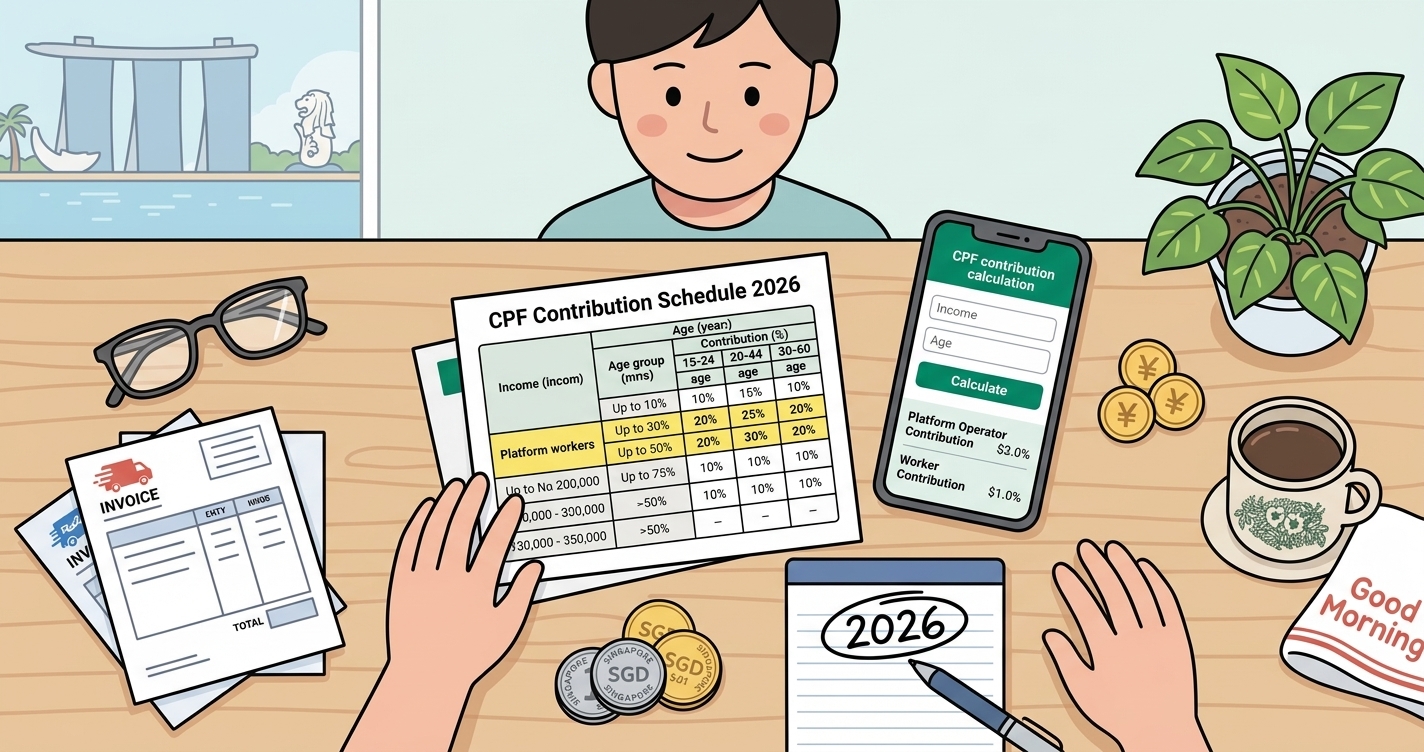
| Year | Platform Worker (you) | Platform Operator | Total CPF |
|---|---|---|---|
| 2025 | 2.5% | 3.5% | 6.0% |
| 2026 | 5.0% | 7.0% | 12.0% |
| 2027 | 7.5% | 10.5% | 18.0% |
| 2028 | 10.0% | 14.0% | 24.0% |
| 2029+ | Align with employee rates (age-banded) | Align with employer rates | ~30–37% for under-55s |
Rates apply to your net earnings from platform work after platform-allowed deductions — not the gross fare or order value. The monthly Ordinary Wage ceiling (S$7,400/month in 2026, subject to CPF Board review) also caps the base.
Allocation across the three accounts follows the standard employee structure for your age band. For a worker under 35, roughly 62% flows to Ordinary Account (OA), 16% to Special Account (SA), and 22% to MediSave (MA). From age 55, SA closes and balances move to the Retirement Account (RA); the allocation shifts accordingly.
Step-by-step: Monthly compliance
- Track your platform earnings monthly. Each platform (Grab, Foodpanda, etc.) issues a payment summary. Save the PDF/CSV — you'll need it for reconciliation.
- Verify CPF statements on mycpf.sg. Operators must remit within 14 days of month end. Check that your 2026 5.0% share matches what you expect, and that the operator's 7.0% has landed.
- Keep business receipts separately. Fuel, phone bills, vehicle maintenance, platform commissions, and delivery-bag purchases are deductible expenses when you file your IRAS Form B as self-employed. CPF is calculated on net earnings before income tax but after platform-allowed deductions.
- Top up MediSave voluntarily if needed. Self-employed MediSave rules still apply to non-platform self-employed income. If you earn from multiple sources (e.g., some Grab driving plus some freelance graphic design), you may owe additional MediSave on the non-platform portion.
- File Form B with IRAS by 18 April. Platform income and operator CPF contributions appear on your Notice of Computation. Declare net trade income from each platform separately — IRAS cross-references against platform data.
For tax-relief purposes, CPF cash top-ups you make yourself (up to S$8,000 to your own SA/RA and another S$8,000 to family members) remain deductible under Section 39(2)(m) of the Income Tax Act. See the IRAS CPF Cash Top-Up Relief page.
Should you opt in if you're pre-1995?
Opting in is irreversible, so weigh it carefully.
Consider opting in if:
- You plan to stay in platform work long-term (5+ years).
- You want matching operator contributions — essentially “free money” into your CPF accounts.
- You don't expect to need the cash for a property down-payment in the next 5–10 years.
- Your retirement savings are behind target.
Consider staying out if:
- You're near 55 and prioritise liquidity.
- Platform work is a short-term side gig while you're a full-time PMET employee (your employer CPF is already accruing).
- You need maximum take-home cash now for business reinvestment.
- You have significant outstanding debt at high interest rates.
Practical examples
Scenario A — Grab driver, age 28, 2026. Ahmad earns net S$3,500/month driving. His 2026 worker share is 5% = S$175, and Grab contributes 7% = S$245. Total S$420/month lands in his CPF accounts, split roughly 62% OA, 16% SA, 22% MA. Over the year, Grab contributes about S$2,940 of “new money” he would not have received pre-2025.
Scenario B — Food-delivery rider, age 47, opted in. Lin earns S$2,800/month delivering for Foodpanda. Her 2026 share is 5% = S$140; the operator adds 7% = S$196. As a 47-year-old, a larger proportion flows to SA (boosting retirement), and she qualifies for full CPF Cash Top-Up Relief when she adds extra to hit her Basic Retirement Sum.
Scenario C — Multi-platform hustler. Marcus earns S$2,000 from Grab driving and S$1,200 freelance graphic-design income. CPF applies to the Grab earnings via the PWA; the freelance income remains subject to classic self-employed MediSave rules. He files Form B declaring both income streams and claims deductions for both.
Record-keeping tips that save you at tax time
Platform workers still file Form B (not Form B1) because platform income is trade income. That means 5 years of receipts for every toll, fuel top-up, phone bill, vehicle service, and insurance premium — the exact pile of paper that buries most gig workers at filing time. A few habits that help:
- Open a separate bank account for platform earnings and business expenses.
- Capture receipts the moment you get them, not weeks later when half have faded.
- Reconcile platform summaries against your bank statements monthly — disputes are much easier to raise within 30 days.
- Store everything in a dated, backed-up folder (not just WhatsApp).
Denpyo for Singapore platform workers
Denpyo was built for exactly this pile of paperwork. Snap a photo, and the app extracts vendor, date, SGD amount, and IRAS-friendly category (motor, telecom, platform commission, other). Receipts are tagged by tax year and export to a clean CSV when you file Form B. Try our free Tax Savings Estimator to see how quickly deductible expenses drop your chargeable income, or the expense deductibility checker to pre-screen which costs IRAS will accept.
Summary
The Platform Workers Act is a genuine shift: for the first time, gig workers in Singapore have an automatic, operator-matched path to the same three-account CPF structure salaried employees use. The 2025–2029 phase-in softens the immediate cash-flow hit, but by 2029 platform workers will contribute and receive nearly full CPF rates. Track every dollar, opt in strategically if you're grandfathered, and keep your IRAS receipts clean — the new system rewards disciplined bookkeeping.
For related reading, see our guides to Singapore freelance tax filing, MediSave relief for the self-employed, and gig economy taxes.
Track expenses, maximize deductions
Denpyo scans your receipts and finds tax savings automatically.