
Korean Freelancer Tax Guide 2026: 3.3% Withholding, Expense Deductions & Hometax Filing
Disclaimer: This article is for general informational purposes only and does not constitute tax or legal advice. Korean tax rules change frequently. Please consult a certified tax accountant (세무사) for advice specific to your situation.
If you freelance in Korea — whether you're a developer, designer, content creator, or consultant — you're likely familiar with the 3.3% withholding tax deducted by your clients before they pay you. But many freelancers don't realize that this withholding is just an advance payment on your actual tax liability, and that filing your 종합소득세 (Comprehensive Income Tax) return in May can result in a significant refund — especially when you claim all your legitimate business expenses.
This guide explains the Korean freelancer tax system for 2026, how to calculate and deduct business expenses, and how tools like Denpyo can help you track receipts throughout the year so you're not scrambling come May.
How Korean Freelancer Tax Works
Korea operates a global income tax system where all income — employment, freelance, rental, interest — is aggregated and taxed together annually. For freelancers, the key mechanics are:
3.3% Withholding at Source
When a Korean business pays a freelancer (사업소득자), they are required to withhold 3.3% (3% income tax + 0.3% local income tax) and remit it to the tax authority on your behalf. You receive the net amount — e.g., if you invoice ₩1,000,000, you receive ₩967,000.
This is not your final tax. It's a prepayment. Your actual tax is calculated when you file your 종합소득세 return.
종합소득세 Filing Period: May 1–31
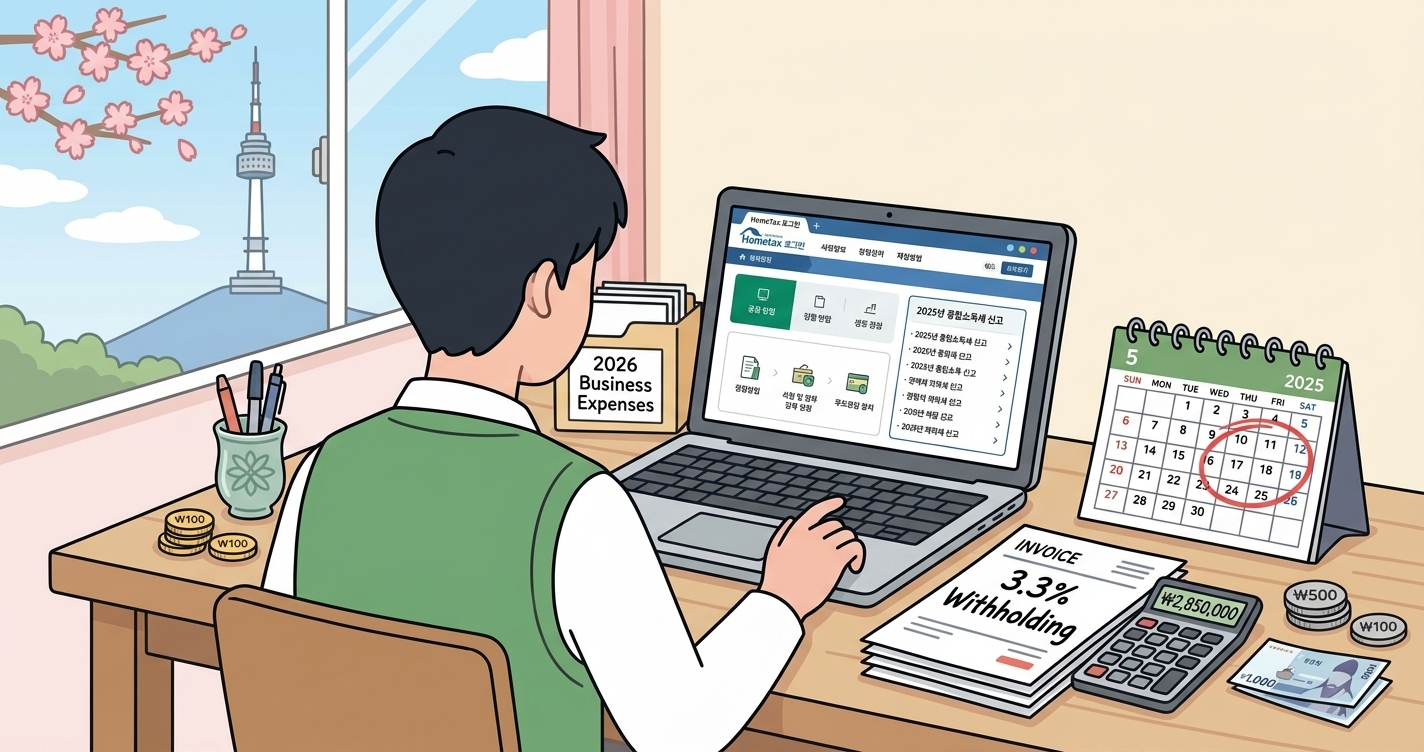
Every year, freelancers must file their Comprehensive Income Tax return for the previous year during May 1–31. The 2026 filing covers income earned January–December 2025. Filing is done through the Hometax (홈택스) system at hometax.go.kr or via the Sontax (손택스) mobile app.
If you miss the May 31 deadline, a 20% failure-to-file penalty applies, plus interest on any underpaid tax.
Tax Rates for 2025 Income (Filed May 2026)
Korea uses a progressive rate schedule. After deducting your business expenses and personal deductions, the remaining taxable income is taxed as follows:
- Up to ₩14,000,000: 6%
- ₩14,000,001 – ₩50,000,000: 15% (minus ₩1,260,000)
- ₩50,000,001 – ₩88,000,000: 24% (minus ₩5,760,000)
- ₩88,000,001 – ₩150,000,000: 35% (minus ₩15,440,000)
- ₩150,000,001 – ₩300,000,000: 38% (minus ₩19,940,000)
- Over ₩300,000,000: 40–45%
Local income tax adds approximately 10% on top of the national income tax amount. Most freelancers earning under ₩50M fall in the 15% bracket, meaning that after expenses and deductions, your effective rate is well below the marginal rate.
Deductible Business Expenses (필요경비)
This is where the refund opportunity lies. The NTS (국세청) allows freelancers to deduct 필요경비 (necessary business expenses) from their gross income before calculating tax. Every deductible expense directly reduces your taxable income.
Standard Expense Rate (단순경비율) vs. Actual Expense Deduction
Freelancers can choose between two methods:
1. Standard Expense Rate (단순경비율 / 기준경비율) The NTS publishes industry-specific rates. For example, a freelance writer or consultant may have a standard rate of 60–70%, meaning 60–70% of gross income is automatically treated as expenses without receipts. This method is simpler but may understate your actual costs.
Eligibility: New businesses or those with annual income below ₩24,000,000 (services) can use 단순경비율. Above that threshold, you must use 기준경비율 (reference expense rate), which covers only major expense categories automatically; other costs must be individually documented.
2. Actual Expense Deduction (장부 기재 방식) You maintain proper books (간편장부 or 복식부기) and deduct actual expenses with receipts. For most freelancers with significant costs — equipment, software, coworking, travel — this method produces a larger deduction and lower tax bill.
Commonly Deductible Expense Categories
- Home office (업무용 비율): A proportional share of rent, utilities, and internet based on the percentage of space used for work. Typically 20–30% for a dedicated room in a home.
- Equipment and hardware: Computers, monitors, cameras, microphones — all deductible. Items over ₩1,000,000 may need to be depreciated over multiple years rather than expensed immediately.
- Software and subscriptions: Adobe Creative Cloud, Figma, Notion, cloud storage, accounting software — fully deductible if used for business.
- Communication costs: Mobile phone and internet bills, deductible at the business-use percentage.
- Transportation: Taxi, bus, KTX, and fuel costs for client meetings and business travel. Keep transportation receipts or use the T-Money (교통카드) statement.
- Meals and entertainment (접대비): Client lunches and business meals are deductible, subject to an annual cap (₩12,000,000 for businesses with income under ₩100M, or 0.2% of revenue — whichever is lower for the entertainment-specific cap). Receipts or credit card statements required.
- Education and training: Online courses, professional books, conference registration fees relevant to your field.
- Professional services: Fees paid to accountants (세무사), lawyers, and other consultants.
- Co-working and meeting rooms: Monthly co-working memberships and meeting room rentals are fully deductible.
- Marketing and advertising: Portfolio website hosting, paid ads, freelancer platform fees (e.g., Kmong commission).
Key Deductions Beyond Business Expenses
In addition to 필요경비, freelancers can reduce taxable income further through personal deductions:
- 기본공제 (Basic personal deduction): ₩1,500,000 per dependent (yourself, spouse, children under 20, elderly parents).
- 국민연금 (National Pension): Full deduction for premiums paid.
- 건강보험 (National Health Insurance): Full deduction for premiums paid. Freelancers pay both employer and employee shares (~7.09% of assessed income for 2025).
- 신용카드/체크카드 소득공제: Credit card usage deduction — you can deduct 15% of credit card spending above 25% of gross income; higher rates apply for traditional markets and debit cards. Keep card statements as supporting documentation.
- 청약저축, 연금저축, IRP: Savings deductions for housing subscription accounts and pension savings products.
Practical Example: The Refund Calculation
Let's say you earned ₩40,000,000 in freelance income in 2025, with ₩1,320,000 withheld at 3.3%.
With actual expense tracking:
- Gross income: ₩40,000,000
- Business expenses (equipment, software, home office, transport): ₩8,000,000
- Business income after expenses: ₩32,000,000
- Personal deductions (self + NPS + NHI): approximately ₩6,000,000
- Taxable income: ₩26,000,000
- Tax at 15% bracket (₩26M × 15% − ₩1,260,000): ₩2,640,000
- Local income tax (10%): ₩264,000
- Total tax: ₩2,904,000
- Already withheld: ₩1,320,000
- Additional tax owed: ₩1,584,000
Now, if you had earned ₩40M from multiple clients with total withholding of ₩1,320,000 and had more in expenses — say ₩15,000,000 — the math could easily flip to a refund. The more expenses you can legitimately document, the lower your final tax.
Filing Step-by-Step via Hometax
- Gather income statements: Your clients are required to issue 지급명세서 (payment certificates) by the end of March. Hometax pre-fills most 3.3% withholding income automatically.
- Compile your expense receipts: Organize all receipts by category. Cash receipts (현금영수증) and card statements are the strongest evidence. Keep originals for 5 years.
- Log in to Hometax: Use your financial certificate (공동인증서 / 금융인증서) or simple authentication via Kakao/Naver.
- Select 종합소득세 신고: Choose the appropriate return type — 단순경비율 for eligible small earners, or 간편장부/복식부기 if keeping actual books.
- Enter income and expenses: The system pre-fills some income. Enter your expense totals by category.
- Apply personal deductions: Enter NPS, NHI premiums, credit card deduction amounts.
- Review and submit: Check the calculated tax. If it's less than your withholding, you'll receive a refund within 30 days of filing.
Important Deadlines for Freelancers
- May 1–31, 2026: File 종합소득세 for 2025 income
- November 2026: Interim prepayment (중간예납) due for those assessed in the prior year — typically 50% of last year's tax
- Year-round: Issue 현금영수증 for cash payments over ₩10,000 upon customer request
Track Expenses Year-Round with Denpyo
The biggest risk Korean freelancers face at tax time is missing receipts. A lunch receipt thrown away, a software subscription unrecorded, a taxi fare forgotten — each untracked expense is money left on the table.
Denpyo makes expense tracking effortless. Photograph any receipt with your phone — Korean 현금영수증, card receipts, invoices — and Denpyo's AI extracts the vendor, amount, date, and category automatically. By May filing time, your entire year's expenses are already organized and ready to hand to your 세무사 or enter into Hometax yourself.
Start tracking today at denpyo.com.
Summary
Korean freelancers operate in a system where 3.3% is withheld upfront, but your actual tax liability — and potential refund — is determined by your 종합소득세 return filed each May. The key levers are: documenting all business expenses (equipment, software, home office, transport, meals), claiming personal deductions for NPS and NHI, and filing accurately through Hometax. Start keeping receipts from January 1 so you have complete records when May arrives.

Track expenses, maximize deductions
Denpyo scans your receipts and finds tax savings automatically.