
15 Hong Kong Business Expense Deductions You Can Claim in 2026
Maximize your tax savings by understanding which business expenses are deductible in Hong Kong. Complete guide to allowable deductions for freelancers and SMEs.
Disclaimer: This article provides general information about Hong Kong tax obligations. It is not professional tax, legal, or financial advice. For your specific situation, please consult a qualified tax advisor or certified public accountant. Disclosure: This article is published on the Denpyo blog. Denpyo provides receipt management and expense tracking services.
Introduction: Lower Your Taxable Profits with Smart Deductions
As a Hong Kong freelancer or small business owner, the cost of running your business directly impacts how much tax you owe. The IRD (Inland Revenue Department) allows you to deduct all "outgoings and expenses wholly and exclusively incurred in the production of chargeable profits" — meaning legitimate business costs reduce your taxable income dollar-for-dollar.
For the 2025/26 tax year, understanding which expenses qualify as deductible can save you thousands of Hong Kong dollars. This guide covers 15 categories of allowable deductions based on IRD Proforma IR957 and official tax guidance, with worked examples in HK$.
The Golden Rule: Wholly and Exclusively for Business
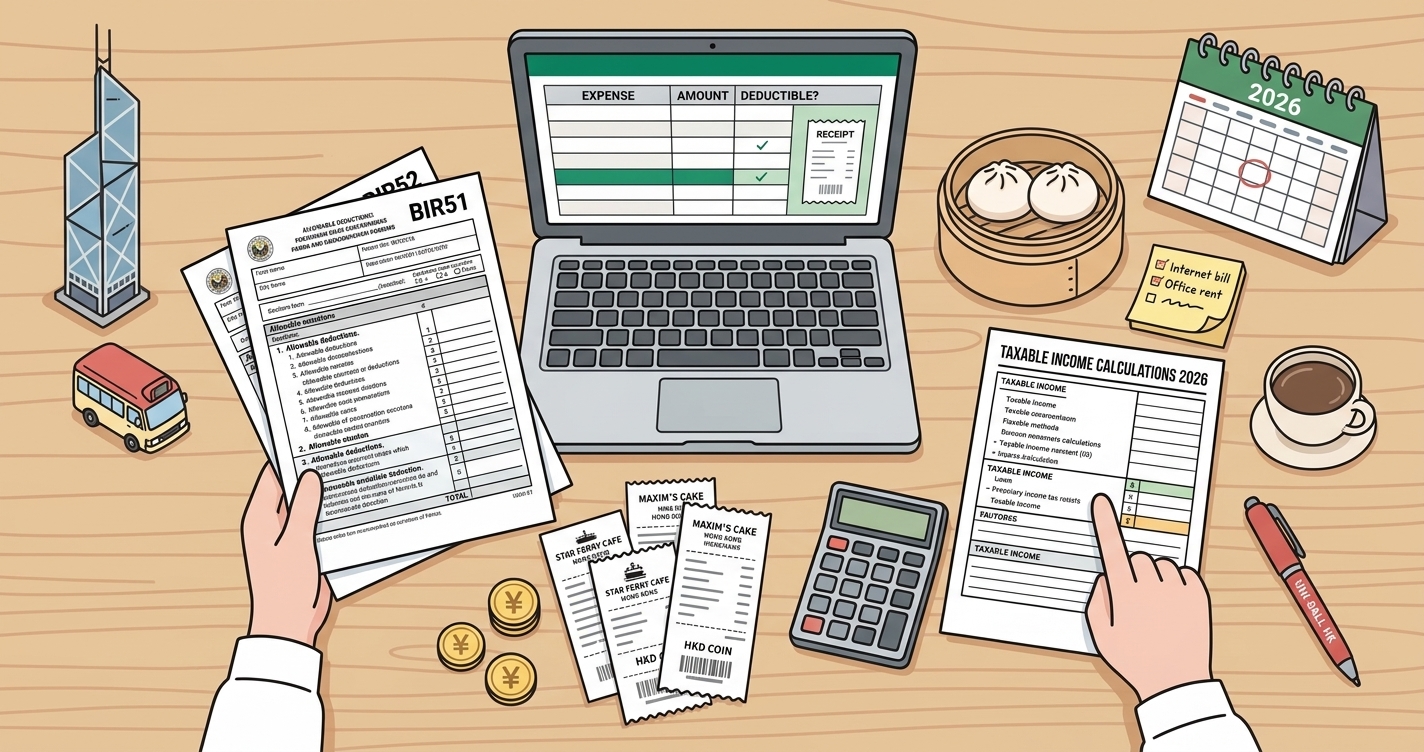
Before claiming any deduction, ask yourself: Was this expense incurred wholly and exclusively to produce my business profits? If yes, it is likely deductible. If it is mixed personal and business use, you can only deduct the business portion proportionately.
Examples of non-deductible expenses include private/domestic costs, capital improvements (these get depreciation instead), fines or penalties, and your own drawings/salary (these cannot be deducted from business profits).
1. Rent & Business Premises
Monthly rent or lease payments for your office, studio, or business location are fully deductible if the premises are used exclusively for business.
Worked Example: A graphic designer rents a small studio at HK$8,000/month. Annual rent deduction = HK$8,000 × 12 = HK$96,000.
If you work from a home office, you can claim a proportionate share of rent based on the percentage of your home dedicated to business (e.g., 30% of a 2,000 sq ft home = 600 sq ft office space).
2. Utilities & Operating Costs
Electricity, water, gas, telephone, internet, and waste disposal are deductible if they serve your business premises.
Worked Example: An accountant office incurs HK$1,500/month in utilities. Annual deduction = HK$18,000. If part of a shared home office, claim only the business portion (e.g., 40% = HK$7,200).
3. Transport & Travel Expenses
Business-related transport, taxi fares, public transport, and mileage for client visits are deductible. However, commuting to a regular place of work is not.
Worked Example: A consultant makes 10 client visits per month at HK$150 per visit (taxi/MTR). Monthly cost = HK$1,500; Annual deduction = HK$18,000.
Keep receipts and maintain a travel log to substantiate these expenses for IRD audit purposes.
4. Professional Fees & Advisory Services
Accounting fees, audit costs, legal advice, tax consultation, and consultancy fees incurred to support your business are deductible.
Worked Example: A freelancer pays a CPA HK$8,000 annually for tax preparation and bookkeeping. This entire amount is deductible = HK$8,000.
This category is critical for documenting the value of professional services in your receipt records.
5. Advertising & Marketing
Advertising costs, promotional materials, website design, social media ads, business cards, and branding expenses are all deductible.
Worked Example: A consultant spends HK$2,000 on LinkedIn ads, HK$3,000 on a website redesign, and HK$500 on business cards annually = HK$5,500.
6. Office Supplies & Materials
Stationery, paper, ink cartridges, folders, furniture pads, cleaning supplies, and other consumables used in your business are deductible.
Worked Example: Monthly office supply expenses = HK$800. Annual deduction = HK$9,600.
Keep all receipts together in your expense management system to build a clear paper trail.
7. Software, Subscriptions & Licenses
Cloud software (Xero, QuickBooks, Microsoft 365), design tools, project management apps, and professional subscriptions are fully deductible.
Worked Example: A freelancer pays HK$300/month for accounting software + HK$200/month for design tools = HK$500/month; Annual deduction = HK$6,000.
8. Insurance Premiums
Professional liability insurance, business property insurance, workers compensation, and cyber insurance are deductible business expenses.
Worked Example: Annual professional indemnity insurance = HK$4,500. This is fully deductible = HK$4,500.
Health insurance premiums, however, are generally not deductible (these fall under personal living expenses).
9. Depreciation Allowances & Capital Assets
While the cost of equipment is capital in nature and cannot be deducted immediately, the IRD allows depreciation allowances (capital allowances) on prescribed assets.
Allowance Rates:
- Initial Allowance (IA): 60% in the year of acquisition
- Annual Allowance (AA) on remaining balance: Buildings: 10% per year Furniture & Fixtures: 20% per year Computers & Machinery: 30% per year
Worked Example: A designer purchases a HK$20,000 MacBook Pro for business use.
- Year 1: IA = 60% × HK$20,000 = HK$12,000 deduction. Remaining = HK$8,000
- Year 2: AA = 30% × HK$8,000 = HK$2,400 deduction. Remaining = HK$5,600
- Year 3: AA = 30% × HK$5,600 = HK$1,680 deduction
10. Entertainment & Client Hospitality
Reasonable entertainment expenses for business development — client meals, industry event tickets, hospitality — are deductible if directly connected to your business. However, the amount must be reasonable and properly documented.
Worked Example: A consultant takes a client to lunch once per week at HK$350/meal. Annual entertainment deduction = HK$350 × 52 = HK$18,200 (if the IRD deems it reasonable for your industry).
Caution: The IRD scrutinizes entertainment heavily. Keep detailed records of who attended, business purpose, and amounts.
11. Staff Costs & Employee Expenses
Salaries, wages, bonuses, staff allowances (phone, meals), Mandatory Provident Fund (MPF) contributions, and employee benefits are fully deductible.
Worked Example: A small design studio employs 1 designer at HK$25,000/month + HK$1,250/month MPF (5% cap). Annual deduction = (HK$25,000 + HK$1,250) × 12 = HK$315,000.
12. Bank Charges & Financial Costs
Bank account fees, transaction charges, credit card processing fees, and loan interest on business loans are deductible.
Worked Example: Monthly business account fees = HK$50. Annual deduction = HK$600. This small amount adds up over years.
Note: Interest on personal loans is not deductible; only interest on loans used for business purposes qualifies.
13. Equipment Maintenance & Repairs
Cost to maintain and repair business equipment (computers, cameras, furniture) is deductible. However, if the repair significantly improves the asset or extends its life, it may be capitalized.
Worked Example: An annual camera maintenance contract costs HK$2,000. This is deductible = HK$2,000. A HK$8,000 camera sensor replacement (improvement) would be capitalized instead.
14. Charitable Donations
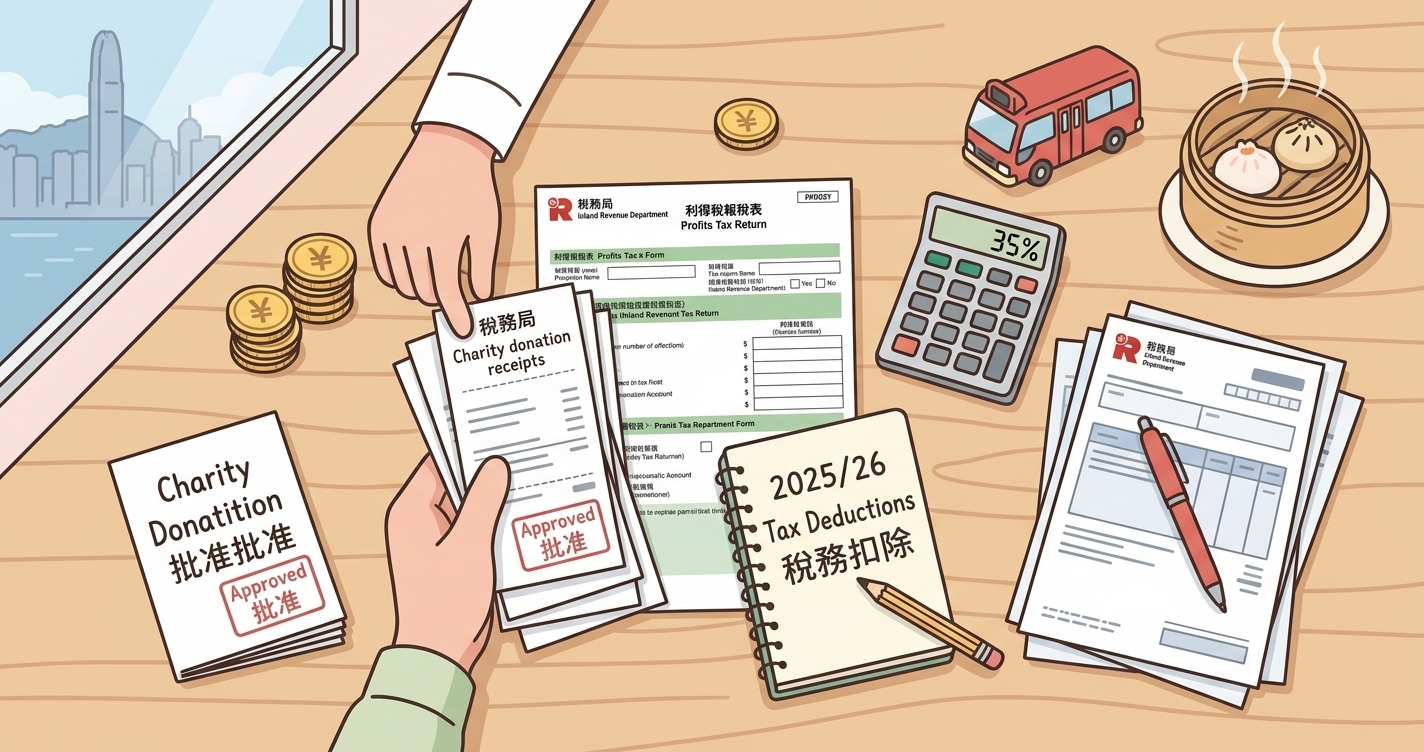
Donations to approved charities are deductible, with a limit of 35% of assessable profits (minimum donation HK$100 per transaction).
Worked Example: A freelancer with HK$200,000 in assessable profits donates HK$10,000 to an approved Hong Kong charity. Deduction = HK$10,000 (within the 35% limit of HK$70,000).
15. Professional Development & Training
Courses, certifications, conference fees, and books directly related to your business skills are deductible as business education expenses.
Worked Example: A consultant enrolls in a professional certification course costing HK$5,000. This is fully deductible = HK$5,000.
However, general education or courses leading to a formal degree are typically not deductible.
Record-Keeping Requirements: 7 Years
The IRD requires you to keep all business records — invoices, receipts, contracts, bank statements — for at least 7 years. Both paper and digital records are acceptable, provided they are complete, accurate, and retrievable.
Inadequate record-keeping can result in the IRD disallowing claimed deductions, so maintaining organized records is essential to defending your tax position.
How Denpyo Helps
Denpyo automatically categorizes your scanned receipts and invoices into the expense categories accepted by the IRD, so when filing season arrives, your deductions are already organized and documented. Instead of manually sorting receipts at year-end, Denpyo builds your audit-ready expense trail throughout the year, reducing errors and ensuring you claim every eligible deduction.
Summary & Action Checklist
- Rent & Premises: Deduct 100% of business premises costs; claim a proportionate home office allocation
- Utilities: Include electricity, water, gas, internet for your business location
- Transport: Track client visit taxi/MTR fares; exclude commuting
- Professional Fees: Save CPA, accountant, and legal service invoices
- Advertising & Marketing: Capture all promotional expenses in your records
- Supplies & Software: Organize monthly stationery and SaaS receipts
- Insurance: Include professional liability and business property premiums
- Depreciation: Track major equipment purchases (computers, machinery) for capital allowances
- Entertainment: Keep detailed records and receipts for business meals and events
- Staff Costs & MPF: Record all salaries and mandatory provident fund contributions
- Bank & Financial: Include account fees and business loan interest
- Repairs & Maintenance: Distinguish between repairs (deductible) and improvements (capitalized)
- Charitable Donations: Confirm IRD approval and stay within 35% limit
- Professional Development: Save certification and course invoices
- Audit Trail: Keep all receipts for 7 years
For detailed guidance on specific deductions relevant to your industry, refer to the PwC Hong Kong tax deductions guide or consult your CPA before filing your BIR60.
Use Denpyo's Expense Checker to validate your deductions and explore Denpyo's Tax Savings Estimator to see your potential annual tax relief.

Track expenses, maximize deductions
Denpyo scans your receipts and finds tax savings automatically.