
Individual Enterprise Tax in Japan: Who Pays, Rates & How to Calculate (2026)
A friendly guide to Japan's individual enterprise tax (kojin jigyozei) for freelancers and small businesses: which of the 70 statutory trades are taxed, the 3-5% rates, and how the 2.9 million yen business-owner deduction works.
Disclaimer: This article is general information as of June 2026, not tax advice. Individual enterprise tax (kojin jigyozei) is a local tax levied by each prefecture, so rates and deadlines can vary. For your situation, confirm with your prefectural tax office or the National Tax Agency (nta.go.jp) or a licensed tax accountant.
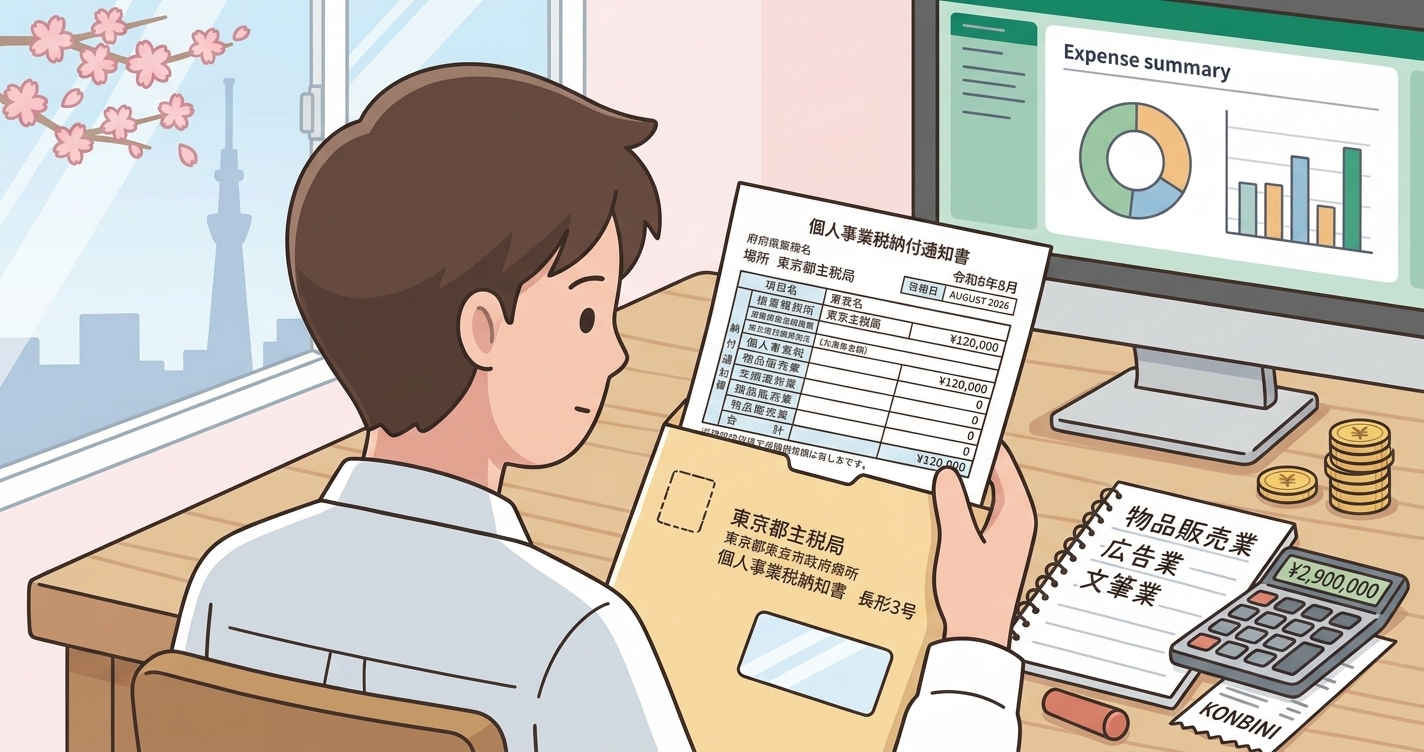
You filed your tax return in spring, relaxed—and then in August a "individual enterprise tax payment notice" lands in your mailbox. Many freelancers and sole proprietors in Japan have never even heard of this tax. This guide explains who pays it, how much, and when, with worked examples.
What is individual enterprise tax?
Individual enterprise tax is a local tax levied by your prefecture on people who run certain businesses. It is separate from national income tax and is paid to your prefectural tax office. It reflects the idea that businesses use local roads and public services.
Importantly, if you have filed your national tax return, you usually do not need to file separately for enterprise tax. Your return data is shared with the prefecture, the tax is calculated automatically, and a payment notice is mailed to you around August. Only those who run a business but did not file a return (for example, some side-business cases) may need to file separately.
Who pays? The 70 statutory trades and rates
Only businesses that fall within the 70 statutory trades defined by the Local Tax Act are taxed. They are split into three categories with rates of 3% to 5%.
- Category 1 (37 trades, 5%): retail, restaurants, property rental, manufacturing, transport, contracting, advertising and more — most trades sit here.
- Category 2 (3 trades, 4%): livestock, fisheries, charcoal making.
- Category 3 (30 trades, mostly 5%): medical practice, licensed professionals (lawyers, tax accountants), design, consulting, beauty services and more. Massage/acupuncture and farriers are taxed at 3%.
A key point: businesses outside the 70 trades are not taxed. For example, pure writing (authors, writers) and fine art are generally exempt, while design work and contract software development can be taxable. Your category is ultimately decided by the prefectural tax office.
How to calculate it: four steps
- Find your business income: annual revenue minus allowable expenses.
- Add back the blue-return special deduction: even if you claimed up to 650,000 yen for income tax, it is not available for enterprise tax, so add it back.
- Subtract deductions: carried-forward losses and the 2.9 million yen business-owner deduction (pro-rated by month if you started or closed mid-year).
- Apply the rate: multiply the remaining taxable amount by your trade's rate (3-5%).
In formula form: enterprise tax = (business income + blue-return special deduction − other deductions − 2.9M yen) × rate. Because of the 2.9M yen deduction, if your annual business income is roughly 2.9M yen or less, no enterprise tax is due.
Worked examples
Example 1 — Web designer (Category 3, 5%), business income 4M yen. Assuming no blue-return deduction: 4,000,000 − 2,900,000 = 1,100,000. × 5% = 55,000 yen.
Example 2 — Restaurant owner (Category 1, 5%), income 3M yen after a 650,000 yen blue-return deduction. Add the deduction back: 3,000,000 + 650,000 = 3,650,000. Subtract 2.9M: 750,000. × 5% = 37,500 yen.
The add-back of the blue-return deduction is the big difference from income tax. If the bill feels higher than your reported income suggests, this is usually why. Estimate your business income first with our income tax calculator.
Payment schedule and expensing
The payment notice arrives from the prefecture around August. Payment is normally in two installments: roughly end of August and end of November (dates vary by prefecture). Bank, convenience-store, direct-debit and smartphone payment options are increasingly available.
Good news: individual enterprise tax is deductible as a business expense ("taxes and dues"). Unlike income tax and resident tax, it relates to your business, so you can expense it in the year paid, which also lowers next year's income and resident tax (see NTA Tax Answer No.2210).
Good receipt habits prevent overpaying
Because enterprise tax rises with business income, capturing every legitimate expense is the best defence. Missed expenses inflate your income tax, resident tax and enterprise tax all at once.
Logging receipts one by one is tedious. With Denpyo, you simply photograph a receipt or invoice and AI extracts the date, amount, expense category and consumption-tax breakdown automatically. It even shows an estimated tax saving as you scan, so you can see how much each expense reduces your tax. Try our tax savings estimator or expense checker to see the impact of your expenses.
Summary
Individual enterprise tax is a prefectural tax on the 70 statutory trades, charged at 3-5% after the 2.9 million yen business-owner deduction. If you filed your tax return, no separate filing is needed; a notice arrives around August and is paid in two installments (end of August and end of November). The amount paid is itself deductible. Record every expense from filing season onward so the August notice never catches you off guard — systematic receipt management is, in the end, your best tax-saving move.

Track expenses, maximize deductions
Denpyo scans your receipts and finds tax savings automatically.