
Chargeable Income vs Gross Income: What Singapore Freelancers Actually Pay Tax On
Many Singapore freelancers think they're taxed on everything they earn. In reality, your tax bill is calculated on 'chargeable income'—which can be significantly lower than your gross income after allowable deductions and personal reliefs. Here's how it works.
Disclaimer: This article is for general informational purposes only and does not constitute professional tax advice. Singapore's income tax is administered by the Inland Revenue Authority of Singapore (IRAS). Tax rules change annually—consult a qualified Singapore tax professional for advice specific to your situation.
The Number Most Freelancers Get Wrong
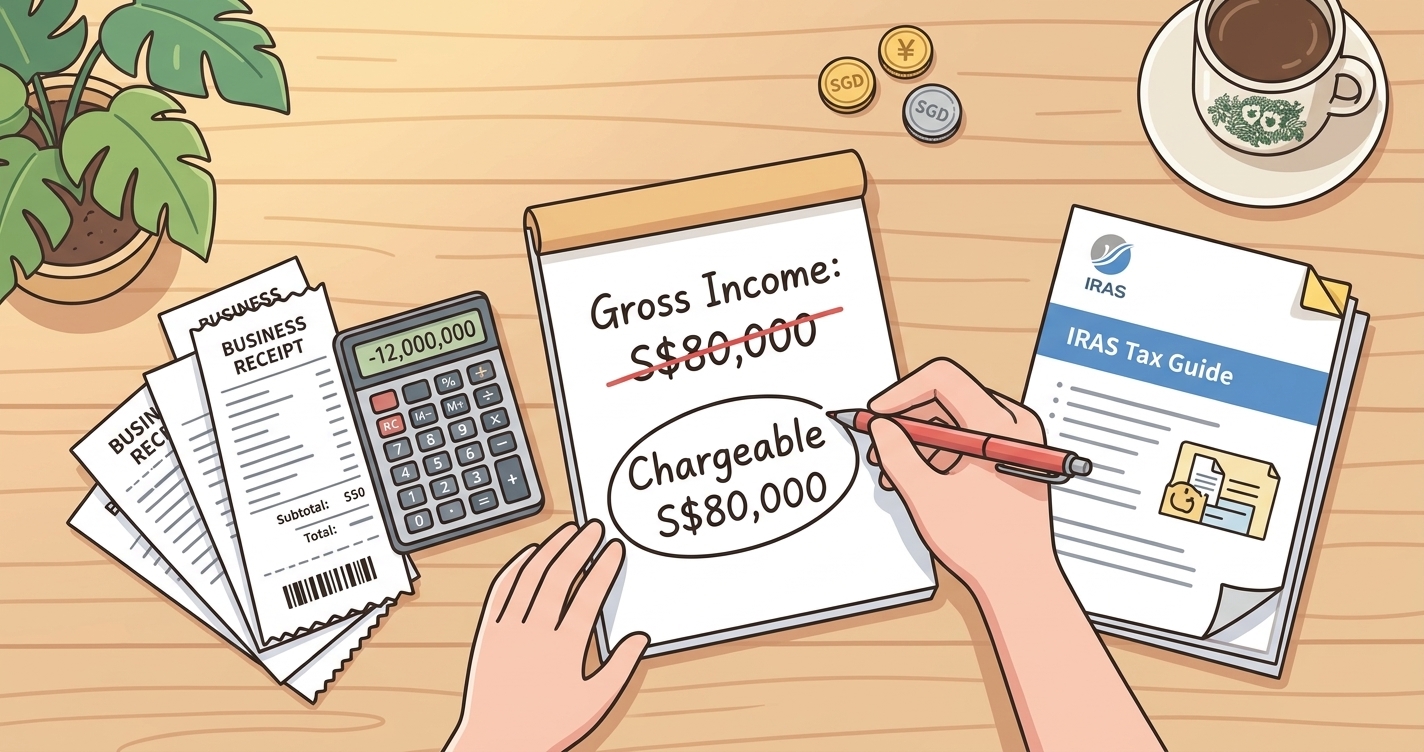
If you earned S$80,000 last year as a self-employed professional in Singapore, you are not taxed on S$80,000. You're taxed on your chargeable income—which, after legitimate business expense deductions and personal reliefs, might be closer to S$45,000 or S$50,000. That difference can translate to several thousand dollars in tax savings.
Yet many freelancers and small business owners file their taxes without fully understanding this distinction. They either claim too little (missing legitimate deductions) or become confused when their tax bill doesn't match their income. This guide explains the full picture: how gross income turns into chargeable income, and what levers you have to reduce the latter legally.
The Building Blocks: Four Key Concepts
1. Gross Income
Your gross income is the total of all money you received for your business activities during the calendar year (January 1 – December 31 in Singapore). For a freelancer, this includes:
- Fees from all clients, regardless of where they're based
- Project-based payments, retainers, and consulting fees
- Commissions and performance bonuses paid by clients
- Income from multiple revenue streams (e.g., freelance writing + online courses + consulting)
Importantly, Singapore taxes on a source basis for self-employed income—income from services performed in Singapore is taxable even if the client pays from overseas. Foreign-sourced income (where services are entirely performed outside Singapore) is generally not taxable for individuals, though this requires careful analysis.
2. Allowable Business Expenses
From your gross income, you can deduct expenses that are "wholly and exclusively" incurred in producing your income. According to IRAS guidance on allowable business expenses, common deductible items for freelancers include:
- Professional tools and software: Design subscriptions, development environments, video editing software, project management tools
- Home office expenses: Proportionate rent, utilities, and internet based on dedicated workspace area
- Business travel: Transport to client meetings, co-working space fees
- Professional development: Courses, workshops, and industry conferences directly related to your trade
- Equipment depreciation: The cost of computers, cameras, and other business equipment can be claimed over their useful life (capital allowances)
- Professional fees: Accounting, legal, and business advisory fees
- Marketing and business development: Website costs, business cards, online advertising
What you cannot deduct: personal expenses (even partially business-related clothing, unless it's a uniform), entertaining friends who are clients without a clear business purpose, and capital expenditure that isn't claimed as a capital allowance.
3. Net Trade Income
Gross income minus allowable business expenses equals your net trade income. This is what IRAS considers your earnings from self-employment before personal reliefs are applied. Your net trade income is also the figure used to compute your mandatory MediSave contributions as a self-employed person.
4. Chargeable Income
From your net trade income, you can subtract personal reliefs to arrive at your chargeable income. Chargeable income is what Singapore's progressive tax rates are actually applied to.
Personal Reliefs: Where the Real Savings Are
Singapore's personal relief system is extensive. IRAS lists all available reliefs—here are the most significant ones for self-employed individuals:
Earned Income Relief
Automatically granted based on your net trade income. For those under 55, the relief is S$1,000 (for income ≥S$1,000). For those aged 55–59, S$6,000; aged 60 and above, S$8,000. This is a baseline relief that applies to everyone with earned income.
CPF/MediSave Relief
Self-employed individuals who make voluntary CPF contributions or mandatory MediSave contributions can claim these as relief. The CPF Relief for self-employed is capped at S$37,740 (37% of S$102,000 Ordinary Wage ceiling). In 2026, the ceiling on MediSave contributions has been revised upward, allowing higher deductions for those topping up their accounts—this was one of the key changes for self-employed Singaporeans this year.
NS Man (NSman) Relief
If you completed National Service, you may be eligible for NSman relief of S$1,500 to S$5,000 depending on your rank and whether you performed in-camp training (ICT) during the year.
Course Fees Relief
Up to S$5,500 per year for approved courses related to your current trade, business, or employment. For freelancers, this covers professional certifications, technical courses, and upskilling programs relevant to your work.
Spouse and Dependent Reliefs
If you support a non-working or lower-earning spouse, you can claim a Spouse Relief of up to S$2,000. Additional reliefs exist for supporting parents, grandparents, and siblings. These compound quickly for freelancers with family responsibilities.
Life Insurance and SRS Relief
Premiums paid on life insurance policies (where CPF contributions are less than S$5,000) qualify for relief up to S$5,000. Contributions to the Supplementary Retirement Scheme (SRS) are deductible up to S$15,300 per year—and SRS investments grow tax-free, making this a powerful tool for higher-earning freelancers.
A Worked Example: From S$90,000 to Chargeable Income
Let's trace a concrete example for a freelance UX designer in Singapore:
- Gross income: S$90,000
- Less allowable business expenses (software, equipment depreciation, home office portion, professional development): S$18,000
- Net trade income: S$72,000
- Less Earned Income Relief: S$1,000
- Less CPF/MediSave Relief (voluntary top-up): S$8,000
- Less Course Fees Relief: S$4,000
- Less NSman Relief: S$1,500
- Chargeable Income: S$57,500
Tax on S$57,500 (at 2026 rates): approximately S$3,350. Tax on S$90,000 without any deductions would have been approximately S$10,200. The difference—S$6,850—is the value of understanding and fully claiming your entitlements.
How to Calculate Your Own Chargeable Income
Use this framework each year:
- Tally your gross income across all clients and income streams for the calendar year
- Identify all allowable business expenses—be rigorous, review every business-related purchase
- Compute net trade income (gross minus expenses)
- List all personal reliefs you qualify for—check the IRAS relief checker on myTax Portal
- Subtract total reliefs from net trade income to get chargeable income
- Apply Singapore's progressive tax rates to the chargeable income
Singapore's 2026 tax rates range from 0% (first S$20,000 chargeable income) to 24% (above S$1 million). Most freelancers fall in the 2%–11.5% range on their chargeable income.
Using the Free Income Tax Calculator
Not sure what your chargeable income will be or how much tax you'll owe? Use the free Denpyo Income Tax Calculator to model your situation. Enter your expected net trade income and applicable reliefs to get an instant estimate of your tax liability—useful for quarterly financial planning and setting aside the right amount throughout the year.
Tracking your expenses consistently throughout the year is equally important. Tools like Denpyo automatically extract expense data from receipt photos using AI, making it easy to maintain accurate records for your business expense deductions without manual data entry.
Common Mistakes to Avoid
Confusing Gross Income with Chargeable Income in myTax Portal
When filing on IRAS's myTax Portal, enter your net trade income (after business expenses) in the self-employment section—not your gross invoice total. IRAS will then apply reliefs to compute chargeable income. Filing the gross amount overstates your taxable income.
Forgetting to Claim Capital Allowances
Large equipment purchases (computers, cameras, production gear) aren't fully deductible in the year of purchase as expenses—they're claimed as capital allowances over 1 or 3 years under the Accelerated Capital Allowance scheme. Many freelancers miss this entirely.
Not Tracking Partial Business Use
Your home internet bill is partially personal, partially business. If 40% of your home is a dedicated workspace, 40% of your rent and utilities may be claimable. Document and claim the business portion—it adds up over a full year.
Summary
Your tax bill as a Singapore freelancer isn't calculated on what you earn—it's calculated on your chargeable income, which is your gross income minus allowable business expenses minus personal reliefs. Maximizing each of these deductions is the legitimate, IRAS-sanctioned path to reducing your tax burden.
The key steps: track every business expense in real time, claim all personal reliefs you qualify for, and understand the difference between gross income, net trade income, and chargeable income before you file. The IRAS self-employed tax guide and the myTax Portal are your primary resources for official guidance.
Track expenses, maximize deductions
Denpyo scans your receipts and finds tax savings automatically.