
12 Common Tax Mistakes Malaysian Freelancers Make (2026 Guide)
From wrong forms and missed deadlines to MyInvois oversights and SST surprises — the 12 most common Malaysian freelancer tax mistakes and how to avoid each.
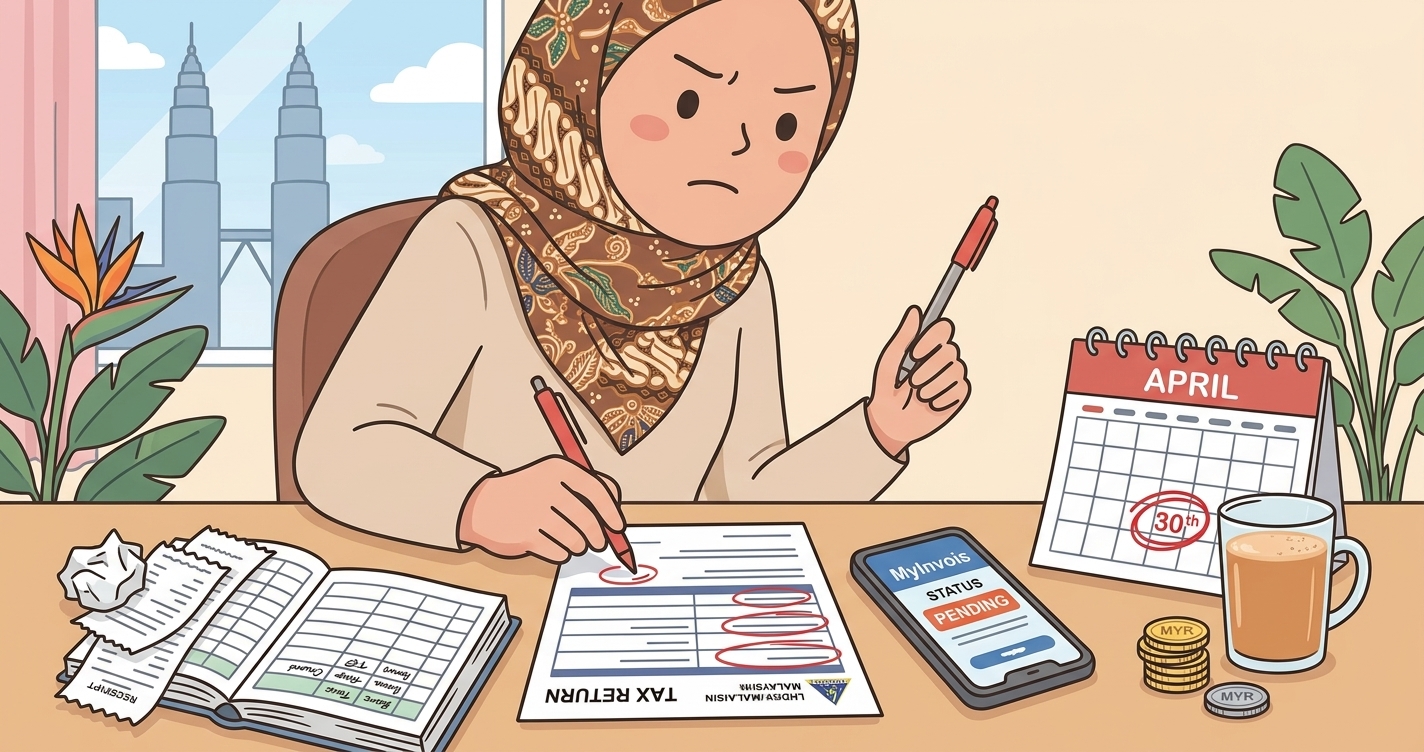
Disclaimer: This article outlines common Malaysian filing errors and is for general education only. Malaysian tax law (Income Tax Act 1967, Sales Tax Act 2018, Service Tax Act 2018) changes frequently, including major 2024–2026 updates to MyInvois, SST, and the Gig Workers Act 2025. For personalised advice, consult a tax agent licensed by LHDN or a member of the Malaysian Institute of Accountants. Always verify current rules at LHDN.
Why this checklist exists
Malaysia's freelance economy is now around 1.5–2 million people — close to one in four workers. Every year, LHDN flags thousands of Form B filings for review, and the same mistakes appear over and over. Some cost a few hundred ringgit in under-claimed reliefs. Others trigger penalties of 10–45% of the shortfall under sections 112 and 113 of the Income Tax Act 1967. With the 15 July 2026 e-filing deadline approaching, here is a clean, opinionated checklist of the 12 mistakes we see most often from freelancers and SME owners — and how to avoid each one.
1. Filing Form BE instead of Form B
Form BE is for resident individuals with employment income only (MTD/PCB withheld; no business income). The moment you earn freelance or business income — whether it is RM50 a month from Shopee or RM50,000 from one client — you file Form B. Submitting Form BE when you should file Form B is treated as non-filing for the business portion and can trigger penalty notices.
Quick test: if you received even one invoice under your own name (not your employer's) for services or goods sold during 2025, file Form B for YA 2025. The PwC Malaysia Individual Tax Administration guide is a useful sanity check.
2. Missing the e-filing deadline (15 July)
The manual Form B deadline is 30 June; the e-filing deadline is 15 July. Miss it and you face:
- Late-filing penalty: RM200–RM20,000, or up to 6 months' jail under Section 112.
- Section 113 penalty: typically 10%+ on the tax shortfall, with multipliers for repeat offences.
There is no automatic grace period. LHDN's servers are usually slow on 15 July — plan to file by 13 July at the latest.
3. Not declaring all income sources
LHDN cross-references bank statements, MyInvois consolidated invoices, EPF contributions, and platform data (Grab, Foodpanda, Shopee, TikTok Shop, Lazada). If Grab remits RM45,000 to your account during the year and you declare RM30,000, expect a follow-up. Declare every ringgit — and claim every legitimate expense against it. Under-declaration is far more expensive than the tax saved, especially with the 45% Section 113(2) penalty for incorrect returns.
4. Forgetting MyInvois consolidated submissions
If you are in MyInvois scope (Phase 2 covers RM5m–25m turnover from January 2025; Phase 3 covers RM1m–5m enforcement from 1 July 2026), you must submit a consolidated e-invoice monthly for B2C transactions where customers do not need an individual e-invoice. Many freelancers wrongly assume MyInvois only applies to B2B; it does not.
See the MyInvois portal, the LHDN e-Invoice page, and our MyInvois Phase 3 compliance guide.
5. Claiming personal expenses as business
The classic trap. Your grocery bill, gym membership, personal Netflix, and family dinner at PJ are not “wholly and exclusively” for your business under Section 33 of the Income Tax Act 1967. If LHDN audits and disallows them, you pay back tax plus a Section 113(2) penalty (often 45%+).
Keep a clean rule: business expenses on the business card; personal on the personal card. If you cannot defend an expense as serving the trade, do not claim it.
6. Confusing capital allowance with current expense
A RM3,500 laptop is a capital asset, not a current expense. You claim it via capital allowance under Schedule 3 of the Income Tax Act — typically a 20% initial allowance plus 14% annual allowance for plant and machinery (rates vary by asset type). Writing off the full RM3,500 in Year 1 under “expenses” is incorrect and will be adjusted in audit.
The distinction matters most for: computers, phones, furniture, vehicles, and software purchased outright. Note that SaaS subscriptions (Adobe, Figma, Notion, etc.) are current expenses, not capital — they go straight into expenses each year.
7. Missing personal reliefs
Freelancers routinely miss legitimate reliefs that would have lowered chargeable income. The most common misses:
- Lifestyle relief — RM2,500: books, internet, sports equipment, gym, personal computer, smartphone, newspapers.
- Internet subscription: already covered by lifestyle relief — do not double-claim.
- EPF voluntary (i-Saraan / i-Saraan Plus): up to RM4,000 deduction.
- SSPN deposits: up to RM8,000 for net deposits to children's education savings.
- Medical insurance for self/spouse/child: up to RM3,000.
- Parents' medical: up to RM8,000.
- PRS contributions: up to RM3,000.
Each missed relief is tax you overpaid. See the LHDN deductions page.
8. Not registering for SST when past the threshold
SST registration is mandatory at RM500,000 annual taxable turnover for sales of taxable goods and RM500,000–RM1.5 million for taxable services (depending on service type — note the 2024 expansion brought many digital and management services into the net). Many freelancers cross the threshold during a big-contract year and do not realise. Late registration penalties are steep, and SST under Section 26 of the Service Tax Act 2018 attracts late-payment penalties on the unpaid output tax.
Check your 12-month rolling turnover at the end of every quarter. If you are within RM50,000 of the threshold, set up registration before the next big invoice goes out.
9. Mixing personal and business bank accounts
This is the fastest way to lose an audit. When LHDN asks for 7 years of records under Section 82 of the Income Tax Act, you need to hand over a clean business account statement. Mixed accounts mean the auditor can — and often does — treat every unidentified credit as taxable business income.
Open a separate current account, even a simple SME account with Maybank, CIMB, or Public Bank, and route everything business-related through it. If you have been mixing for years, consider opening the business account today and migrating cleanly from January 2026 forward.
10. Forgetting the 7-year record retention rule
Under Section 82 of the Income Tax Act 1967, you must keep business records for 7 years from the end of the year of assessment. Paper receipts fade. Cloud storage disappears when you forget to pay the bill. Make 7-year retention a system, not a promise — scan receipts into a dated, backed-up folder the moment you receive them. See the LHDN Public Rulings for the full record-keeping framework.
11. Not claiming home office expenses correctly
If you work from home, you can claim a proportion of rent, electricity, internet, and broadband under Section 33 — but the formula is strict: the dedicated work area divided by total floor area. Claiming 100% of rent because “I work here all day” is not allowed. Claim only the proportionate amount and keep a simple floor-plan note as evidence.
See our home office deductions guide for the calculation.
12. Forgetting the Gig Workers Act 2025 / SESSS
From 2025, platform gig workers (ride-hail, delivery, logistics) are enrolled in SESSS (Self-Employment Social Security Scheme) via SOCSO under the Gig Workers Act 2025. Your platform withholds and remits the contribution. Forgetting to declare SESSS contributions means missing the deduction. See our Gig Workers Act guide and the SOCSO/PERKESO overview.
Bonus: 5 small mistakes that quietly add up
- Filing in the wrong assessment year — Form B for YA 2025 is filed in 2026, not 2025.
- Forgetting tax-exempt income still needs declaration — e.g., dividends from tax-exempt funds belong on the return for record purposes.
- Not keeping a copy of the submitted Form B — download the PDF acknowledgement and save it for 7 years.
- Forgetting to update LHDN address/bank details — refunds bounce when the bank account is closed.
- Not paying provisional CP500 instalments on time — late-payment surcharges add up quickly.
How Denpyo helps you avoid the top three
Twelve mistakes is a lot to remember. Most come down to two habits: track every ringgit in and out, and keep every receipt for 7 years. Denpyo automates both. Snap a photo and the app extracts vendor, date, RM amount, and SST breakdown in seconds, filing them by assessment year. Try the expense deductibility checker to pre-screen which expenses are legitimately claimable before you file your Form B, or the tax savings estimator to see how quickly deductions reduce your chargeable income.
Summary
LHDN's audit triggers are predictable: undeclared platform income, personal expenses on the business side, late filing, and missing SST registration. None of these are exotic — they are paperwork hygiene failures. Build the system now (separate accounts, monthly reconciliation, receipt auto-capture), and the 15 July deadline becomes a 10-minute review instead of a panicked all-nighter.
Related reading: Form B filing guide, deductible business expenses, and 2026 Malaysia tax deadlines.
Track expenses, maximize deductions
Denpyo scans your receipts and finds tax savings automatically.