
Japan Invoice System October 2026 Changes: Consumption Tax Deduction Drops to 50%
The Qualified Invoice System (Tekikaku Seikyu Hakko Houshiki) was introduced on October 1, 2023, and represents a significant overhaul of Japan's consumption tax system. The system's most critical feature is that businesses must retain qualified invoices to claim consumption tax deductions.
Disclaimer: This article provides general information only and does not constitute tax or legal advice. Please consult a qualified tax professional (zeirishi) for advice specific to your situation. Information is based on official National Tax Agency (NTA) sources and current as of February 2026. Disclosure: This article is published by Denpyo, a receipt and expense management service.
What is the Qualified Invoice System in Japan?
The Qualified Invoice System (Tekikaku Seikyu Hakko Houshiki) was introduced on October 1, 2023, and represents a significant overhaul of Japan's consumption tax system.
The system's most critical feature is that businesses must retain qualified invoices to claim consumption tax deductions. This represents a major shift from the previous system where almost any receipt could be used to claim deductions.
Purpose of the Qualified Invoice System:
- Ensure proper consumption tax collection and prevent tax evasion
- Eliminate double taxation concerns for buyers
- Improve transparency in sales and purchases
- Link accounting records directly with invoices
How the Invoice System Works
Key Difference from Previous System:
Before the Invoice System (before October 1, 2023), Japan used the "Ledger Preservation Method." Under this system, businesses could claim deductions for almost any purchase if they had a receipt or invoice, regardless of whether the supplier was a registered taxpayer.
After Invoice System Implementation (October 1, 2023):
Only invoices from Qualified Invoice Issuers (registered businesses) can be used to claim deductions.
Required Information on Qualified Invoices:
- Name of the invoice issuer
- Registered invoice issuer registration number
- Date of the transaction
- Description of goods/services and amounts by tax rate
- Consumption tax amount
- Name of the recipient
Who is a "Qualified Invoice Issuer"?
A Qualified Invoice Issuer is a business that:
- Has registered with the tax authorities
- Has previous-year taxable sales exceeding ¥10 million (¥100 million in some cases)
- Meets all legal and regulatory requirements
October 2026 Amendment: The Deduction Rate Drops to 50%
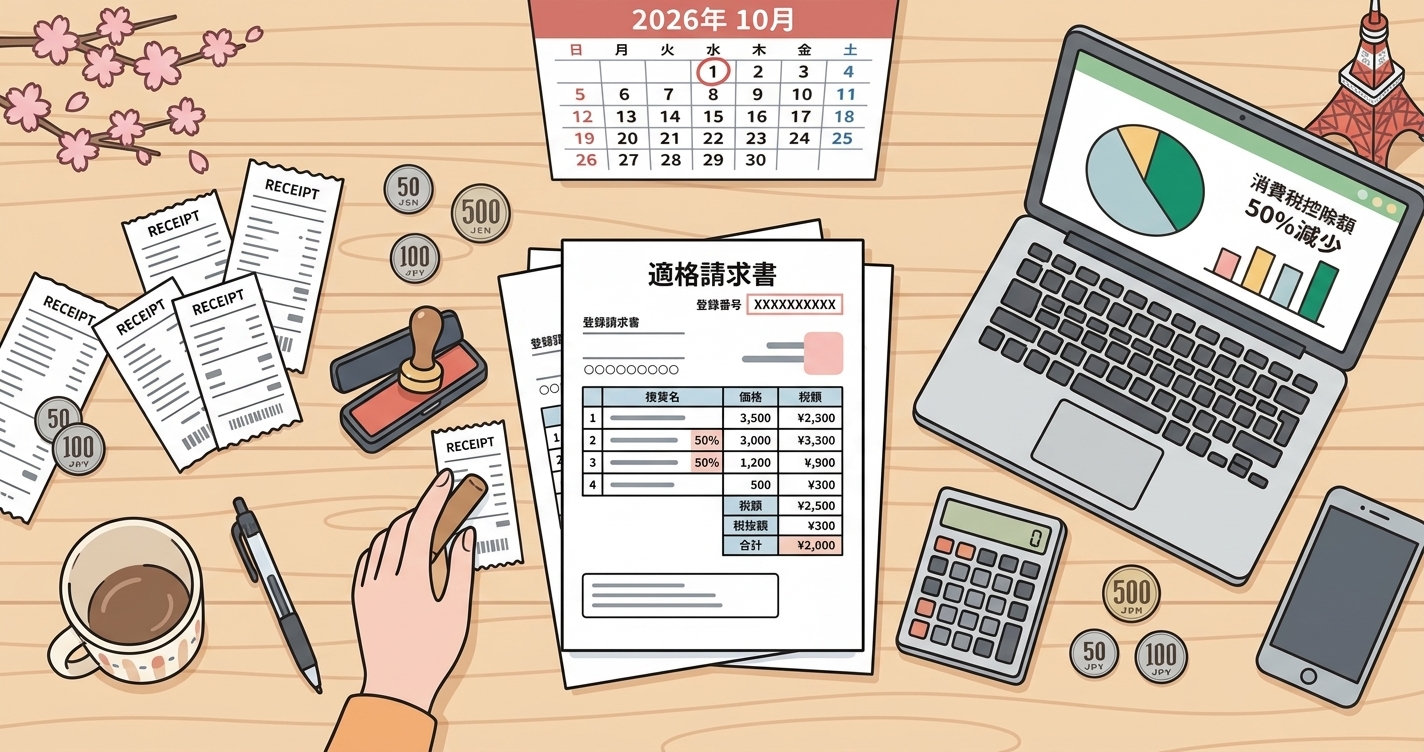
Major Change: Beginning October 1, 2026, the first phase of the phased discontinuation of the Invoice System begins with the input deduction rate dropping from 80% to 50%.
This is just the beginning. Here's the full timeline:
Phased Reduction Schedule:
| Period | Deduction Rate | Status |
|---|---|---|
| Oct 2024 - Sep 2026 | 80% | Current phase |
| Oct 2026 - Sep 2028 | 50% | First reduction phase |
| Oct 2028 - Sep 2030 | 30% | Second reduction phase |
| From Oct 2030 | 0% | System abolished |
Critical Point: This applies ONLY to purchases from non-registered businesses (tax-exempt businesses).
This is an important distinction. Purchases from registered businesses continue to allow 100% deductions even after October 2026. The rate reduction only affects purchases from businesses that have NOT registered as Qualified Invoice Issuers.
Understanding the Deduction Rate Change with Real Examples
Example 1: Purchase from a Registered Business (No Change)
| Item | Amount |
|---|---|
| Purchase amount | ¥1,000,000 (before tax) |
| Consumption tax on purchase | ¥1,000,000 × 10% = ¥100,000 |
| Deductible amount | ¥100,000 (100% - unchanged) |
Purchases from Qualified Invoice Issuers will continue to be 100% deductible regardless of the date.
Example 2: Purchase from a Tax-Exempt Business (Significant Change)
| Item | Until September 2026 | From October 2026 |
|---|---|---|
| Purchase amount | ¥1,000,000 (before tax) | ¥1,000,000 (before tax) |
| Consumption tax | ¥100,000 | ¥100,000 |
| Deductible amount | ¥100,000 × 80% = ¥80,000 | ¥100,000 × 50% = ¥50,000 |
Impact: You lose ¥30,000 in deductible tax.
Who Must Register and Who Are Tax-Exempt Businesses?
Businesses Required to Register as Qualified Invoice Issuers:
- Businesses with previous-year taxable sales exceeding ¥10 million — Must file consumption tax returns. Registration became essentially mandatory from 2024.
- Newly established corporations — May be exempt from sales testing in the year of establishment. Registration required from the following year based on sales.
Tax-Exempt Businesses Defined:
Tax-Exempt Business = Previous-year taxable sales of ¥10 million or less
Characteristics of Tax-Exempt Businesses:
- No consumption tax filing or payment obligation
- Can still charge consumption tax to customers
- Cannot issue qualified invoices
- Not registered with the tax authorities
The Real Business Impact: Simulation for Different Business Sizes
Small Business Scenario: ¥8 Million Annual Sales
Current Situation (Until September 2026)
| Item | Amount |
|---|---|
| Sales (incl. tax) | ¥8,000,000 |
| Consumption tax to pay | ¥600,000 |
| Purchases from 20 tax-exempt suppliers | ¥100,000 each |
| Total consumption tax on purchases | ¥100,000 × 20 × 10% = ¥2,000,000 |
| Deductible portion (80%) | ¥2,000,000 × 80% = ¥1,600,000 |
| Final tax owed | ¥600,000 - ¥1,600,000 = (Refund) |
From October 2026
| Item | Amount |
|---|---|
| Sales (incl. tax) | ¥8,000,000 (unchanged) |
| Consumption tax to pay | ¥600,000 (unchanged) |
| Purchases from 20 tax-exempt suppliers | ¥100,000 each (unchanged) |
| Total consumption tax on purchases | ¥2,000,000 (unchanged) |
| Deductible portion (50%) | ¥2,000,000 × 50% = ¥1,000,000 ← Reduced! |
| Final tax owed | ¥600,000 - ¥1,000,000 = (Reduced Refund) |
Impact: Additional ¥600,000 annual tax burden.
This is significant for small businesses operating on slim margins.
Should You Register as a Qualified Invoice Issuer?
Registration is "Required" If:
- Previous-year sales exceed ¥10 million — Registration is essentially mandatory. Most SMEs were already registered by 2024.
- You do significant business with large corporations — Major corporations almost universally require vendor registration. Cannot do business with them without registration.
- B2B transactions are your primary revenue — Corporate customers assume you're registered. Lack of registration may mean losing orders.
Registration is "Beneficial" If:
- Sales between ¥7-10 million with growth plans — Register early before reaching the mandatory threshold. Secure business relationships before registration becomes legally required.
- Key customers are requesting registration — Meet their requirements and improve relations. Stability in your customer base.
- You plan to apply for government support or financing — Banks and agencies prefer registered businesses. Improves creditworthiness.
Registration May Not Be Necessary If:
- Sales below ¥5 million with no growth plans — Tax-exempt status doesn't significantly impact your business. Administrative costs of registration outweigh benefits.
- Primarily B2C transactions (individual customers) — Individual consumers don't require registered businesses. You can still charge consumption tax.
- No business partner requires registration — Stay flexible and monitor the situation. Minimal competitive disadvantage.
Decision Framework by Business Size
Sales Under ¥5 Million
Recommendation: ★☆☆☆☆ (Registration not required)
- Tax-exempt status is acceptable to most customers
- Administrative burden exceeds benefits
- Register only if explicitly required by customers
Sales ¥5-10 Million
Recommendation: ★★☆☆☆ (Depends on circumstances)
- If sales exceed ¥7M, consider early registration
- If B2B transactions are more than 50%, registration recommended
- Check if major customers require registration
- Assess prospects of exceeding ¥10M soon
Sales Exceeding ¥10 Million
Recommendation: ★★★★★ (Registration mandatory)
- Registration is essentially legally required
- Most business partners require it
- Not registering risks losing contracts
- Most likely already registered
Benefits and Drawbacks of Registration
Benefits:
- 100% Input Deduction — Maintain full deductions on tax-eligible purchases. More favorable tax position.
- Improved Customer Relations — Proof of legitimate business status. Can do business with corporate and government clients.
- Issue Qualified Invoices — Meet customer deduction requirements. More competitive positioning.
Drawbacks:
- Increased Administrative Burden — Registration application process. Changes to bookkeeping methods. Invoice format modifications.
- Higher Audit Risk — Registered businesses face more scrutiny. Stricter bookkeeping inspections.
- Tax Filing Obligation Begins — Must file consumption tax returns annually. Compliance costs increase.
- Potential Supplier Conflicts — May need to reduce purchases from tax-exempt suppliers. Suppliers may request lower pricing.
FAQ: Frequently Asked Questions
Q1: Should I stay tax-exempt to avoid costs?
A1: This seems smart short-term but is risky long-term.
The system is being gradually abolished. By October 2030, purchases from tax-exempt businesses will have zero deduction. Eventually, your customers will require you to register. When that happens, you'll lose competitive advantage.
Early registration provides long-term business stability.
Q2: If I'm registered, does the October 2026 change affect me?
A2: No, if you only purchase from other registered businesses.
Purchases from registered businesses continue at 100% deduction. However, if you buy from tax-exempt suppliers, your deductions drop to 50%, significantly affecting your costs.
Q3: For a new business, when should I register?
A3: Register from the beginning.
Even if first-year sales are low, registering from the start provides:
- Better credibility when acquiring customers
- Better tax deductions from the start
- Avoids the complex process of changing from tax-exempt to registered later
Q4: Will deductions from tax-exempt suppliers truly become zero in 2030?
A4: According to current legislation, yes.
However, political and economic changes could alter this trajectory. Given the significant impact on small businesses, policy changes are possible.
Q5: Will businesses pass along the cost of reduced deductions in higher prices?
A5: Likely, especially in B2B.
In business-to-business transactions, reduced deductions increase costs, so price increases are likely. For B2C (consumer-facing), complete pass-through may be difficult since consumers are sensitive to price changes.
Practical Response Steps
Step 1: Audit Your Current Situation
- Confirm current sales level
- List all suppliers (how many are registered businesses, how many are tax-exempt, calculate percentages)
- Check major customer registration requirements
- Review your current registration status
Step 2: Make Your Business Decision
Decision Framework:
Q1: Are sales exceeding ¥10 million? → Yes: Registration essential / No: Go to Q2
Q2: Do major customers require registration? → Yes: Registration recommended / No: Go to Q3
Q3: Will you likely exceed ¥10 million within 1-2 years? → Yes: Early registration recommended / No: Go to Q4
Q4: Do more than 30% of purchases come from tax-exempt businesses? → Yes: Consider registration / No: Monitor situation; registration not required
Step 3: Manage Your Business Relationships
If registered:
- Encourage tax-exempt suppliers to register
- Negotiate price reductions to reflect lower deduction rates
- Diversify supplier base toward registered businesses
If remaining tax-exempt:
- Inform major customers of your status
- Highlight competitive pricing advantages
- Monitor for registration requirement changes
- Prepare for eventual registration
Step 4: Update Accounting Systems
- Verify accounting software compatibility
- Update invoice templates
- Train staff on new procedures
- Consult with tax professional
Tax Impact Simulation: Registered vs Tax-Exempt
Scenario: ¥20 Million Sales, 30% from Tax-Exempt Suppliers
| Item | Amount |
|---|---|
| Annual Sales | ¥20 million (before tax) |
| Sales tax | ¥2 million |
| Purchases total | ¥10 million |
| From registered businesses | ¥7 million |
| From tax-exempt businesses | ¥3 million |
| Tax on registered purchases | ¥700,000 (100% deductible) |
| Tax on tax-exempt purchases | ¥300,000 (variable deductibility) |
If Registered as Qualified Invoice Issuer
| Item | Until Sep 2026 | From Oct 2026 |
|---|---|---|
| Sales tax owed | ¥2,000,000 | ¥2,000,000 |
| Input tax deduction | ¥700,000 + (¥300,000 × 80%) = ¥940,000 | ¥700,000 + (¥300,000 × 50%) = ¥850,000 |
| Final tax liability | ¥2,000,000 - ¥940,000 = ¥1,060,000 | ¥2,000,000 - ¥850,000 = ¥1,150,000 |
Additional annual tax cost: ¥90,000
Common Misconceptions and Cautions
Misconception 1: "Without a qualified invoice, you can't deduct the purchase at all"
Truth: From April 2024 to September 2026, you can still deduct part (80%) of purchases without qualified invoices. However, from October 2026, the rate gradually decreases.
Misconception 2: "Tax-exempt businesses cannot charge consumption tax"
Truth: Tax-exempt businesses can charge consumption tax. Even if they do, there's no tax payment obligation. However, customers can't claim deductions, so in practice, tax-exempt businesses rarely charge it.
Misconception 3: "If I register in October 2026, I can retroactively claim deductions from the previous year"
Truth: Registration takes effect from the application date. Retroactive registration or deduction claims are not possible. The timing of registration must be carefully considered.
NTA Reference Materials
For official information on Japan's consumption tax system and the Invoice System amendments, consult these resources:
- National Tax Agency - Invoice System Information: https://www.nta.go.jp/taxes/shiraberu/zeimokubetsu/shohi/keigenzeiritsu/invoice.htm
- National Tax Agency - Qualified Invoice Registration: Official guidance on registration requirements and procedures
- National Tax Agency - Consumption Tax Deduction Rules: Technical information on deduction calculations and documentation
Timeline and Action Items
Now (January-March 2026)
- Assess Current Status — Verify sales and supplier information. Confirm current registration status.
- Gather Information — Ask major customers about their registration requirements. Check supplier registration status.
- Seek Professional Advice — Consult with tax professional. Get support for your decision.
April-September 2026: Preparation
If Registering:
- Submit registration application
- Update invoice format
- Train staff
- Modify accounting procedures
If Remaining Tax-Exempt:
- Notify customers
- Prepare for October changes
- Monitor regulations
- Plan future registration timeline
October 2026: Amendment Takes Effect
New 50% deduction rate applies. Begin filing with updated deduction calculations.

Track expenses, maximize deductions
Denpyo scans your receipts and finds tax savings automatically.