
Reducing Estimated Tax in Japan 2026: The 15 July Deadline for Freelancers
If your income is down this year, an application to reduce estimated tax lowers your prepayment. Ahead of the 15 July first-period deadline, we explain the conditions, steps, and examples for freelancers and small businesses.
This article is for general information only and is not tax advice. Whether you qualify for a reduction of estimated tax prepayment, and the exact amount, depends on your individual circumstances. For authoritative guidance, see the National Tax Agency (NTA) guide to reducing estimated tax or consult your local tax office or a licensed tax accountant.
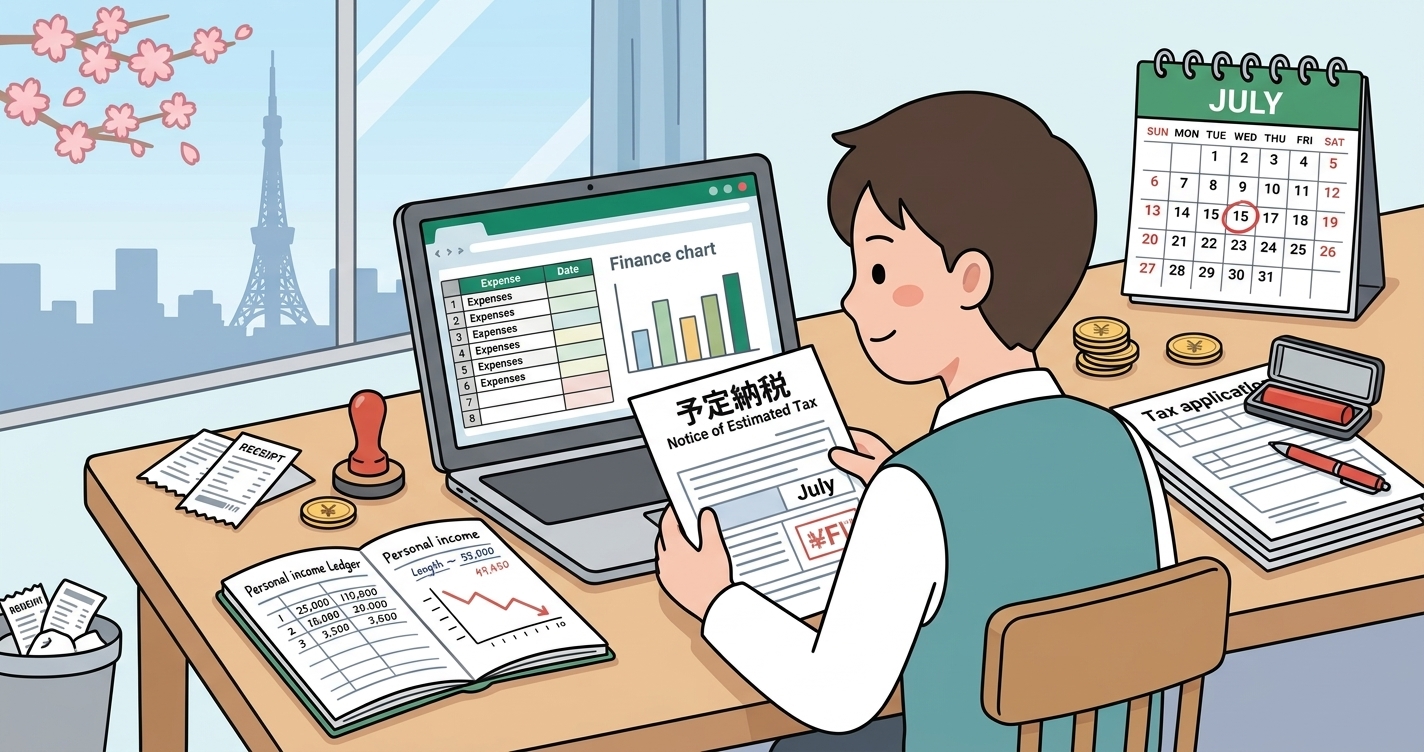
Many sole proprietors and freelancers in Japan are surprised when a "notice of estimated tax" (予定納税) arrives from the tax office in July. Even if this year's sales are down, you are asked to prepay based on last year's results. That is how estimated tax prepayment works. The good news: if your income is expected to fall this year, you can lower the amount you pay through an application to reduce estimated tax. The first-period deadline is typically 15 July. This guide explains the conditions, steps, and worked examples for freelancers and small businesses.
What is estimated tax prepayment?
Estimated tax (yotei nozei) requires taxpayers whose prior-year income tax reached a certain level to prepay part of the current year's income tax in advance. Rather than paying everything at once at final filing, the government asks you to prepay in instalments.
- Who it applies to: taxpayers whose "estimated tax base amount" is 150,000 yen or more, calculated by the tax office from your prior-year income tax.
- How much: one-third of the base amount in each of the first and second periods.
- When: first period 1–31 July; second period 1 November–1 December (moved to the next business day if it falls on a holiday).
For example, if last year's base amount was 300,000 yen, you prepay 100,000 yen in July and 100,000 yen in November, then settle the remainder at next year's final tax return.
When you can apply for a reduction
Estimated tax is only an estimate based on last year. If your situation has worsened, your actual tax may be lower than the prepayment. You can apply to reduce estimated tax if, for example:
- You closed, suspended, or changed your business
- Business income is expected to drop sharply due to job loss or fewer clients
- You suffered a loss from disaster, theft, or embezzlement
- Deductions (medical, social insurance, life insurance, dependents) are expected to increase
- Your estimated income tax for the year is expected to be lower than the estimated tax base amount
The key test is whether, based on your situation as of 30 June (first period) or 31 October (second period), your estimated income tax falls below the base amount.
Application deadlines
- First-period (and second-period) reduction: 1 July to 15 July
- Second-period only: 1 November to 15 November
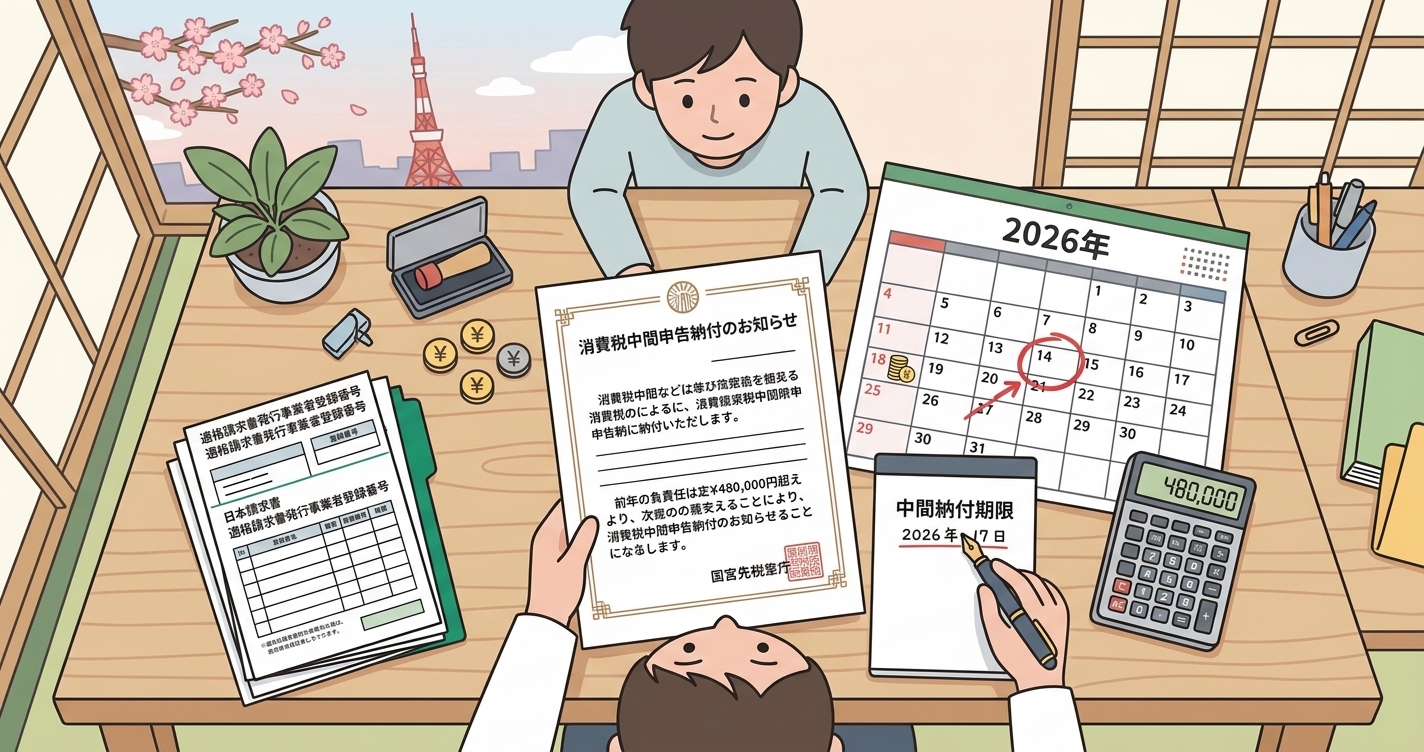
For 2026, the first-period deadline is 15 July. After the deadline, the first-period reduction is generally not allowed, so review your notice promptly.
How to apply, step by step
- Estimate this year's income: total sales and expenses from January to end of June and project the full year. Keeping your books up to date makes this fast.
- Calculate estimated income tax: subtract deductions from projected income to estimate your income tax for the year.
- Compare with the base amount: if your estimate is below the notice's base amount, you likely qualify.
- Complete the reduction application form: download it from the NTA website or prepare it via e-Tax.
- Attach supporting documents: such as a profit-and-loss statement backing your estimate.
- Submit to the tax office: by post, in person, or via e-Tax.
A worked example
Example: Sato, a freelance web designer
Last year's base amount was 240,000 yen, so Sato was asked to prepay 80,000 yen each in July and November. But this year a major client contract ended and first-half income dropped to less than half of last year. Projecting the full year at end of June, Sato's estimated income tax was around 90,000 yen.
Sato filed a reduction application by 15 July. Each instalment was reduced to 30,000 yen, freeing up about 100,000 yen of cash flow. Without applying, Sato would have prepaid 160,000 yen and waited for a refund at next year's filing.
For cash flow, overpaid tax only comes back next year. If your income is down this year, a reduction application lets you keep more cash now.
Accurate estimates depend on daily bookkeeping
Success hinges on how accurately you can estimate this year's income. If receipts pile up in a box, just tallying expenses to the end of June can take days. Tools like Denpyo let you photograph a receipt and have AI automatically extract the date, expense category, amount, and consumption-tax breakdown, then organise it into your books. With first-half expenses visible in real time, projecting income for a reduction application takes minutes. Denpyo also shows an estimated tax-saving effect for each expense, so you can see how each cost lightens your tax burden.
To quickly gauge your income tax, try Denpyo's free income tax calculator and tax savings estimator.
Points to watch
- Approval is at the tax office's discretion; an overly optimistic estimate may be rejected.
- Prepare specific supporting documents (e.g., a profit-and-loss statement).
- If you miss 15 July, you can still apply for the second period by 15 November.
- Any over- or under-payment is reconciled at next year's final tax return.
Summary
Because estimated tax is a prepayment based on last year, it can be a heavy burden when this year's income falls. If your estimated income tax is expected to be below the base amount, a reduction application by 15 July lowers your first- and second-period payments. The key is estimating this year's income accurately—so make daily bookkeeping and digital receipt management a habit. Start by comparing the amount on your notice with your projected income for the year.

Track expenses, maximize deductions
Denpyo scans your receipts and finds tax savings automatically.