
Blue Form vs White Form Tax Filing 2026: The Complete Guide for First-Year Freelancers in Japan
Blue Form (Aoiro) vs White Form (Shiroiro) tax filing compared. ¥650K special deduction requirements, income-based tax simulations, application deadlines for freelancers in Japan.

Disclaimer: This article provides general information only and does not constitute tax or legal advice. Please consult a qualified tax professional (税理士 / zeirishi) for advice specific to your situation. Information is current as of December 2025.
The Bottom Line: When in Doubt, Go Blue
Are you a first-year freelancer in Japan struggling to decide between Blue Form (青色申告) and White Form (白色申告) tax filing?
Here is the bottom line: If you are unsure, choose Blue Form filing.
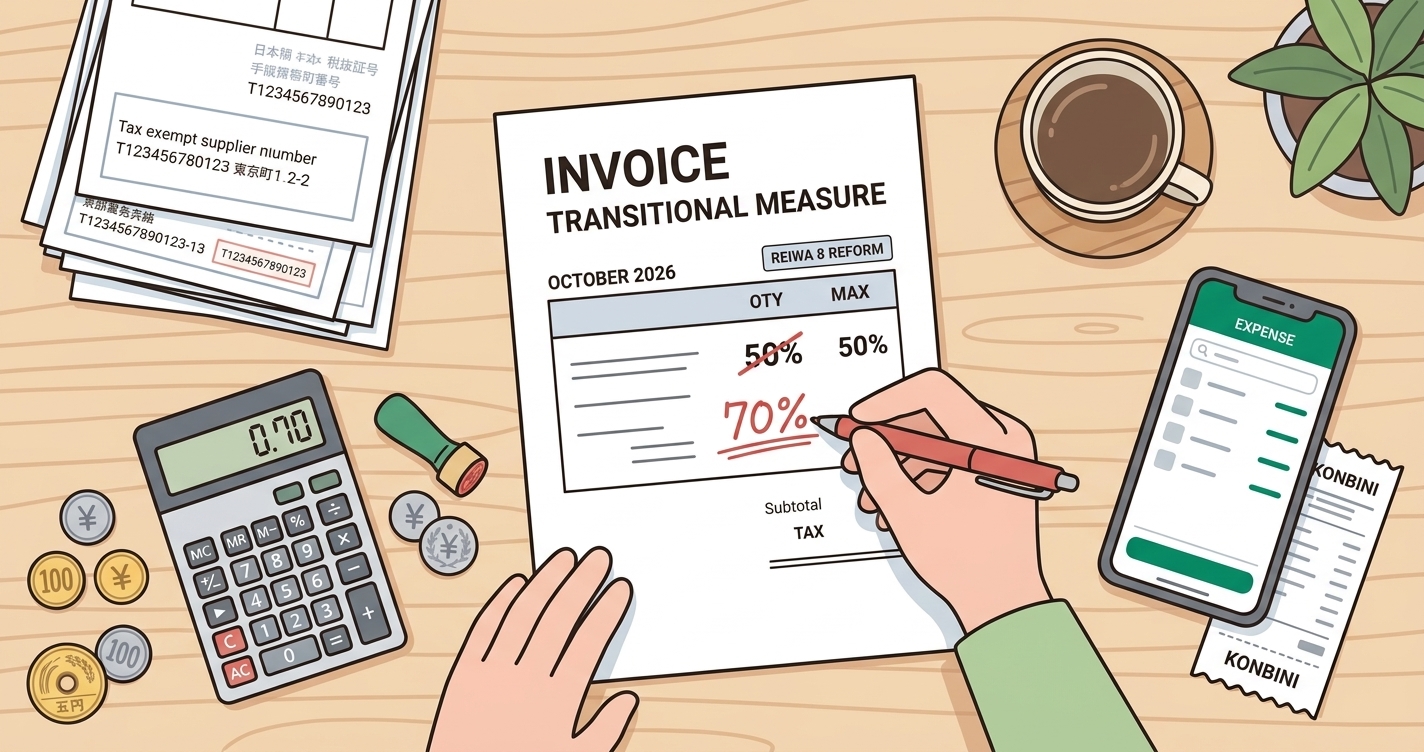
Why? Because the Blue Form ¥650,000 special deduction can save you over ¥100,000 in taxes annually. Plus, starting in 2026, the basic deduction expands to up to ¥950,000, making Blue Form benefits even greater.
"But double-entry bookkeeping sounds difficult..." This concern is outdated. Modern accounting software (freee, Money Forward, Yayoi, etc.) handles double-entry bookkeeping automatically—no specialized knowledge required.
1. Blue Form vs White Form Basics
What is Tax Filing (確定申告)?
Tax filing (確定申告 / kakutei shinkoku) is the annual process of calculating your income and taxes for the year (January 1 - December 31) and reporting them to the tax office. Freelancers and sole proprietors must generally file between February 16 and March 15 each year.
Key Differences at a Glance
| Item | Blue Form (青色申告) | White Form (白色申告) |
|---|---|---|
| Advance Registration | Required (Blue Form Application) | Not required |
| Special Deduction | Up to ¥650,000 | None |
| Bookkeeping Type | Double-entry (for ¥650K deduction) | Simple bookkeeping |
| Loss Carryforward | Up to 3 years | Not allowed |
| Family Employee Salary | Full amount as expense | Limited (max ¥860,000) |
| Asset Depreciation | Items under ¥300K expensed immediately | Only items under ¥100K |
Source: NTA Tax Answer No.2070: Blue Form Filing System
2. Five Benefits of Blue Form Filing
Benefit 1: Up to ¥650,000 Special Deduction
The biggest advantage of Blue Form is the ¥650,000 special deduction. This reduces your taxable income by ¥650,000, significantly lowering both income tax and resident tax.
| Requirements | Deduction Amount |
|---|---|
| Double-entry + e-Tax filing | ¥650,000 |
| Double-entry + paper filing | ¥550,000 |
| Simple bookkeeping | ¥100,000 |
Source: NTA Tax Answer No.2072: Blue Form Special Deduction
Benefit 2: Carry Forward Losses for 3 Years
If your business has a loss, you can carry it forward for up to 3 years. When you have profits in future years, you can offset them against previous losses to reduce taxes.
Example:
- Year 1: ¥1,000,000 loss
- Year 2: ¥1,500,000 profit → Taxable income is only ¥500,000
Benefit 3: Deduct Family Member Salaries
With Blue Form, you can deduct the full salary paid to family members working in your business. White Form limits this to a maximum of ¥860,000.
Benefit 4: Immediate Expense for Assets Under ¥300,000
Blue Form filers can expense assets under ¥300,000 immediately in the purchase year (up to ¥3,000,000 total per year). White Form only allows this for items under ¥100,000.
Source: Special Taxation Measures Act, Article 28-2
Benefit 5: Bad Debt Reserves
You can set aside a portion of accounts receivable as bad debt reserves, reducing taxable income while preparing for potential non-payment.
3. White Form Advantages
White Form has some benefits:
- No advance registration: Start immediately
- Simpler bookkeeping: Simple ledger acceptable
- Less paperwork: No double-entry knowledge needed
However, since 2014, even White Form filers must keep records, so the "no bookkeeping required" advantage no longer exists.
4. Tax Simulations by Income Level
Let us compare how much tax differs between Blue Form and White Form at various income levels.
→ Use our Blue vs White Comparison Tool to simulate your specific situation.
Annual Income: ¥3,000,000
| Item | Blue Form | White Form |
|---|---|---|
| Business Income | ¥3,000,000 | ¥3,000,000 |
| Blue Form Deduction | -¥650,000 | ¥0 |
| Income Tax (est.) | ~¥73,000 | ~¥102,000 |
| Annual Tax Savings | ~¥94,000 | |
Annual Income: ¥5,000,000
| Item | Blue Form | White Form |
|---|---|---|
| Business Income | ¥5,000,000 | ¥5,000,000 |
| Blue Form Deduction | -¥650,000 | ¥0 |
| Income Tax (est.) | ~¥234,000 | ~¥364,000 |
| Annual Tax Savings | ~¥195,000 | |
Annual Income: ¥8,000,000
| Item | Blue Form | White Form |
|---|---|---|
| Business Income | ¥8,000,000 | ¥8,000,000 |
| Blue Form Deduction | -¥650,000 | ¥0 |
| Income Tax (est.) | ~¥638,000 | ~¥788,000 |
| Annual Tax Savings | ~¥215,000 | |
→ Calculate your exact tax with our Income Tax Calculator
5. How to Apply for Blue Form Filing
Required Documents
- Business Registration Form (個人事業の開業届出書)
- Blue Form Application (青色申告承認申請書) — Download from NTA
Application Deadlines
| Situation | Deadline |
|---|---|
| New business (started by Jan 15) | March 15 of that year |
| New business (started after Jan 16) | Within 2 months of starting |
| Switching from White to Blue | By March 15 of that tax year |
Example: To use Blue Form for 2026 taxes (filed in early 2027), submit by March 16, 2026 (March 15 falls on Sunday).
How to Submit
- e-Tax: Submit online 24/7
- Mail: Send to your local tax office
- In person: Visit the tax office directly
6. Key Requirements for the ¥650,000 Deduction
Requirement 1: Use Double-Entry Bookkeeping
The ¥650,000 deduction requires double-entry bookkeeping. Accounting software handles this automatically.
Requirement 2: File Electronically with e-Tax
Since 2020, the full ¥650,000 deduction requires electronic filing via e-Tax. You need a My Number Card and IC card reader (or smartphone).
Requirement 3: Submit by the Deadline
| Submission | Deduction |
|---|---|
| On time + e-Tax | ¥650,000 |
| On time + paper | ¥550,000 |
| Late submission | ¥100,000 only |
7. When White Form is Acceptable
White Form may be fine if:
- Side income under ¥200,000 (may not need to file at all)
- One-time income this year only
- Closing the business this year
However, if your annual business income exceeds ¥1,000,000, Blue Form benefits usually make it worthwhile.
→ Check if you need to file with our Filing Requirement Checker
8. 2026 Tax Reform Impact
Starting in 2026, the basic deduction expands significantly:
| Total Income | Until 2025 | From 2026 |
|---|---|---|
| Under ¥1,320,000 | ¥480,000 | ¥950,000 |
| Under ¥3,360,000 | ¥480,000 | ¥880,000 |
| Under ¥6,550,000 | ¥480,000 | ¥630,000 |
Combined with the Blue Form ¥650,000 special deduction, freelancers can now enjoy up to ¥1,530,000 in total deductions.
→ Read more about the 2026 tax reform
9. Frequently Asked Questions
Q1. Can I switch between Blue Form and White Form?
A. Yes. To switch from White to Blue, submit the Blue Form Application by March 15. Switching from Blue to White requires no paperwork.
Q2. Is accounting software required?
A. Not required, but highly recommended. Popular options: freee, Money Forward, Yayoi.
Q3. How long must I keep receipts?
A. Generally 7 years. Apps like Denpyo let you photograph and store receipts digitally.
Q4. Can I use Blue Form for side business income?
A. Yes, if it qualifies as "business income" (事業所得). If classified as "miscellaneous income" (雑所得), Blue Form is not available.
Summary
Key Takeaways:
- When in doubt, go Blue: The ¥650,000 deduction saves ¥100,000+ annually
- Accounting software makes it easy: Double-entry bookkeeping is automated
- e-Tax for full deduction: Electronic filing unlocks maximum benefit
- 2026 brings bigger savings: Basic deduction expansion adds to Blue Form benefits
- Watch the deadlines: Within 2 months of starting, or by March 15 for next year
Related Tools
| Tool | Purpose |
|---|---|
| Blue vs White Comparison | Tax savings simulation |
| Income Tax Calculator | Calculate your taxes |
| Filing Requirement Checker | Check if you need to file |
References

Track expenses, maximize deductions
Denpyo scans your receipts and finds tax savings automatically.