
How to Object to Your Hong Kong Tax Assessment 2026: The One-Month Deadline
If your Hong Kong tax assessment is wrong or estimated, you can object to the IRD — but only within one month. Here is how freelancers and SMEs lodge a valid objection, use Form I.R.831, and protect their cash flow.
This article is for general information only and is not tax advice. Objection procedures and time limits are set by the Inland Revenue Department (IRD). Always confirm the current rules on GovHK: Objections and Appeals and the IRD website, or consult a Hong Kong tax adviser before acting.
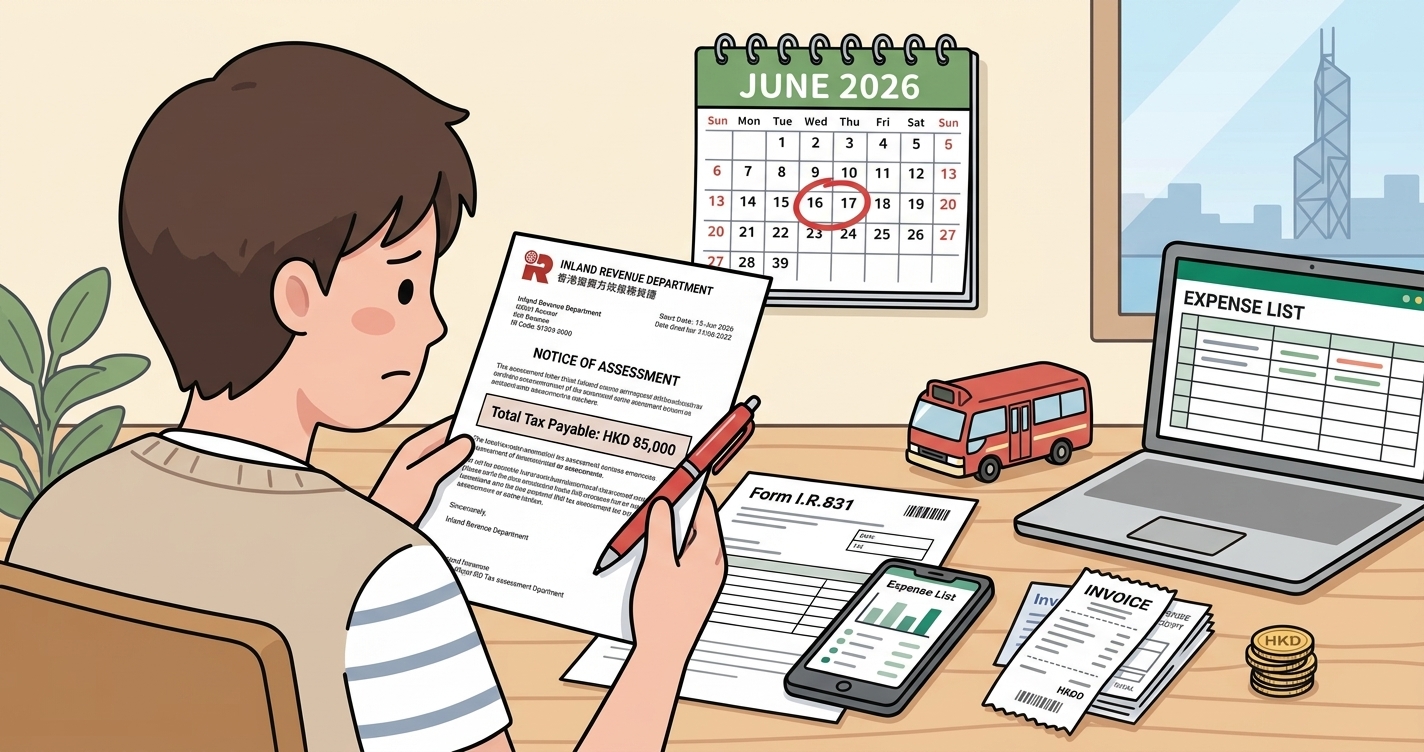
You open your mail, look at your Hong Kong tax assessment, and the number is higher than you expected. Maybe the IRD issued an estimated assessment because your return was late, or it disallowed an expense you were sure was deductible. The good news for freelancers and small business owners is that you are not stuck with it. You have the right to object to your tax assessment — but you must act fast, because the window is just one month. This guide explains how to object to a Hong Kong profits tax or salaries tax assessment, what to include, and how to protect your cash flow while the objection is considered.
What "objecting to an assessment" means
When the IRD issues a Notice of Assessment, it states how much tax it believes you owe. If you disagree — because the assessable profits are wrong, an expense was disallowed, or the figure is simply an estimate — you can lodge a notice of objection. This is a formal request asking the Commissioner of Inland Revenue to revise the assessment. It is separate from applying to hold over provisional tax, which deals with reducing an advance payment rather than disputing the assessed amount.
Common reasons freelancers and SMEs object include:
- An estimated assessment was raised because a return (BIR60 or profits tax return) was not filed on time.
- Legitimate business expenses were disallowed or overlooked.
- Income was double-counted or attributed to the wrong year of assessment.
- An arithmetic or input error inflated the assessable profits.
- Relief, allowances, or a loss brought forward were not applied.
The one-month deadline
This is the single most important rule: your written notice of objection must reach the IRD within one month after the date of issue printed on the Notice of Assessment. Miss it and the assessment generally becomes final and conclusive.
The clock runs from the date of issue on the notice — not the date you happened to open the envelope. Diarise the deadline the moment the assessment arrives.
The IRD may accept a late objection only in limited circumstances — for example, if you were prevented from objecting on time by absence from Hong Kong, illness, or other reasonable cause. Do not rely on this; treat one month as a hard deadline.
How to lodge an objection, step by step
- Read the assessment carefully. Identify exactly which figure is wrong and why — the assessable profits, a disallowed expense, the year of assessment, or the tax computation.
- State your grounds clearly and in writing. A valid objection must set out the specific grounds. "I think it is too high" is not enough; explain what should change and by how much.
- Use Form I.R.831. The IRD provides a Notice of Objection / Application for Revision of Assessment form (I.R.831). Completing it helps ensure your objection is valid.
- If it is an estimated assessment, attach your return and accounts. Where the estimate was raised because you did not file, you must submit a properly completed return together with supporting accounts alongside the objection.
- Submit through an accepted channel. You can lodge the objection by post to the IRD, by fax, or — for sole proprietorship profits tax — through your eTAX account. Keep proof of submission.
- Keep copies of everything. Retain your objection letter, the completed form, and all supporting documents.
"Pay first, argue later": protecting your cash flow
Lodging an objection does not automatically suspend the tax that is due. Hong Kong follows a "pay first, argue later" approach, so tax on the assessment can remain payable while the objection is being considered. To manage this, you can apply to the Commissioner to hold over all or part of the tax in dispute pending the outcome. If you succeed in your objection, over-paid tax is refunded; if the held-over tax becomes payable, interest may apply. Plan your cash flow around both possibilities.
Evidence is everything — and receipts are your evidence
Objections succeed or fail on documentation. If you claim an expense was wrongly disallowed, you need the invoice or receipt to prove it. If you argue the assessable profits are overstated, you need clean records that let an assessor trace every figure. Hong Kong businesses must keep sufficient records of income and expenditure for at least seven years, and an objection is exactly the moment those records earn their keep.
This is where day-to-day digital bookkeeping pays off. Tools like Denpyo let you photograph a receipt or invoice and have AI automatically extract the date, vendor, amount, and expense category, filing it in an organised, searchable record. When you need to substantiate a disallowed expense or reconstruct your assessable profits for an objection, the evidence is already assembled rather than scattered across a shoebox. Denpyo also shows an estimated tax-saving effect for each expense, helping you spot deductions worth defending.
Before you object, it helps to sanity-check the numbers yourself. Use Denpyo's free expense deductibility checker to confirm whether a disputed cost is genuinely claimable, and the tax savings estimator to gauge the impact on your bill.
A worked example
Example: Mr Chan, a freelance photographer
Mr Chan filed his profits tax return late, so the IRD issued an estimated assessment of HK$400,000 assessable profits — well above his actual figure. His real accounts showed HK$180,000 after deducting equipment, studio rental, and travel to shoots.
Within one month of the notice's date of issue, Mr Chan lodged an objection using Form I.R.831, stated that the assessment was an over-estimate, and attached his completed return plus a profit-and-loss statement and receipts. He also applied to hold over the disputed tax. The IRD revised the assessment to reflect his true profits, and the excess provisional tax was adjusted. Because his receipts were already digitised and categorised, assembling the evidence took an afternoon rather than a fortnight.
Common mistakes to avoid
- Missing the one-month window. By far the most common and most costly error.
- Objecting without specific grounds. Vague objections can be treated as invalid.
- Forgetting the return with an estimated assessment. The objection is incomplete without the outstanding return and accounts.
- Assuming you do not have to pay. Apply for a holdover rather than simply ignoring the demand note.
- Weak documentation. Without receipts and records, even a correct objection is hard to prove.
Summary
If your Hong Kong tax assessment looks wrong, you can object — but the one-month deadline is unforgiving. Read the assessment, state clear grounds in writing, use Form I.R.831, attach your return and accounts if it was an estimated assessment, and apply to hold over disputed tax to protect your cash flow. The strength of any objection rests on your records, so keeping receipts and invoices digitised and categorised throughout the year turns a stressful scramble into a straightforward submission. Start by checking the date of issue on your notice and marking the deadline today.

Track expenses, maximize deductions
Denpyo scans your receipts and finds tax savings automatically.