
Japan's Invoice Transitional Credit Is Now 70% from October 2026 (Reiwa 8 Reform)
The FY2026 tax reform revised Japan's invoice transitional measure. From October 2026, the input-tax credit on purchases from tax-exempt suppliers is 70%, not 50%. Here's the new schedule and the bookkeeping rules to claim it.
This article is a general explanation based on National Tax Agency (NTA) and Ministry of Finance materials as of August 2026. It is not individual tax advice. For your specific situation, consult your local tax office or a licensed tax accountant.
If you are a freelancer, sole proprietor, or small-business owner who prepared for Japan's invoice transitional credit to drop to 50% in October 2026, it is time to update that plan. Under the fiscal-year 2026 (Reiwa 8) tax reform, the transitional measure for purchases from tax-exempt suppliers has been revised: from October 2026 the deductible portion is 70%, not 50%, and the phase-out has been extended by two years. For taxable businesses that buy from unregistered suppliers, this softens the consumption-tax hit — but you still have to meet the bookkeeping and invoice-retention requirements to claim it. This guide walks through the new schedule, who is affected, and what to do in practice.
The invoice system and the transitional measure, briefly
Since 1 October 2023, Japan's Qualified Invoice System has required businesses to retain a "qualified invoice" to claim an input consumption-tax credit. Only "qualified invoice issuers" registered with the tax office can issue one. That means purchases from tax-exempt suppliers (businesses under the ¥10 million threshold that are exempt from remitting consumption tax) are, in principle, not creditable.
To avoid an abrupt shock, a transitional measure lets buyers still credit a fixed percentage of tax on purchases from tax-exempt suppliers. The original rule ran in three steps: 80% (Oct 2023–Sep 2026), 50% (Oct 2026–Sep 2029), and 0% thereafter. Most guides and accounting apps were built around this old "50% from October 2026" schedule.
What the Reiwa 8 reform changed: 80% to 70%, plus a two-year extension
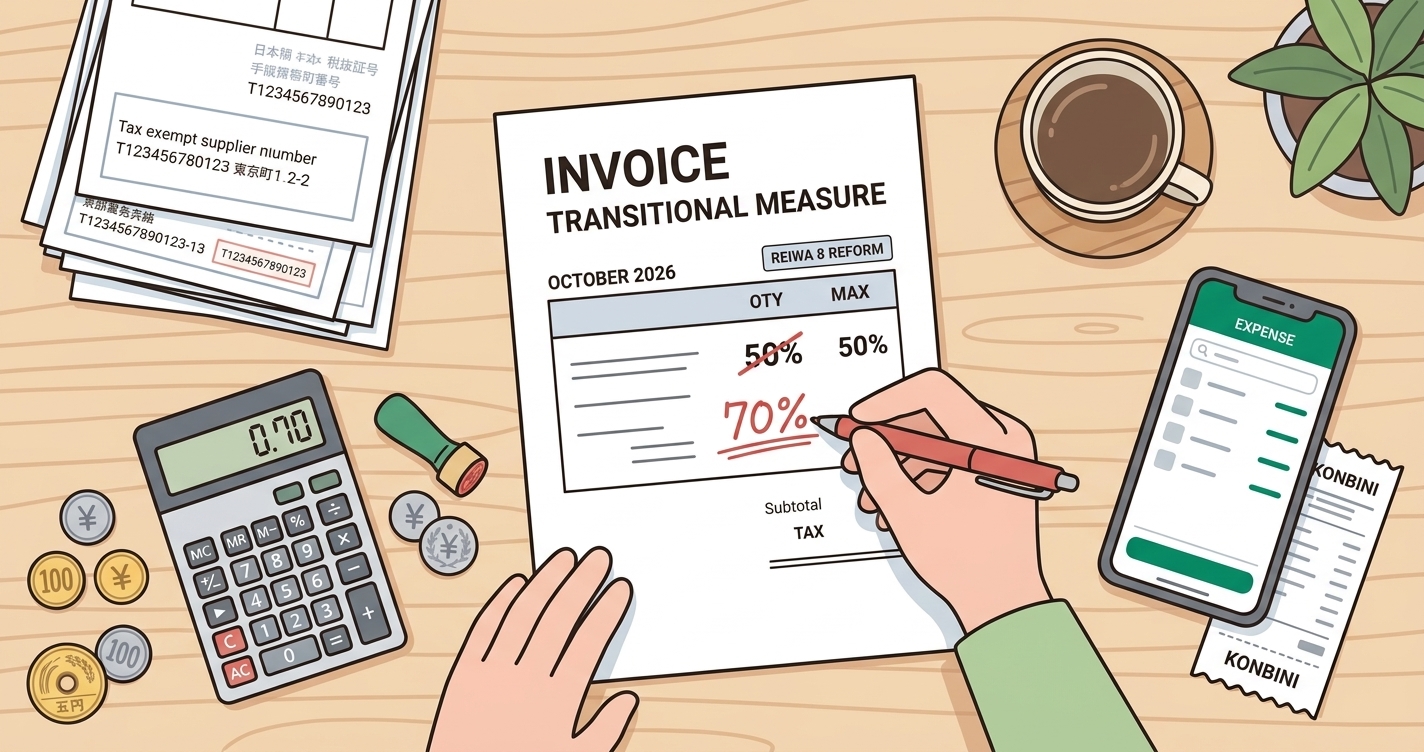
The fiscal-year 2026 tax reform smoothed the tapering and extended the transitional period by two years as a concession to small businesses. The revised schedule is:
- 1 Oct 2023 – 30 Sep 2026: 80% credit (unchanged)
- 1 Oct 2026 – 30 Sep 2028: 70% credit (new — it was previously scheduled to be 50%)
- 1 Oct 2028 – 30 Sep 2030: 50% credit
- 1 Oct 2030 – 30 Sep 2031: 30% credit
- 1 Oct 2031 onward: no credit (0%)
Two things matter here. First, the rate from October 2026 is 70%, not 50%. Second, the end date moves from September 2029 to September 2031, with the credit tapering 70% → 50% → 30% in between. The goal was to avoid a sudden cost jump for smaller businesses that trade heavily with tax-exempt suppliers (Ministry of Finance, "Fiscal Year 2026 Tax Reform").
Who is affected
This measure only matters to taxable businesses filing under the standard (general) method — those that credit input tax on an actual, invoice-by-invoice basis, including purchases from tax-exempt or unregistered suppliers.
By contrast, the following do not need to think about it, because they do not credit input tax based on actual purchases:
- Businesses on the Simplified Taxation regime, which computes credits from a deemed purchase ratio on sales, regardless of who the supplier is.
- Businesses using the 20% special rule (2-wari tokurei), which sets tax at 20% of output tax and ignores the purchase mix.
- Businesses that remain tax-exempt, which do not file consumption tax at all.
So the 70% revision directly affects standard-method filers with tax-exempt suppliers — for example production houses and construction firms that outsource to individual creators or sole traders, and businesses that commission freelancers.
Two requirements to claim the transitional credit
The credit is not automatic. You must meet both of the following (NTA Invoice System portal).
1. Bookkeeping entry
As under the former classified-invoice method, record (1) the supplier's name, (2) the transaction date, (3) the description (noting reduced-rate items), and (4) the amount. In addition, you must note that the purchase is subject to the transitional measure — in practice a tag such as "80% creditable" or "transitional (70%)," or a dedicated tax code.
2. Retaining the invoice
Keep the invoice, receipt, or delivery note received from the supplier, carrying the same items as a classified invoice. It need not be a qualified invoice, but the document itself must be retained. Invoices received electronically must be stored electronically in line with the Electronic Books Preservation Act.
A worked example
Suppose you pay a tax-exempt individual designer ¥110,000 for outsourced work (¥100,000 base + ¥10,000 consumption tax).
- Until September 2026 (80%): ¥8,000 of the ¥10,000 is creditable; the remaining ¥2,000 folds into your cost (expense).
- From October 2026 (70%): ¥7,000 is creditable; the non-creditable ¥3,000 becomes expense.
Per transaction, the credit falls from ¥8,000 to ¥7,000 — ¥1,000 more consumption tax to pay. Had the old 50% applied, you would have credited only ¥5,000, so keeping it at 70% halves the increase. For high-volume buyers the difference adds up. Use the tax-savings estimator and income-tax calculator to see the bigger picture.
Rethinking trade with tax-exempt suppliers
Because the rate keeps declining, buyers with many tax-exempt suppliers should plan ahead. Options include: (1) discussing registration as a qualified-invoice issuer with key suppliers, (2) modelling whether the Simplified regime is more favourable, and (3) reviewing pricing and order terms. Note that unilaterally imposing worse terms on tax-exempt suppliers can raise antitrust or subcontracting-law issues, so any change should be a genuine, mutual negotiation. Either way, the starting point is knowing exactly how much of your purchasing comes from tax-exempt suppliers.
Make classified bookkeeping and document retention easier with Denpyo
The quietly time-consuming part of applying the transitional measure is checking, one by one, whether each supplier is a registered qualified-invoice issuer and noting the transitional treatment in your books. With Denpyo you just photograph a receipt or invoice, and it auto-extracts details like the registration number (a "T" plus 13 digits), supplier, date, and amount — streamlining classified bookkeeping. Because the extracted data also feeds a live view of your tax savings, you can see how much you can credit and deduct as part of everyday record-keeping. Paper invoices are digitised on the spot, which also helps with Electronic Books Preservation Act compliance.
Summary
Under the Reiwa 8 reform, the transitional credit for purchases from tax-exempt suppliers becomes 70%, not 50%, from October 2026, and the phase-out is extended to September 2031. The rate tapers 80% → 70% → 50% → 30% → 0%. It applies to standard-method taxable businesses, and claiming it requires a bookkeeping note that the transitional measure applies plus retention of the invoice. Start by measuring how much you buy from tax-exempt suppliers and get your classified-bookkeeping process in order — digitising receipts and invoices day to day makes each rule change far less stressful.

Track expenses, maximize deductions
Denpyo scans your receipts and finds tax savings automatically.