
Freelance Startup Guide 2026: Opening Notification & Blue Return
The first two forms to file when you go freelance in Japan. This 2026 guide covers the difference between the opening notification and blue return application, their deadlines, how to complete and submit them, and how to secure the up-to-650,000-yen deduction.
This article provides general information based on National Tax Agency (NTA) guidance as of July 2026 and is not tax advice. For your specific situation, consult your local tax office or a licensed tax accountant (zeirishi).
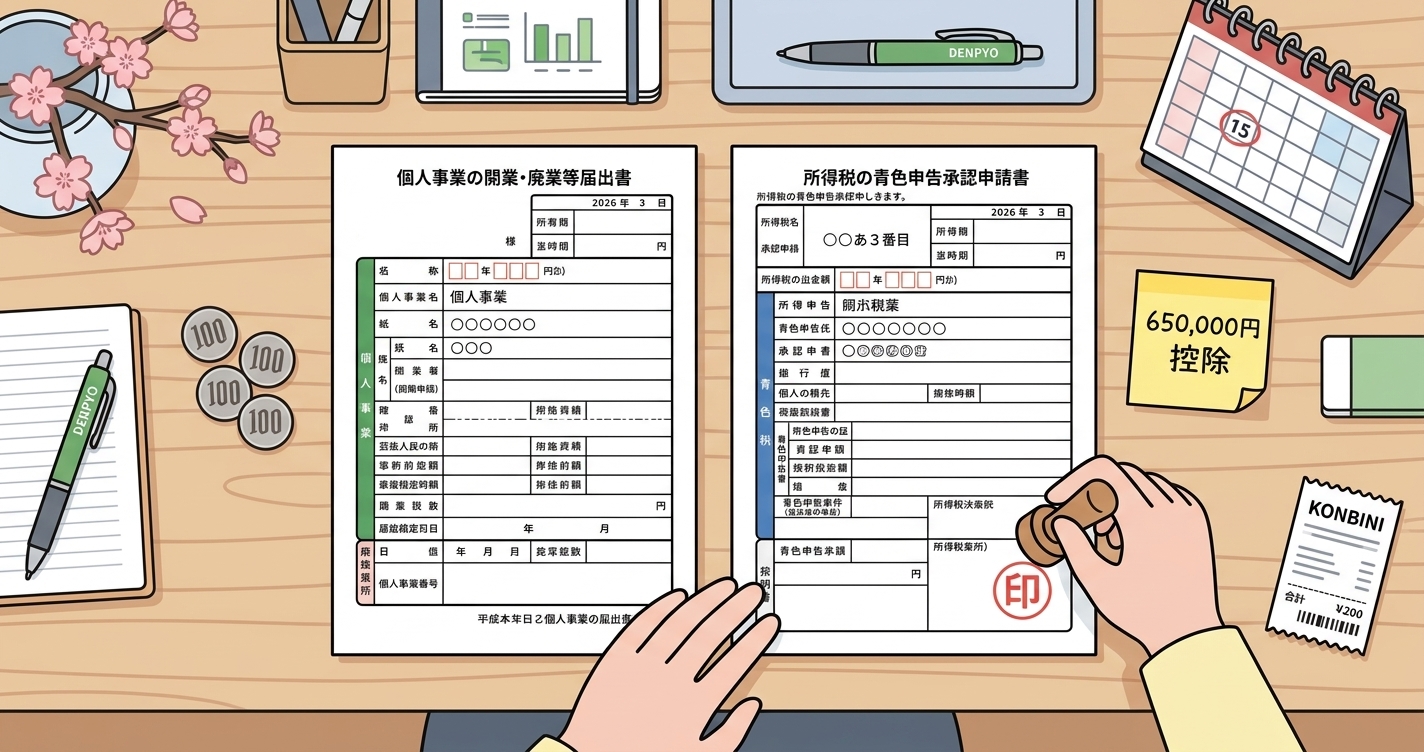
When you start working as a freelancer or sole proprietor in Japan, the very first paperwork to file is the business opening notification (kaigyo todoke) and the blue return approval application (aoiro shinkoku shonin shinseisho). Filing these two one-page forms unlocks tax benefits worth up to a 650,000 yen special deduction. This 2026 guide explains the difference between the two forms, their deadlines, how to fill them in, and how to submit them.
The two forms go together
These forms are often confused, but they do completely different jobs.
- Business opening notification (kaigyo todoke): tells the tax office "I have started a business." It also makes it easier to open a bank account under your trade name.
- Blue return approval application: gives you permission to file your annual tax return under the "blue return" system. Without it, you are automatically a white-return filer.
To enjoy blue-return benefits you generally submit both. Filing only the opening notification does not qualify you for blue-return filing.
Deadlines: miss this and you lose a year of savings
- Opening notification: within one month of your start date.
- Blue return application: by 15 March of the year you want blue-return status. However, if you open the business on or after 16 January of that year, the deadline is within two months of your start date.
For example, if you start on 1 May 2026, the blue-return application is due by 30 June 2026. Miss it and your 2026 income (filed in March 2027) defaults to a white return with no 650,000 yen deduction. Because that means losing a full year of savings, the safest move is to file both forms at the same time.
Key benefits of the blue return
- Special deduction up to 650,000 yen: available if you keep double-entry books and file electronically via e-Tax (or use qualifying electronic bookkeeping). Paper filing gives 550,000 yen; simplified books give 100,000 yen.
- Loss carry-forward (up to 3 years): a first-year loss can offset profits in the following three years.
- Salary to family members as an expense: qualifying payments to family who work in the business can be deducted.
- Immediate write-off of assets under 300,000 yen: items like a laptop can be fully expensed in the year of purchase (up to 3 million yen per year).
How to complete the opening notification
Download the PDF from the NTA website. The main fields are:
- Place for tax payment: usually your home address.
- Name, date of birth, My Number.
- Occupation and trade name: be specific (e.g., "web design"). Trade name is optional.
- Type of filing and start date: circle "opening" and enter the date you actually started.
- Type of income: usually "business income."
- Blue return application: yes/no: circle "yes" if you are filing it at the same time.
How to complete the blue return application
The key fields are the bookkeeping method and the books you will keep.
- Bookkeeping method: choose "double-entry" to aim for the 650,000 / 550,000 yen deduction.
- Books maintained: check "general ledger" and "journal," which are required for double-entry.
Simplified bookkeeping still gives the 100,000 yen deduction, but accounting software automates double-entry, so aiming for the 650,000 yen deduction from year one is worthwhile.
Three ways to submit
- In person at the tax office: you get a stamped copy, useful for opening a trade-name account.
- By post: include a copy and a stamped self-addressed envelope to receive a stamped copy back.
- e-Tax (electronic): with a My Number card you can file from home 24/7 — and it pairs well with the e-filing requirement for the 650,000 yen deduction.
After filing: keep books and store your receipts
The 650,000 yen deduction assumes you keep accurate books and retain receipts and invoices. From day one:
- Record sales and expenses regularly (accounting software makes this realistic).
- Organize receipts and invoices by expense category. Under the Electronic Bookkeeping Preservation Act, data from electronic transactions must be stored electronically.
Right after opening, though, your core work will absorb most of your time. Tools like Denpyo let you photograph a receipt and have AI auto-extract the date, amount, consumption tax, and expense category, recording and storing it in one step — before paper receipts fade and become unreadable, and without a last-minute data-entry marathon before filing.
Estimate your first-year tax savings
It helps to know in advance how much the special deduction and your expenses will actually reduce your tax. Denpyo's free tools let you check an estimated tax-saving effect just by entering expenses. To picture your opening-year tax, try the income tax simulator, and when unsure whether a cost is deductible, the expense checker helps.
Summary
Every Japanese freelance or sole-proprietor journey begins with two forms: the opening notification and the blue return application. The blue-return deadline in particular — within two months of opening, or by 15 March — is strict, and missing it costs you a full year of savings. File both together, then build the habit of recording income and expenses and storing receipts from day one. Add an AI receipt-scanning tool and you can stay focused on your work while quietly getting ready for tax season.
Sources and official references
The following official and reputable sources were used to prepare and verify this article:

Track expenses, maximize deductions
Denpyo scans your receipts and finds tax savings automatically.