
LHDN Tax Audit for Malaysian Freelancers 2026: Triggers and How to Stay Ready
An LHDN tax audit is usually a document check, not an accusation. Learn what triggers an audit for freelancers and SMEs, what officers ask to see, the seven-year rule, and how to stay audit-ready all year.
This article is for general information only and is not tax advice. Audit powers, record-keeping rules, and penalties are set by the Inland Revenue Board of Malaysia (LHDN/IRBM). Always confirm current requirements on the LHDN website or with a licensed tax agent before acting.
For most Malaysian freelancers and small business owners, an LHDN tax audit is the fear that lurks behind every Form B submission. The reassuring truth is that an audit is usually a document check, not an accusation — and if your records are in order, it is manageable. With e-invoicing (MyInvois) and SST data now feeding into LHDN's systems, though, mismatches are easier to spot than ever. This guide explains what triggers an LHDN audit, how the process works, what officers look for, and how freelancers and SMEs can stay audit-ready all year.
What is an LHDN tax audit?
A tax audit is LHDN's examination of your tax returns, business records, and financial affairs to confirm that you have reported the right income and claimed only genuine expenses. It is different from a tax investigation, which is a more serious inquiry into suspected evasion. Most freelancers who are audited face a routine desk audit or, less commonly, a field audit.
- Desk audit: conducted at an LHDN office. You are asked to submit specific documents by post or through official channels for review.
- Field audit: officers visit your business premises to examine records on site, more typical for larger or more complex businesses.
The core lens of any audit is simple: is your income complete, are your expenses credible, and can an officer trace every figure back to a document?
What triggers an audit for freelancers and SMEs
Some audits are random, but many are prompted by red flags in a submission. Common triggers include:
- Inconsistent or fluctuating figures: income or expenses that swing sharply year to year without explanation.
- Unusually high deductions: expenses that look large relative to income, or claims that deviate from the norm for your industry.
- Third-party data mismatches: discrepancies between what you declared and information LHDN receives from banks, clients, contractors, or employers.
- Income tax vs SST or e-invoice mismatches: as tax data becomes integrated, high declared SST sales with low income tax revenue (or the reverse) stands out.
- Cash-heavy activity: businesses dealing largely in cash attract closer scrutiny.
- Repeated losses: continued losses that are hard to reconcile with a going concern.
The theme across every trigger is inconsistency. Numbers that do not reconcile — with each other, with prior years, or with third-party data — invite a closer look.
What officers ask to see
When an audit begins, expect LHDN to request the documents that back up your return. For a freelancer or SME, that typically means:
- Invoices issued to clients and, increasingly, your e-invoice records via MyInvois
- Receipts and payment vouchers for claimed expenses
- Bank statements reconciled to your income and outgoings
- Ledgers or bookkeeping records showing how figures were compiled
- Contracts, agreements, or supporting schedules for larger items
Well-organised files shorten an audit dramatically and lower the chance of an adverse finding. Missing or disorganised records are what turn a routine check into a stressful, drawn-out exercise.
The seven-year rule
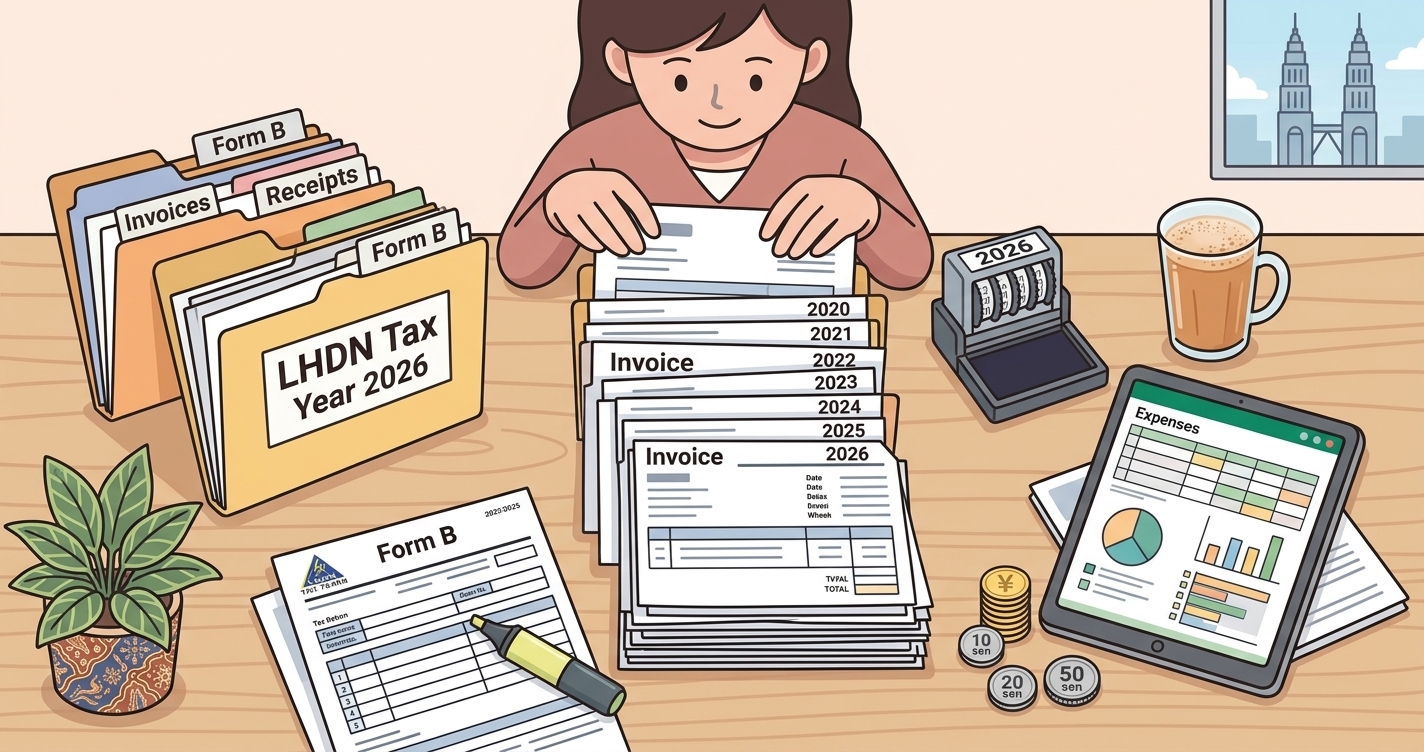
Malaysian taxpayers must keep sufficient records — receipts, invoices, and payment records — for at least seven years in case LHDN requests them. This is the single most important habit for audit readiness. An expense you cannot document is an expense LHDN can disallow, which can increase your tax and expose you to penalties.
How to stay audit-ready all year
- Digitise receipts as you go. Paper fades and gets lost. Capture every receipt and invoice the moment you receive it.
- Reconcile monthly. Match your income and expenses to your bank statements each month so nothing is a mystery at year-end.
- Keep business and personal separate. A dedicated business account makes your records far easier to trace.
- Only claim what you can prove. If a cost is genuinely business-related and documented, claim it; if it is borderline, keep evidence of the business purpose.
- Align your returns. Make sure your income tax, SST (if registered), and MyInvois figures tell a consistent story.
How digital record-keeping protects you
Audit readiness comes down to whether you can produce a clean document for every figure on your return — quickly. This is where day-to-day digital bookkeeping pays for itself. Tools like Denpyo let you photograph a receipt or invoice and have AI automatically extract the date, vendor, amount, and expense category, filing it into an organised, searchable record. If LHDN asks for the documents behind a particular deduction, you can retrieve them in seconds rather than digging through a shoebox. Because everything is captured at source, your income and expenses stay reconciled throughout the year, so the figures on your Form B already match your records.
Before you file, it also helps to sanity-check which costs are actually deductible. Use Denpyo's free expense deductibility checker to confirm whether a cost is genuinely claimable, and the tax savings estimator to see how legitimate expenses reduce your tax — without overstating anything that could invite scrutiny.
A worked example
Example: Aiman, a freelance videographer
Aiman received a desk-audit letter asking him to substantiate RM40,000 of claimed expenses, including camera equipment, travel, and subcontractor payments. Because he had photographed and categorised every receipt through the year and kept a separate business account, he exported an organised expense report with matching receipts and bank entries within a day. LHDN accepted his claims and closed the audit. His neighbour, who kept receipts loosely in a drawer, spent weeks reconstructing records and had several undocumented expenses disallowed — raising his tax and triggering a penalty.
What to do if you receive an audit letter
- Do not ignore it. Respond within the stated timeframe; silence makes matters worse.
- Read exactly what is requested. Provide precisely the documents and years asked for.
- Organise before you submit. Present receipts, invoices, and reconciliations clearly and logically.
- Be honest and consistent. If you find a genuine error, disclosing it is better than hoping it goes unnoticed.
- Get help for complex cases. A licensed tax agent can represent you and manage correspondence with LHDN.
Summary
An LHDN tax audit is far less frightening when your records are ready. Most audits are routine document checks triggered by inconsistencies — mismatched figures, outsized deductions, or gaps between your income tax, SST, and MyInvois data. Keep every receipt and invoice for at least seven years, reconcile monthly, separate business from personal, and only claim what you can prove. Turning receipt capture into a daily digital habit means that if the letter ever arrives, you respond with a tidy, traceable file instead of a frantic search. Start today by digitising the receipts already sitting on your desk.

Track expenses, maximize deductions
Denpyo scans your receipts and finds tax savings automatically.