
Singapore Gig Economy Taxes 2026: Upwork, Fiverr, Grab, and FastGig Workers Complete Guide
Earning through Upwork, Fiverr, Grab, foodpanda, or FastGig in Singapore? Here is exactly how IRAS treats your gig income, what you can deduct, and how CPF for platform workers changes in 2026.
Disclaimer: This article is a practical overview for Singapore-based gig and platform workers. It reflects publicly available IRAS guidance at the time of writing and is not personal tax advice. Tax rules and CPF rates change — verify with IRAS or a qualified Singapore accountant for your specific case.
Why gig workers in Singapore need a different mental model than employees
If you earn income through Upwork, Fiverr, Grab, foodpanda, Deliveroo, FastGig, Carousell, or any similar platform — whether full-time or as a side hustle — Singapore's Inland Revenue Authority (IRAS) treats you as a self-employed person. That classification changes almost everything about how you pay tax compared to someone on a Ministry of Manpower salary. You are responsible for reporting gross earnings, you can deduct business expenses, you contribute to CPF differently (and from January 2025 onwards, many platform workers contribute mandatorily), and you receive a tax bill roughly once a year rather than having PAYE withheld.
This guide walks you through exactly how gig income is taxed in Singapore for the 2026 Year of Assessment (covering 2025 income), what expenses are deductible, the CPF changes affecting platform workers, and how to stay on the right side of IRAS without spending your weekends on paperwork. Whether you code for Upwork clients, ride for Grab, or flip listings on Carousell, the same tax principles apply.
How IRAS classifies gig income
IRAS does not care what platform you use. They care whether you are carrying on a trade, business, profession, or vocation. Three buckets are common for gig workers:
- Platform workers — ride-hail drivers (Grab, Gojek), delivery riders (foodpanda, Deliveroo, GrabFood), task workers (FastGig). A specific legal category as of 1 January 2025 under the Platform Workers Act.
- Freelance service providers — designers on Upwork, writers on Fiverr, consultants on Toptal, tutors on Superprof. Traditional self-employed income.
- Peer-to-peer sellers — people running a steady trade on Carousell, Shopee, Lazada. Also treated as self-employed if done as an ongoing trade.
All three report under "Trade, Business, Profession or Vocation" in their annual tax return. If you also hold a regular job, that salary sits separately on your return — you don't blend the two.
The 2026 filing basics for Singapore gig workers
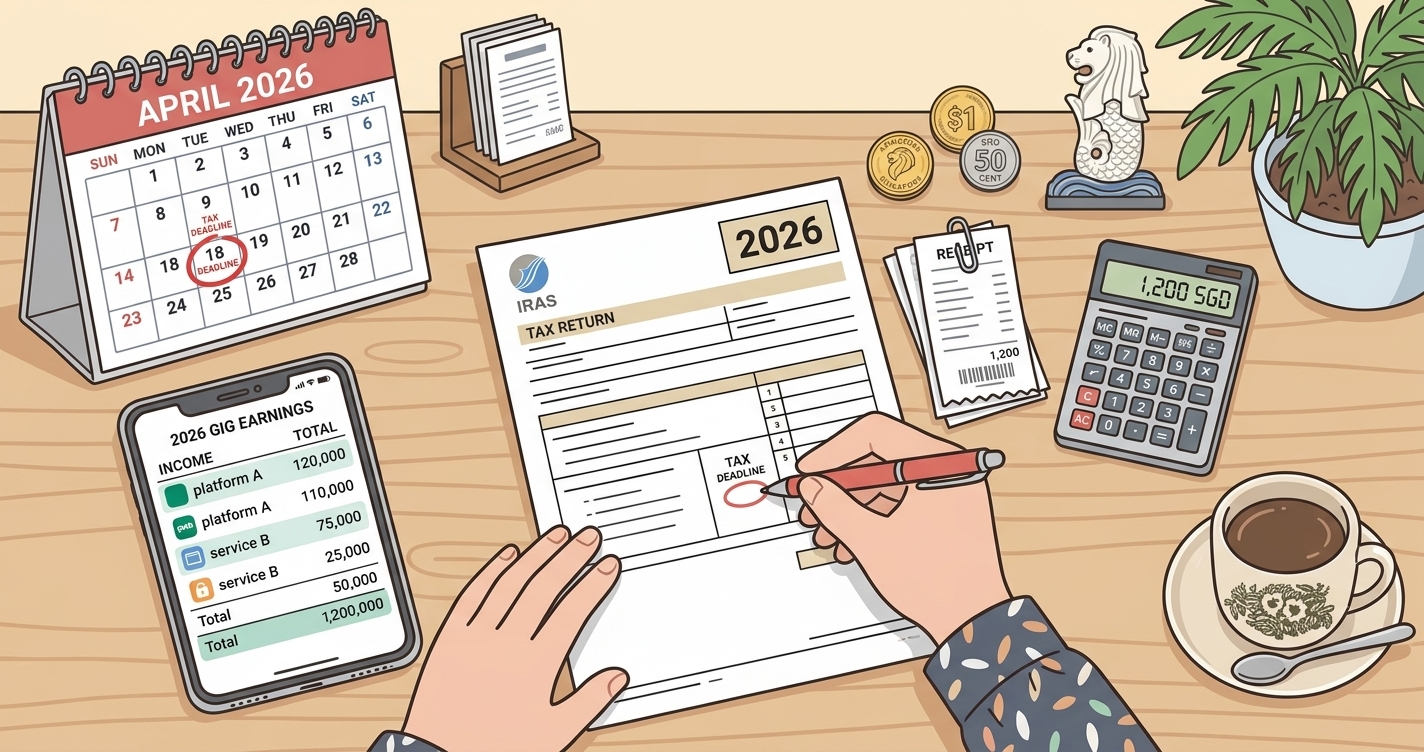
Singapore's tax year aligns with the calendar year (1 Jan – 31 Dec). For income earned during 2025, you file between 1 March and 18 April 2026 via myTax Portal. Key numbers to know:
- First S$20,000 of chargeable income is tax-free
- Rates are progressive, 2% on the next S$10,000, rising to 24% at higher bands
- You can e-file if you earned from one or more platforms — most gig workers will receive a tax form (Notice of Filing)
- Self-employed workers with annual revenue at or above S$200,000 must submit a 2-line statement; below that, a 4-line statement (revenue, gross profit, allowable expenses, adjusted profit) suffices
If you are a Singaporean or Permanent Resident and your self-employed income was at least S$6,000 in 2025, you are a Self-Employed Person (SEP) for CPF purposes and must contribute MediSave. More on that below.
Step by step: declaring platform income on myTax Portal
- Gather all income statements — Upwork, Fiverr, and Toptal issue earnings summaries under your account history. Grab and foodpanda provide annual statements via their driver/partner portals. Carousell sellers must extract transaction history manually.
- Convert foreign-currency earnings to SGD — use the IRAS average exchange rate for the year, or the exchange rate at the transaction date. Consistency matters more than which method you pick.
- Log in to myTax Portal with Singpass. Select "File Income Tax Return."
- Enter trade income under Section 4: Self-Employment Income / Trade, Business, Profession or Vocation.
- Complete the 4-line statement: Revenue → Gross Profit → Allowable Expenses → Adjusted Profit.
- Claim personal reliefs — earned income relief, parent relief, course fee relief, SRS contributions, etc.
- Submit and save the acknowledgement — you'll need it for subsequent year filings.
What you can deduct as a gig worker
The deductibility principle in Singapore is the same as elsewhere: expenses must be wholly and exclusively incurred in the production of income. In practice, this is broader than most new freelancers assume. Common deductions by gig category:
For platform drivers and riders
- Vehicle rental or leasing costs (the portion used for work)
- Fuel, EV charging, road tax, insurance
- Maintenance, tyres, servicing
- Mobile data plan (work portion)
- Vehicle depreciation if you own
- Platform commissions paid to Grab, foodpanda, etc.
- Protective gear — helmets, rain gear, thermal bags
For digital freelancers
- Laptop, monitor, peripherals (usually through capital allowance)
- Software subscriptions (Adobe, Figma, GitHub, etc.)
- Platform fees (Upwork service fee, Fiverr 20% commission)
- Internet and mobile bills (work portion)
- Home office portion of rent/utilities if working from home
- Professional development courses and certifications
- Accounting fees and business insurance
For online sellers
- Cost of goods sold
- Platform fees (Carousell Plus, Shopee service fees, Lazada commission)
- Packaging and shipping materials
- Storage or co-working desk rental
- Advertising fees (Shopee Ads, Meta Ads)
Keep receipts and invoices — IRAS requires retention for 5 years from the relevant YA. Digital copies are acceptable provided they are clear and accessible.
CPF for platform workers: the big 2025 change
The Platform Workers Act came into force on 1 January 2025, introducing mandatory CPF contributions for platform workers (ride-hail drivers and delivery riders) aged below 30 at the point of registration. The rates phase in gradually over five years:
- From 2025: platform operator contributes 3.5%, worker contributes 2.5% of net earnings
- By 2029: operator contributes 17%, worker contributes 20% — matching the full employee CPF rate structure
Workers aged 30 and above on 1 January 2025 can opt in voluntarily but are not mandated. All self-employed persons (including digital freelancers not covered by the Act) remain required to contribute to MediSave if their annual net trade income exceeds S$6,000.
The 2026 MediSave contribution rates for self-employed workers follow a tiered structure based on age and Net Trade Income, capped at the CPF annual limit. IRAS automatically includes a MediSave reminder in your Notice of Assessment if you are a SEP.
Practical example: Amira, a part-time designer and Grab driver
Amira earned S$45,000 from Upwork design work and S$18,000 from Grab rides in 2025. Her expenses were:
- Laptop, Adobe CC subscription, home internet share: S$4,200
- Grab commissions paid: S$2,700
- Fuel and vehicle maintenance: S$3,800
- Platform fees (Upwork): S$2,250
Gross revenue: S$63,000. Total deductions: S$12,950. Adjusted net trade income: S$50,050. After personal reliefs (earned income relief S$1,000, CPF reliefs, parent relief), her chargeable income falls into the S$40,000–S$80,000 band. Because her net trade income exceeds S$6,000, she owes MediSave contributions in addition to income tax. A quick run through our free Singapore income tax calculator gives her an estimate before filing.
Common pitfalls for Singapore gig workers
- Forgetting platform fees are deductible. The Upwork 10% service fee or Fiverr 20% commission reduces your gross revenue — don't enter the gross fee clients paid, enter what you actually received plus any allowable expenses.
- Not declaring side-gig income because "it's small." Singapore has no de minimis threshold for self-employment trade income if you are carrying on a trade. Declare everything — penalties for omission are 100–400% of tax undercharged.
- Mixing personal and business spend. Open a separate bank account or at least a separate credit card for business use.
- Claiming 100% home internet. IRAS expects a reasonable personal-use portion to be excluded. 50–70% is a defensible range for a full-time remote freelancer.
- Ignoring MediSave. MediSave contributions for SEPs are mandatory and enforceable by IRAS / CPF Board.
- Forgetting multi-platform aggregation. You sum all platform earnings when filing. Earning S$30,000 across Upwork, Fiverr, and a personal website is one number on your return — not three separate entries.
How Denpyo fits into a gig worker's workflow
The hardest part of filing accurately isn't math — it's documentation. Ride-hail drivers accumulate dozens of small fuel, tolls, and maintenance receipts per month. Digital freelancers collect software invoices, coffee-shop workspace receipts, and the occasional client lunch. Denpyo lets you photograph each receipt in seconds; AI extracts vendor, date, amount, GST where applicable, and category. At filing time, you export a clean expense summary aligned to the 4-line statement IRAS expects — no searching through glove compartments or email threads in April. Our free expense deductibility checker also helps you decide ambiguous cases before you commit them to your books.
Summary and next steps
Singapore treats gig income as self-employed trade income. Declare gross platform earnings, deduct every wholly-and-exclusively business expense, file between 1 March and 18 April 2026, and pay MediSave if your net trade income exceeds S$6,000. Platform workers born in 1995 or later now have mandatory CPF contributions under the 2025 Act — check your operator's portal to confirm your rate band. Keep digital receipts for 5 years. Run your numbers through our income tax calculator and tax savings estimator before filing, and you'll know exactly where you stand. For the official guidance on self-employed tax, see the IRAS self-employed page.

Track expenses, maximize deductions
Denpyo scans your receipts and finds tax savings automatically.